Software
Houzz Logo Print
mad_gardener

Fig tree - grows up but not out!

18 years ago

A year or so ago my mother (who lives in the NE), gave me her fig tree. She'd bought the tree between 6-8 years ago from Gurneys. She doesn't remember what variety it was, and I have no way of identifying it. When she received the fig, it was quite small and she potted it in a small container. Since then, it's been re-potted once. At the time the root ball was quite small. It shows no signs of being root-bound at this time, so I haven't bothered to put it in a larger pot. I'm also afraid to plant it outside for fear it will freeze (I live in zone 7, so winters are mild compared to the NE but we still do get some freezing temperatures here). Another puzzling thing is that it has shot up, but has not grown out. It has one trunk that has remained very thin (it's no wider than a normal-sized person's ring finger). Also, for the longest time it had only a few leaves, but recently, it has started to develop more leaves and possibly some sucker branches. It has never borne fruit. My questions are these:

1. Is the fact that it has grown up but not out a result of the potting mixture having too much nitrogen or phosphorus?

2. Should I try pruning the plant in the hopes that it will shoot out growth lower on the stem, or will this kill the plant?

Comments (17)

  • 18 years ago

    1) No. It is the result of the trees normal tendency toward apical dominance & has nothing to do with the soil mix.

    2) How you prune depends on whether the tree has leafed out or not. Trees are at the absolute lowest energy levels of the growth cycle right after they have flushed and before foliage is mature in spring, so heavy pruning could have considerable ill effect on the tree at that time. If the tree has not leafed out, and the tree was growing with reasonable vitality when it went dormant, you can pretty much prune as hard as you like. If the tree is in leaf, tip pruning ALL the branches to remove apical meristems & the growth regulator produced in them, which inhibits lateral growth, will force growth behind your pruningt cuts and lower on the tree. To help manage energy allocation so the lower parts of the tree will retain strength, you need to prune the top 1/3 of the tree harder than the middle 1/3, and the middle harder than the lower 1/3.

    As an example: For a dormant tree: pruning all branches at the top 1/3 of the tree to 2 buds, while allowing 4 buds on the middle branches, and 6-7 buds on the lower branches will help you fight against the habit of the tree to concentrate strength at the top of the canopy.

    Your tree needs repotting and root work (not simply potting up) if it has only been repotted once in 8 years. You need to get it in a free-draining soil that you can be sure is getting thoroughly moistened when you water, and adopt an appropriate fertilizing regimen. It's almost certain that the tree's poor performance is a result of soil/nutrient issues and the condition of the roots. A 6 year old fig grown in an appropriate soil/container combination is fully capable of having grown to a 2-3" trunk caliper, even if the canopy was kept in check by pruning.

    Al

  • 18 years ago

    Hi Mad Gardener,

    I don't know if I would be afraid to put the fig out in this climate. I have several in pots that spent the entire winter out on the deck and are sprouting quite happily now in the recent warm-up (you remember that we were even into the 20's a couple of times this winter). I also have some in the ground, including several brown turkey which haven't frozen for the last 7-8 years.

    It might be good to take a cutting and start a new plant to make sure you don't lose the original one and then set one or the other out in a sheltered place.

  • 18 years ago

    Wow, Al -- thank you!

    If you don't mind, I have some follow up questions:

    1) How do I tell if my tree is dormant? It's been an indoor plant for it's entire existence, so it doesn't typically lose all of its foliage during the winter. Right now it does seem to be more active, as it has been sprouting new leaves, so my guess is that it's in an active state -- but how will I know when its dormant period has begun?

    2) All of the leaf and branch growth is in the top quarter of the plant; below that there's about four to five feet of pure trunk. Should I still try pruning the tree to encourage lower branches?

    3) When you say, "root work", do you simply mean improving the drainage and initiating a fertilizing regimen, or is there more work required? Also, can you recommend an appropriate soil mixture and a good fig fertilizer? Sadly, I have never applied a fertilizer to my fig -- the most it has ever received is some flat leftover beer (which I've heard is good for plants in general and which my fig seems to appreciate).

    Thanks again for your tips!

  • 18 years ago

    I was watching a scrawny, pencil thin fig tree sprout this spring, only there was no sprouting from the nodes below the top bud. Even though I had a fig tree years ago, I did not recall this kind of behavior. Then, I came across the term apical growth. I pruned about two feet from the top of one of my skinny fig trees two weeks ago, and now there are several side shoots with significant foliage sprouting. I pruned a second fig tree similarly one week ago and the same positive result is playing out. Gardenweb and Figs4Fun have been great resources for fig tree info. This is my first foray into fig tree propagating and my first posting here. Thanks AL (tapla), for shedding light on this subject. I posted some photos of the 16 day old pruning experiment at my webpage http://mysite.verizon.net/bill.moke/pg086.html

  • 5 years ago

    I cant bear to prune my leafy fig tree. Its is Sep 27 in NC and the tree will drop its leaves at the first frost. My question is why is my Fig tree more like a 5 ft tall woody plant and less like a tree with a solid trunk and bark


  • 5 years ago

    More info, please. Are we talking F carica (hardy/deciduous fig) or one of the many hundreds of species of evergreen figs? Figs ARE woody plants, so it would be unusual if it didn't look like one.

    Bark/periderm as most think of it forms as the tree lays down accumulating layers of cells on the outside of the vascular cambium. As this occurs, the outer bark splits dies and accumulates, truing the outer bark from smooth/green to brown, corky, hard, and increasingly furrowed, all a part of the trees normal morphology.

    Interestingly, I have many very small bonsai with trunks as thick as my first finger, which have bark that looks furrowed and ancient. That appearance comes with age, not size.


    Al

  • 5 years ago

    It's a deciduous and I think it is a dwarf fig. I have had since May 2015 and it barely survived what with the deer eating its leaves. But two years ago I put a wire fence around it and it has grown to five feet with voluminous leaves at the top and from branches at the side. In fact the leaves are pressing against the wire. The tree is also under two deciduous trees so it is not in full sunlight. In appearance it is more like a tall Blueberry bush than a cherry tree. What could I do next spring to ensure the best possible growth.

  • 5 years ago

    It is a fig tree which should be 10 ft tall by no

  • 5 years ago

    Pictures please? Is it planted in the ground? Have you fertilized? If in the ground, did you plant the rootball as it was or did you correct the congestion in the root mass at planting time and backfill with only the soil that came from the planting hole? It's almost an obligate full-sun plant, so moving it would be in its best interest, but need to know more about it.


    Al

  • 5 years ago

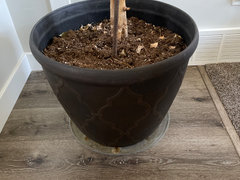
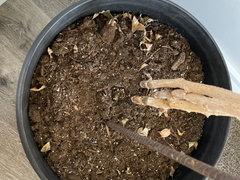
    Al, you definitely know your Fig trees. I have a fig that I purchased 30 years ago. It is 8’ tall with 3 trunks that I wove together when it was a sapling. It is in an 18” pot. It seems to be very sparse in the foliage. the trunks are about 3/4“ in diameter at the base. I have had to use a piece of rebar as a stake to keep the tree standing upright. My question is what can I do to promote growth in the trunk size as well as increase foliage?


  • 5 years ago

    Thank you for the kind words.

    Can you provide an image of the entire plant and pot? Also, it would help if you took close-ups of anything you consider to be a potential problem.

    Al

  • 5 years ago

    Al

    I hope the pictures come through. No potential problems I am aware of, I would like to understand what I need to do to promote the trunk to grow thicker and how to promote foliage growth in the canopt.


  • 5 years ago
    last modified: 5 years ago

    I would like to understand what I need to do to promote the trunk to grow thicker and how to promote foliage growth in the canopy. You know the plant's vitality level is on the poor side or you wouldn't be asking after it, and that's why the canopy is sparse and the trunk thin. Unless it has a pest problem, all it really needs is some modifications of the cultural influences (light, temp, soil/ air/ water relations, fertility, air movement, so the influences are as close as possible to the plant's sweet spot.

    The best thing you could do for the plant is move it outdoors as soon as or whenever temperatures allow. Nights reliably above 55* for full time and any time temps are above 60-65*. I'm not sure what type of medium it's in, but it should drain freely and the medium should hold very little excess water. Excess water is water that fills the pores between soil particles toward the bottom of the pot, which limits the roots' oxygen supply and sets the stage for fungal root infections. The pot it's in now will tip easily, so I would opt for a larger pot and use some bricks in the bottom as ballast, which will also reduce the amount of excess water the medium can/will hold.

    I would plan a repot as soon as the timing is appropriate, during which I would correct all root issues and reestablish the plant in a high quality grow medium to replace the medium it's in now. At the same time you repot, I would prune the top 1/3 - 1/2 of the canopy back hard, cutting the visually heavy (thick) branches at the top back severely and not doing much with the bottom 1/2 - 2/3 of the tree in terms of pruning until later in the summer when the tree has recovered from the root work.

    Fertilizing regularly with a quality soluble synthetic fertilizer like Foliage-Pro 9-3-6 is the best bet. That's what I use and you won't likely find better for the 95% plus of your containerized plants which will respond to it enthusiastically.

    That's a rough outline. Let me know if you want more specific info in select areas or have questions; or, if you want to see images of some of the work I do on my own figs.

    Plants that grow with little enthusiasm are very close to the break-even point in terms of the amount of energy (food) they create from the sun's energy as opposed to the amount of energy consumed during respiration. To accomplish your goals, your focus should be on making it easier for the plant to deal with the cultural hand you're dealing. Since the plant can't change it's needs, it's up to the grower to make the adjustments. If a grower was given a grade, the whole of his/her efforts on which (s)he would be judged, would be no more than the effectiveness with which limiting factors are ferreted out and the degree to which they're mollified.

    That's the view from here, YMMV.

    Al

  • 5 years ago

    Thank you Al, yes I would love to see a picture or two of your fig trees.

  • 5 years ago

    My outdoor fig has great foliage and has even produced fruit this spring. But the trunk and branches continue to be thin like those of a sapling and the tree is still only 5.5ft tall though it has grown about 6 inches since last Fall. What should I do to make the tree taller and more robust? Perhaps removing the wire fence will help as the branches are straining against it.

  • 5 years ago

    Also, should I pick the fruit or let them be?

Sponsored