Software
Houzz Logo Print
north53zone2b

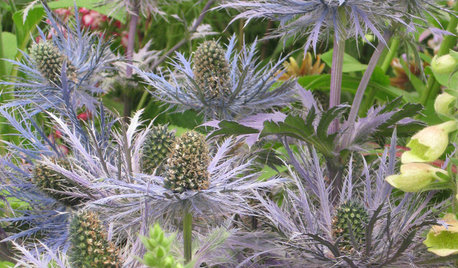
sea holly self seeded!

20 years ago

I was happy to see my sea holly was sprouting, but today I noticed several sprouts coming up far away from the center. I'll be able to share this neat plant. I've heard that they self seed, but I've never experienced it. It's amazing how quickly the perennials are coming up though. Okay back outside to see what else I can discover.

Comments (13)

  • 20 years ago

    Good news on the sea hollies! Re. sharing sea holly seedlings, it's best to dig them out while they are very young, as their tap roots make it a lot more difficult to do stressless transplants later on. With time, you'll find that all perennials self-seed, the exceptions being the relatively rare sterile hybrids.

  • 20 years ago

    Well since my discovery I've done a bit of research and found that according to Glenn of 'Perennial Gardening on the Prairies' the self seeding can be a major deterrent to growing sea holly. In fact he says he pulled his out. So my question is, has anyone else found this to be a problem? I was planning to pot up a couple to take to our annual plant sale, but I don't want to inflict a problem on unsuspecting customers. It's for that reason I won't take goutweed, even though it's fine in the right location for me.

  • 20 years ago

    No, I've grown sea holly (Eryngium planum) in this location for 10 years now, and don't consider it's seeding to be excessive, and it doesn't spread any great distance from the roots. But that's purely my opinion... and Glenn's opinion is obviously different. We probably have much different styles of gardening (though both collectors and testers, I think I'm safe in saying), and different ideas of what plants are most worthy of the precious remaining space in our yards!

    I don't know where you garden, but I get the impression that sea holly of any species is still rather sought after by the folks on this forum.

    Much of gardening with respect to "worthiness" of plants is opinion. For example, contrary to what seems like general cold zone opinion, I do find johnny-jump-ups (Viola tricolor) to be invasive, and spend time every year trying to eradicate them. (Problem is, I don't really want to eradicate them... I wish I could have just a few, but it doesn't seem to work that way! But they grow too thickly to allow my other "more desirable" plants to seed in...) Some other plants that I personally find to be "excessive" seeders (or maybe are just too-easy germinators!) are Centaurea macrocephala, Echinops ritro, Valeriana officinalis... I spend lots of time in spring pulling and digging out seedlings. Soon, I'm likely to start including Verbascum nigrum, Symphyandra hoffmanii and a few others in that list.

    A good guideline to use for "what and what not to bring to plant sales" might be the list compiled by the Calgary Hort Society for exactly that purpose. I'll see if I can find it... unless someone else out there has it, or a link to it, or a similar list from some other gardening club?
    Off-hand, of the plants discussed, I think that only goutweed makes the "not welcome" list.

  • 20 years ago

    Abgardeneer, Thank you very much for sharing your opinion. Also I would appreciate the list of what not to bring to plant sales. Your timing is great as we have a meeting Tuesday and I could enlighten everyone else.

    I agree with you about johnny-jump-ups. I have been weeding them out diligently and have not made any impact on their numbers at all. Another problem plant for me is some kind of strawberry plant in my perennial border. It would happily choke out everything. I've been pulling it out for years, but it keeps coming back. I have never seen a single strawberry on it, so it can't be reseeding. Another self seeder is self inflicted. Years ago I planted forget-me-nots. Soon my garden will be a sea of blue. But even though I pull up the plants as soon as they finish blooming, they continue to show up year after year. But they are pretty and easy to pull out.

  • 20 years ago

    I think a list of what not to take to plant sales is one of the most useful ideas I've heard. The more knowledgeable have a responsibility to the less informed. Just because we choose to grow something and keep an eye on it, it doesn't mean that it is something that should be foisted on the unsuspecting.

    I'm currently keeping an eye on Obedient Plant (Physostegia virginiana), Bee Balm (Monarda didyma) (I see little runners already, and it's just new and has never bloomed yet), and Sweet Woodruff (Galium odoratum). I always get a few Johnny Jump Ups but not enough to be concerned. Sea Holly and Verbascum nigrum are new to me this year so thanks for the heads up on their seediness. Sweet Woodruff has been a steady spreader for me over the three years since I planted it, but I still wouldn't call it invasive.

  • 20 years ago

    Here's what I find from perusing recent hort club bulletins as to which plants are allowed at the plant exchanges run by the Calgary Hort club:
    "Plants on the provincial or City of Calgary's Restricted or Noxious Plants List are not allowed."

    And from earlier publications:
    "The following plants have been deemed invasive: They will be accepted at the Exchange but will not have any exchange value...
    Campanula rapunculoides
    Campanula glomerata
    Centaurea montana
    Goutweed
    Yarrow
    Creeping Charlie
    Perennial morning glory
    Himalayan impatiens"
    I'm not certain if the second part is still in effect, but it's still a reasonably good guideline. (Although, personally, I have a bit of trouble with a self-sowing annual, Himalayan impatiens, being on this list.)

    However, I really think most people have to experience a fair bit of gardening before they can reasonably decide, first, their definition of invasiveness, and then, their tolerance to it. (I mean... when the store the "public" votes as "Calgary's favorite garden center" sells all or most of of the above, how do you tell people otherwise?)

    By the way, north3, I suspect your non-fruit-bearing "strawberry plant" is probably actually something like rough cinquefoil (Potentilla norvegica)... are the flowers yellow? The basal leaves of this plant resemble strawberry but are much hairier.

  • 20 years ago

    Yikes,
    I've been guilty of taking at least three of those on the list- campanula glomerata, centaurea montana and yarrow. I've stopped taking lamiastrum galeobdolon'variegatum' after it completely engulfed a shade bed when I wasn't looking.

    I'll have to take a closer look at that so called strawberry plant now. I've looked at a few pics of potentilla norvegica and I think you're probably right. Now I feel like a total idiot. I should have realized that no strawberry plant could be that tenacious. Geez

  • 20 years ago

    Don't worry about it... everyone is learning all the time.

    Even a list like that is misleading. though. To say that "yarrow" is invasive is incorrect, since there are commonly-grown species that are not at all invasive. And, judging by how eagerly folks on this forum trade the various colors of the species that are considered invasive, it's likely that not everyone finds it such, or at least hasn't yet, or has different tolerance of it. (Myself, I succumb every few years to planting some form of A. millifolium, and then end up tearing it out again a few years later!)

    Lori

  • 20 years ago

    Lori,

    Would you mind saving some Centaurea macrocephala seed for me this year? I would love to have that one as well and I've never seen the plants for sale around here. Thanks,

    Syreeta

  • 20 years ago

    Sure, better to give them away than weed them out later. Best to remind me later on in the summer, though, as these are late-blooming plants.
    Lori

  • 20 years ago

    Thanks Lori, I'll make a notation in my gardening journal to remind you in August.

    Syreeta

  • 20 years ago

    Wow, Abgardeneer, You weren't exaggerating about the roots on those sea holly seedlings. They would put any dandelion to shame. I had a hard time finding a pot deep enough to put them in. Thanks for the advice. You probably saved those seedlings from being snapped in half. I was able to get most of them out intact.

  • 8 years ago

    We raise Angora Goats and the sea holly has taken over one of our pastures! How do we get rid of it?


Sponsored
Hope Restoration & General Contracting
Average rating: 4.7 out of 5 stars35 Reviews
Columbus Design-Build, Kitchen & Bath Remodeling, Historic Renovations