

?? about lizards
Hi
have never paid much attention to them until a skink moved into the house . She(I think lol) behaves entirely different than all the others including the other skinks.
She stays right out in the open even follows me around
and even begs for food at the table. My wife started giving her scraps and I was surprised sh e actually ate them. Aren't skinks insectavores not to mention that most reptiles require food to move ??. She has become so tame that I fear stepping on her. All the other lizards including other skinks will not come within 10 feet of me lol. Anyone else have this experience??
Since the cold front she has disappeared ,hibernating?? If so where would that be?? I assume they dig into the ground and I'm curious as to how it works in Florida since the one thing you can be sure of is that it will warm up very soon. Have noted that all have disappeared except some anoles. Have always been rather neutral on reptiles but this has really got my curiosity up lol gary
Comments (41)
 17 years ago
No, no skinks in house, but lot's of them in hangar and they always scurry out of the way.
We have noturnal gecko's but never had a "pet" one :>)
- 17 years ago
In my yard, the skinks reside up in the palm tree petioles.
They run like wildfire if I get anywhere near them.Years ago I had one gecko in particular that was huge...had lost the end of its tail...probably from a bird or whatever.
I named him 'Stumpy'...how very original, I know! LOLAM
I considered him a pet, too. :)
He would hang on the kitchen window sill until I fed him tiny bits of raw ground beef...so, yes, they do eat 'people food'...hehehe.
Sadly, after we had the house tented, he was gone. *sniff Related Professionals
Aberdeen Landscape Architects & Landscape Designers · Cambridge Landscape Architects & Landscape Designers · Concord Landscape Architects & Landscape Designers · Atlantic City Landscape Architects & Landscape Designers · Brainerd Landscape Architects & Landscape Designers · Rochester Landscape Architects & Landscape Designers · Eugene Landscape Architects & Landscape Designers · Belleville Landscape Contractors · Owensboro Landscape Contractors · Davenport Landscape Contractors · Kankakee Landscape Contractors · San Francisco Landscape Contractors · New Bedford Kitchen Remodelers · Portsmouth Kitchen Remodelers · London Kitchen Remodelers- 17 years ago
Here is a good reason to protect and care for our lizard and gecko buddies :
Natural cockroach enemies include wasps, nematodes, spiders, toads and frogs, centipedes, birds, lizards, geckos, beetles, mantids, ants and small mammals (mice). It is very important that these populations of natural enemies be maintained to help keep cockroach populations in check.
from the U of F Entomology Dept .
 17 years ago
I wonder if it was previously someone's pet. It seems odd that it is so tame. I think that would be cool to have a tame one around. Anything that eats roaches is a friend of mine, I'm scared to death of those big flying ones! LOL!
garyfla_gw
Original Author17 years agoHi
This is the kind that keeps it's tail curled over the back like a scorpion. Kind of gray with darker markings
Others are larger darker more distinct markings. Skinks??
Much larger than the anoles and they move like lightning.
I assume this is a female while the others are males though I don't see a dewlap as with anoles.
Gatormom Where is chocolate, beef ,chicken pork, bread ,fish food?? Only thing she refuses is lava rock.lol
I'm familiar with geckoes as they have the toepads though NONR have ever tried to sell me insurance lol Amazing how they run over glass ??.
Anyway the most intriguing part of this particulr one is the begging.at the table.lol if she was someones "pet" ,came from more than two blocks away. I asked the neighbors. Only one had a reticulated python which can't be confused with a lizard lol
Have seen her both in and outdoors and I'm sure it's the same one as she always comes toward me.
Since the cold front ,has disappeared ,Seemed to hang out under the stove when in the house.
I'm very far from a lizard expert lol but figured this was extremely odd behavior. Sure different than her friends lol thanks gary- 17 years ago
Bet there are some great gecko munchies under the stove !
What a smart reptile she is ! - 17 years ago
Gary, you sure that is a "skink"? Those lizards with curled tail over there back lived on Palm Beach and the Bahamas. Saw one in the Bahamas that was a "pet"
- 17 years ago
I found a site that has the Northern Curly Tailed Lizard. Says they live in FL but not native to FL. Scroll down and see if this looks like her.
~LenetteHere is a link that might be useful: Northern Curly Tailed Lizard
- 17 years ago
Gary, I've never seen a skink with a curly tail. Skinks are shiny, and "snakey" in their movements, being much more limber than regular lizards (anoles) and the like. We have several in Florida, very striking in coloration. Some have bright blue tails, long stripes down their backs, and some males get bright red heads during breeding season. I'm not sure what you have (could be a curly-tailed anole), but I'm fairly sure it isn't a skink. At least, not a native one.
Here's a picture of our most common skink, the southeastern five-lined skink.
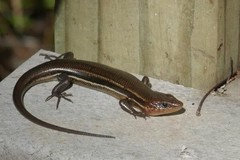
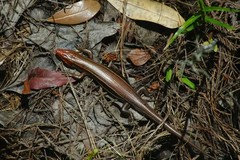
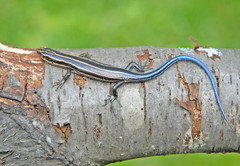
Hope this helps!
Marcia
garyfla_gw
Original Author17 years agoManature
Definitely not the one here. The most distinctive characteristic is curling the tail over the back.Scorpion like. No stripes mostly spots of gray and brown.Much larger and stockier than the brown anoles.
If not native is certainly common I see them in several local shopping centers. None ever come toward me,in fact just the opposite ,want to stay as far away as possible, lol
The larger darker colored one stays mostly on the seep wall in the shadehouse . He is absolutely terrified of me though will run when I approach within 3 feet lol.
Might mention that the one that comes toward me will not allow touching but will only move a couple of feet away,
I really have never had much interest in lizards but this "odd behavior is so noticeable and I'm sure it's not average behavior lol
Oh well . If she comes back will try to get a pic of her and her "boyfriend lol Thanks gary- 17 years ago
Gary, I suspect you have a lizard called...ready?...the curly-tailed lizard. There are several types, but one in particular is becoming a nuisance in south Florida. It is an exotic, of course, and displaces our native anoles, but in your part of the world, I doubt there's anything to be done about it. I have never heard of one becoming so tame, either, though there are several varieties of this lizard that are sold in the pet trade. So it's quite possible you have an escapee. Here is a picture of a typical one that has been introduced into south Florida. Look anything like your guy?
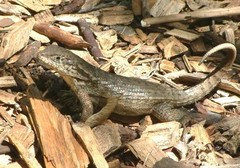
No relation to skinks at all, though you should have plenty of those around, too, if I remember correctly. Keep us posted on what this guy does.
Marcia
- 17 years ago
I will go around watering with the hose and the nasty roaches or chinch bugs, whatever icky cockroachy-looking-insects, come crawling out of the mulch when the water near-drowns them, and my lizards jump out of nowhere and gobble them up, and they can take down 2-3 of those in one meal.
I love, love lizards!!
teeka
garyfla_gw
Original Author17 years agoMarcia
There's the curled tail !!! Thats it though I seem to remember more spots on the back but about the same colors.
Though the larger ones (males??) are much darker on the tail but still keep it curled like your pic.
Not Skinks?? Shows you how much I know lol. A rather noticeable characteristic is the lack of the fold of skin under the chin called a dewlap. absent on all that I've seen but very hard to get a good look at them ,They all scatter except for the one lol
She must have been somebodys pet, could be no other explanation of why only the one would associate humans with food Interesting that she would eat things that couldn't be on a "normal" diet such as chocolate lol
Sure odd to have a lizard begging at the table like a puppy lol I assune that she is hibernating due to the cold front as all have disappeared if she comes back I'll try to get a pic .
Had no Idea any reptile could be trained lol thanks gary- 17 years ago
I've seen very tame individuals of the Curly Tailed Lizards too!
There was/is (?) a little breakfast/lunch Place (Hollywood Joe's) on Ocean Avenue (Lantana) that has long lines and pleasant outdoor seating. The lizards have learned that begging gets them fed, and they work the tables expertly. They especially like scrambled eggs. Some are HUGE and you can hear their feet thudding as they dash for tidbits.
We always enjoyed watching and feeding them!
I've attempted to catch them at local Lantana/Lake Worth shopping centers, but the young/slim ones are FAST!
I like them a lot, but I like all reptiles(G).
Lisa
- 17 years ago
Well, there you go, Gary...if Lisa's experiences are any indication, then perhaps this lizard is smart enough to figure out which side his bread is buttered on...literally. Very interesting.
No, they aren't in the skink family at all. You can always tell skinks from other lizards by their glossy coloration and very snakey, side to side movement. Their tails in particular can almost coil up. They are my favorite lizards, as they are so pretty and smooth looking. We have a large male five-lined skink in our woodpile, and his head turns bright red in breeding season. He will hide in the logs with just that bright red head peering out. In cold weather, they squeeze under downed branches, rocks or other debris and nestle down in the dirt or leaf litter, though I've never seen one go into a hole.
So far, we don't have any curly-tails moving into this area, and I think I'll leave them to poor, exotic-infested south Florida, interesting as they may be. Our Carolina anoles are already under enough stress from the Cuban anoles and the Cuban treefrogs. (Why are those Cubanos so much trouble???? Felix???) *grin*
Marcia
garyfla_gw
Original Author17 years agoHi
Well that explains it lol Not so unusual after all.Gee I was going to catch her and sell her for several million lol Still would think that type of lizard would be an insect eater and therefore wouldn't accept plant matter . Only thing I've seen her reject is a piece of lava stone.lol
Have had those gigantic marine toads figure out that cat food is not only edible it's delicious lol
Who says reptiles are stupid ??lol thanks gary- 17 years ago
Well, I can tell you for sure, reptiles aren't stupid when it concerns feeding themselves! They have plenty of cleverness, agility and determination when meals are involved. I've seen pictures of alligators climbing fences to get to puppies on the other side, and I have had snakes in my own yard hide on top of my birdfeeder tray, just waiting for Lunch On Wings. And we all know gators LOVE a handout, which is one thing that can make them extra dangerous. Guess the little guy is not that far removed from the Big One (El Ligarto), eh?
Even if other curly-tails do get used to people and handouts, I still think it's really odd behavior, though. And very interesting. Glad you shared with us!
Marcia
- 17 years ago
I never cared for the black skinks. If a cat gets one and
bites into it possible cat death. My moms cat got one and
went blind in one eye and walked around with it's head cocked to one side the rest of its life. The other lizards are cool. - 17 years ago
We have all kinds of lizards in our yard. The ones that are not native are the curly-tailed lizards. We didn't have these up until about 5 years ago. They can get pretty large, some as long as 7 or 8 inches, and quite fat, too!
Sheri
garyfla_gw
Original Author17 years agoHi
Well when you think about it no matter what kind of animal you are there are only two choices of food .Vegetable or meat. Swiching menus for any animal is certainly rare.
Obviously diet is programed into the animal so would guess the lower the mental capability the more difficult to change the diet.
I have intentionally trained fish( really stupid animal??)for various reasons but reversing the diet between the two choices is almost impossible. One interesting aspect
is FW fish feed at various levels in the water .Even though they've learned that seeing me means "FOOD" and they know what it looks like they will refuse it to the point of starvation unless it's at the "right " level. It can't be on the surface nor at the bottom.!! I find that interesting as they see it become very excited so they know it's food and will run at it but usually wait for the bottom feeders to cause it to sink . Which means the bottom feeders get ALL the food.
Ah the mysteries of nature.?? Thanks gary- 17 years ago
Yes, Nature in her infinite variety is amazing! But don't forget, Gary, that not all animals are strictly carnivores or herbivores. Some are omnivores (like us). Bears and various scavengers come to mind. Possums, raccoons, and the like will eat anything they can find, being creatures who know how to take advantage of an opportunity. Heck, even a confirmed carnivore like an alligator will eat MARSHMALLOWS if people are uninformed enough to throw them at them. So...sounds like these little lizards have learned to grab anything edible that appears before them. Don't know whether that is a good thing or not, but it is surely interesting.
By the way, I have posted a question on the Reptile forum about whether there is any truth to the old wive's tale of skinks being toxic to animals. I can find nothing "out there" that confirms that, but I did find plenty of info on the fact that raccoons, possums, bobcats, coyotes, and yes, dogs and cats prey on them routinely. So I don't know whether there IS one type that is toxic, or whether that's just not the case. Hoping for an answer today, as I don't want to think people would start killing skinks in an effort to protect their pets. Also, fishead, I've never seen a "black skink" in Florida (ours are various tans, browns, reds and blues), so I don't know if you are referring to a variety from another place or not. Will post back when I get a definitive answer on the toxic issue from those experts on the Reptile Forum. They really know their stuff over there (well, at least several of them do.)
Marcia
garyfla_gw
Original Author17 years agoMarcia
I recently read an interesting article on a type of parrot that appears to have swiched "preferred diet" from mostly seeds to mostly mammal blood. !! They land on sheep backs draw blood and eat it . Some even appear to have switched entirely, rejecting seeds. Appears to be the first documented case of "manipulated" diet alteration. Have been unable to determine when this occured and more importantly why lol. but appears to be within the last 25 years. As you may know there is no such thing as a carnivous parrot.nor a diet alteration in any specie.
If i can find the article again I'll give it to you. I can tell you're an avid natualist lol.- 17 years ago
Hi,Gary! True, parrots are not known to be precisely carnivores, but guess what? They do eat meat on occasion, when they find something lying about already dead or the like. And many, many parrot owners feed their birds a lot of human food, including things with meat.
I used to raise lovebirds and other small parrots for sale and I had several larger parrots for pets for many years until I decided to put them in a breeding program to help preserve the species. (They are happily making little parrots now.) My larger birds loved nothng more than a chicken leg bone to crack open and get the marrow out of, and they are thought to do that in the wild when an opportunity presents itself.
BUT, having said that, they are certainly not thought to actively seek out prey animals nor drink blood. I'd love to read that article...sounds intriguing.
Sometimes wild animals don't let us in on all their secrets...we have to find things out gradually, and with much studying, filming, and listening to indigenous cultures tell what they have observed over the years.
Avid naturalist? Who, me? Shucks. Guess my secret is out!
Marcia
- 17 years ago
A Florida gardener named Gary,
Encountered a critter of which he was wary,
Curly tail and all shiny,
And oh so tiny,
Was it a skink he did query?A picture would tell the whole story,
If this was a skink in its glory,
There were some that did echo,
That it was a gecko,
This reptile that now was our quarry.Marcia has the answer, I think,
Of this our would-be skink,
A curly-tailed lizard,
Says our reptile wizard,
With a nod, a smile and a wink. garyfla_gw
Original Author17 years agoMacia
I think one of the most interesting thing about the blood eating parrots would be what the offspring will choose as a preferred diet?? Bet the sheep farmers are hoping it's a passing fad?? lol
gary- 17 years ago
HEY, GARY!!!
I think I may have seen one of those blood-sucking parrots at my feeder yesterday! Whaddya think?
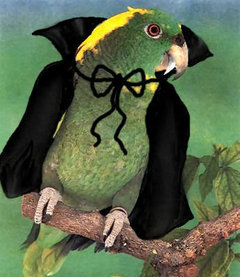
Marcia
- 17 years ago
Vampire parrots! On the loose in Florida, no less. We can put this down on the list along with:
1. The Swamp Ape
2. The Crescent City Ghosts
http://www.ghostsofamerica.com/3/Florida_Crescent_City_ghost_sightings.htmlThere are only 3 ways to kill a vampire parrot:
1. Stab them in the heart with a silver garden trowel;
2. Throw holy water treated with Miracle Grow on them;
3. Put okra in their food (come to think of it that would kill anything) - 17 years ago
Kill them? KILL THEM???? BILL!!! Has no one told you of my predilection for all things Vampire??? Me, Dracula's #1 Senior Citizen Fan? HBO True Blood addict? I figured I'd catch it, make a pet out of it, feed it Cuban Treefrog blood, and ghost write its autobiography, "Interview With a Vamparrot!"
*loud cape swishing, here*
Marcia
garyfla_gw
Original Author17 years agoHi
Could not find the article on the study of the parrots
But you can google Kea (nestor notabilis) an alpine species endemic to New Zealand. They are quite remarkable
among parrots for several reasons but most notable is omivours diet including carrion. They have been hunted almost to extinction because of the belief that they ate meat.many tales of them attacking and killing sheep.
Always denaied by science. Anyway, from there you may be able to find more info?? I think there is one or two other species of omnivorous parrot but no carnivores.
gary- 17 years ago
Gary, kea's are real pest to tourist. When we were in New Zealand in 01 (one week after 9/11) and were driving west across the southern alps to the Tasmanian Sea. When you left your car in a parking lot along the road, Kea's would pick and pull the rubber molding from around the cars windows and they were everywhere.
think I have a pic of one doing it's deed in my many photos of NZ.
bernie
- 17 years ago
Gary, I should have realized you were talking about keas, the only species of parrot known to have nocturnal habits. I have seen infra-videos of them several times. Just never heard about the blood sucking bits. Here is what Wikipedia says, for those interested:
"An omnivore, the Kea feeds on more than 40 plant species (Tab. 1), beetle larva, other birds (including shearwater chicks) and mammals (including sheep and rabbits).[17][3] The Kea has also taken advantage of human garbage and "gifts" of food.[21] In captivity, the bird is fond of butter, nuts, apples, carrots, grapes, mangoes, figs, bread, dairy products, ground meat and pasta" (This diet sounds about right for captive parrots of many species, actually, leaving out the butter.)
Here is a bit more info:
"There had been a long-running controversy about whether the Kea preys on sheep, with the earliest reports appearing in 1867. An article by naturalist G.R. Marriner in 1906, describing substantial anecdotal evidence of these attacks, became the accepted view of the bird's habits.[12] Several prominent members of the scientific community concluded that the rumours were true, although others were not convinced. However, in 1962 animal specialist J.R. Jackson concluded that the bird may attack sick or injured sheep, especially if it mistook them for dead, but that it was not a significant predator.[22] Finally, in 1993, its nocturnal assaults were captured on video,[3], proving that at least some Kea will attack and feed on healthy sheep. The video confirmed what many scientists had long suspected, that the Kea uses its powerful curved beak and claws to rip through the layer of wool and eat the fat from the back of the animal. Though the Kea does not directly kill the sheep, death can result from blood poisoning or accidents suffered by animals trying to escape."
This would not seem to be aberrant behavior, but rather a learned one from a bird that is highly intelligent and very adaptable. Not being a true predator, but definitely being a carrion eater, it obviously discovered sheep were easy targets, and it didn't have to wait around until they died.
It was also noted that they steal items from tourists backpacks and camping gear, being curious and liking to make off with bright objects. I guess I should be happy that I only have wintering red-shouldered hawks to contend with in my garden.
Kea:
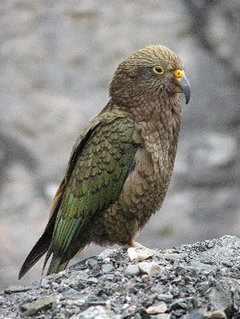
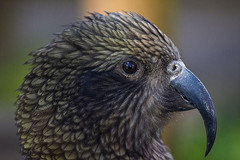
Close up of Kea's formidable beak, which is quite different than most parrots'.
And lastly...I can't believe you didn't comment on my picture above of the blood-sucking parrot that is currently visiting my birdfeeder, Gary??? Shucks. I thought maybe it would give you a smile.
Marcia
- 17 years ago
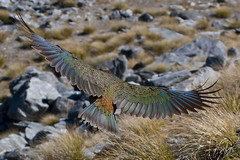
Thought this was a stunning picture of a kea. Notice that it appears to be gliding like a raptor, rather than flying in a more normal parrot fashion.
I'm still wondering who can identify the suspicious looking psitticine observed at my feeder recently? (Scroll up for photo) I've been watching for his return...keeping the dogs on a short leash with garlic tied to it!
Marcia
garyfla_gw
Original Author17 years agoMarcia
It did make me smile. Just too lazy to write comments.lol Though I have kept birds for many years not parrots because I also wanted to keep plants . I don't think you'll have the least problem with any SA parrot lol As I'm sure you know they can easily draw blood no fangs necessary Cape optional??
The article I was referring to took this reseach MUCH further because of the accidental discovery that DNA molecules can be identified even after being digested.
Which means, for the naturalist, that it's possible to tell exactly what an animal ate. which animal ate it and more importantly how much. Possible now to have long term
charts of diet without observation.. Besides how do you tell when a parrot is eating or just chewing.?? Not to mention the incredible ability to "learn"
The early results of the study showed that at least some were actually consuming the blood to the rejection of other material. Several of the "Sheep diners" had levels as high as 90 perccent of the total diet. Since the test is only accurate for two months at best, results are very debatable. Since the bird is a known omivore even carrion eater not too startling until you consider that at least some are demonstrating "preference" for a single source mammal protein. Since sheep were not there until settlements from europe obviously this habit has developed recently. Another aspect is the digestive tract shows none of the bacterial adaptations of Vultures so why isn't carrion eating fatal??
There are some similar studies going on on Darwins famous finch. Now a carniverous Passerine let alone finch
is really "oddball" gary- 17 years ago
Lazy? Harumph! And I went to so much trouble to show you my interesting visitor! And even though it's obviously an aberrant amazon, why who's to say the word hasn't gotten out? When fruits and seeds are scarce, like after a honking big freeze, perhaps ALL the birds go looking for something else? I've noticed that caped & fangy one three nights in a row, skulking around the yard, looking for sheep! I have a feeling, though, he would settle for little stumpy-legged sausagey guys in a heartbeat! (Does anyone know how to make a dog collar out of strings of garlic?)
Serially now...the kea is truly fascinating. Can you imagine living where such birds might show up in your yard? Or on your ranch? Or maybe even in your garden?
I found them fascinating originally because of their nocturnal habits, and I knew they were scavengers. Parrots are opportunists and will eat things not normally on their diet if presented with them, but no other species actually occupies the niche of full time scavenger (that I'm aware of). But the fat eating and blood drinking thing is just astounding.
And yes, since keas have been there much longer than sheep, this is obviously a learned behavior. Perhaps it is just much easier? Lots of slow-moving, warm-blooded sheep standing around waiting to be drained. So bizarre!!
Even looking at the bird shows that it is unique. I don't know of any other parrot with an upper mandible that long, pointy, and sharp. I wonder if it has gotten noticeably longer since they have developed this habit? It looks like the perfect tool for getting through a thick layer of wool and piercing the skin underneath.
It's a beautiful bird, for sure...love the picture of it flying. I will be doing a bit more research just for the fun of it. Thanks for mentioning these parrots. I had sort of forgotten they existed. (Probably better for the species that we ALL forget about them.)
As for the carnivorous passerine...very odd in a finch, but not totally unheard of in other passerines. (Loggerhead shrike comes to mind.) I'm going to have to look up the new info on finches, too.
NATURE!!! So interesting in all its infinite variety!
Marcia
- 17 years ago
Florida Short Sale Help to stop foreclosure and save your credit. Work with us to avoid foreclosure and keep your home & prevent foreclosure With Florida short sale specialist.Floridashortsaleshelp.com - help you with your short sale locally in Florida. We have experience in the short sale process and along with a local attorney can provide the best chance of getting you out of your home as easily as possible. When you are looking for a company to help you with your home or condo you want trustworthy and ethical people helping. We have very high success rate closing short sales.
Here is a link that might be useful: Prevent Foreclosure Weston









coffeemom