Software
Houzz Logo Print
pudge2b

Troughs

21 years ago
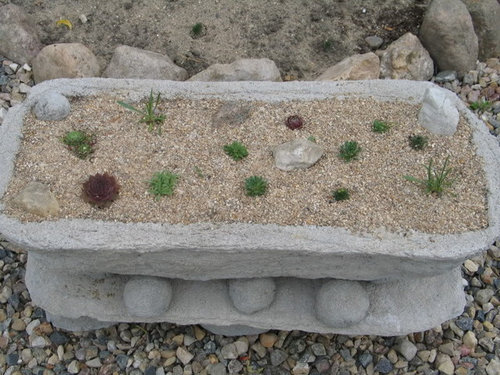
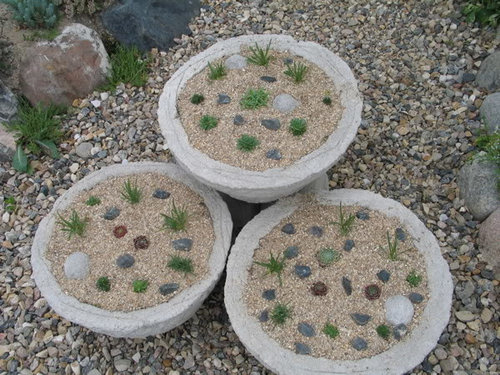
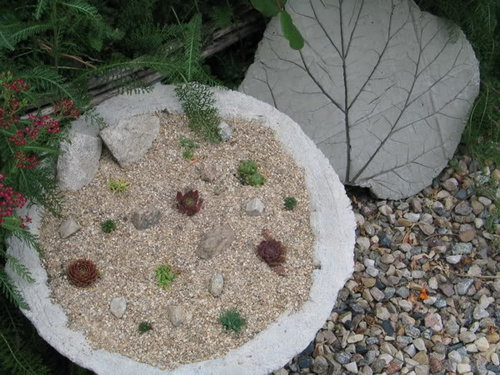
I tried my hand at some hypertufa this year - had to wait 30 days for them to cure so I just got them planted up last weekend. My mix was portland, sand and fine vermiculite. Only one is in the shape of a trough, the others I used pots for forms. They're planted in a potting soil & course sand mix with various Semps, Dianthus, Draba, Delospermum, and Edraianthus serbicus. I'm hoping everything winters - leaving stuff in a pot above ground over winter just doesn't seem right but seeing as others have success, I'm willing to give it a whirl.

This is 3 pots, the middle one is raised

A big pot, next to a gift of a concrete leaf casting

I know there are others on this forum who have troughs - anyone want to share pics, tips?

Comments (22)

  • 21 years ago

    Wow, just terrific Pudge, you always seem to do your garden projects to perfection!

    I really like those rolled up cement balls in the design of your first hypertufa trough! Where did you come up with the great idea!

    Sharon

  • 21 years ago

    Very nice, Pudge. My large strawberry put (red clay) is giving up this year. I have petunias in it and I think the roots are going to burst right thru any day now. I'm thinking of just coating it with about 1" of hypertufa. Would that work or should I cast the whole thing? It would be stored for the winter if I was to just coat it.

    Shauna

  • 21 years ago

    Very nice PUdge!!
    Do you know how well it overwinters?
    Tina

  • 21 years ago

    Thank you. They were fun to make and plant up. Sharon, I made those little balls with leftover mix and the ones you see in the pic are just sitting on the flat base, but there are more underneath the trough to look like feet. None of it was really intentional - I did 3 separate batches and had some leftover mix each time so things got made and ideas came later.

    Shauna, I'm way too new at this to be giving out advice. The Hypertufa forum has a whole 'nother crowd of passionate experts though - I'd ask there about the strawberry pot.

    Tina, I have no idea how well it will winter. I guess that's how my success will be determined - that it doesn't crack or fall apart and that the plants don't die.

  • 21 years ago

    Those look great Pudge! I like those leaf castings too. I have no such nifty things but someone in my neighbourhood has either a (dry) fountain or a really really big birdbath full of annuals and I thought it was a really nice idea. It must be 5' across. Looks great.

  • 21 years ago

    So long as they are constructed properly (with good drainage in and out), there is no problem with wintering troughs in cold zones - that is, simply leaving them in place, fully planted up, and with or without any protection. Growing alpines in troughs and beds is pretty popular here, and it works, needless to say.
    As I've mentioned before, our troughs line the drive-way (using otherwise ungardenable space) and they simply sit there all year - no winter protection, very low maintenance (though that would depend on the species you're growing).
    You may find that your circular troughs might need to be set into the ground in order to winter over the plants - there is obviously much less tufa/soil volume out towards the edges on a semispherical planter, so less mass, higher tendency to dry out in winter, big temperature shifts - setting such troughs into the ground is something that people here have to do (even with much larger ones). The square and rectangular ones, though, tend to be just fine - the mass is larger and evenly distributed (no thin edges).

  • 21 years ago

    Your point about the round containers never even crossed my mind, Lori. Thanks for mentioning it.

    NS, I had plans to do leaf castings this year as well but for some reason my ornamental rhubarb died this year :( (who kills a rhubarb, for pete's sake?). Anyways, I now I have some incredible castor bean plants with large leaves that I can use but somehow time runs out and now my busy season starts for harvesting, drying, crafting. Good thing I live in 'next year' country.

  • 21 years ago

    OK, so you want to see more troughs? Here are some of mine.

    {{gwi:766328}}

    {{gwi:369729}}

    {{gwi:369709}}

    Well, no one explicitly said they had to be hypertufa. The second and third are, but the first is made from a styrofoam fish box.

    Very nice troughs, Pudge. Feet are a really good idea, especially if the trough is set on a wood deck. The wood underneath will stay dry. Also keeps potentially damaging insects from hiding under there too. This all in addition to the good looks.

    I am interested to know the proportions of your mix, Pudge. It is the local sentiment here that that plays a role in the life of a trough that goes through repetitive freeze/thaw cycles. We use portland cement, peat and vermiculite or perlite as basic ingredients, at a ratio of approximately 1:1.5:1.5. And fibermesh.

    Rick

  • 21 years ago

    Wow your troughs are really nice too Rick! I especially like that red dangly plant (I'm not at all up to speed on alpines and such).

    The styrofoam fish box takes me back, my parents used one as a cooler for camping when I was little. I remember it smelled funny. ha ha

  • 21 years ago

    Thanks for posting your photos, Rick. What type of cactus is in the 2nd photo? It never even occurred to me to include some cactus but it looks fantastic. And those little round balls in the bottom left of the third photo? Is that a plant, or little round balls?

    The mix was portland cement, sand and vermiculite 1:1:2, and did not include fibermesh. I read that the addition of sand increases the strength (but, of course, heavier). We'll see next spring if it worked.

  • 21 years ago

    2cd Photo
    Hypertufa trough: the mold was a little plastic basin for dishwashing.
    First row: Sempervivum 'May Imp', Echinocereus coccineus(the cactus), Sedum mentha requenii
    Second row: Sedum obtusifolium, Rabia albipuncta(found not to be hardy)

    3rd photo
    Furrows on the trough sides are 1/4 inch deep.
    1. Escobaria leei(the white cactus), Sempervivum 'Red Ace',Delosperma nubigeum(the red dangly thing)
    2. Jovibarba allionii, Escobaria viviparia
    The photo is deceiving in that the E. leei are not balls, rather fingers. So the plant is quite small and relatively slow growing. Of course the cactus itself is a blue-green, but the areoles and spines are chalk white. It came from High Country Gardens. I highly recommend it. It did bloom this year, but I was out of town and didn't see.

    Interesting story about the delosperma: When this photo was taken (2 years ago), Ian Young (from Scotland) was touring here for NARGS. Ian is well known in the alpine gardening societies, and quite well respected, although somewhat of a maverick. He spoke to our Chapter on Fritillaria, and I got to host him for the time he was in Minnesota.

    So he looked at that trough(#3) and said, "This was just planted this season, wasn't it?." It was. He went on to explain that the hardy ice plant(Delosperma) would calm down after the first year, and not take over like it did. It's a common problem, he said, until the excess nutrients are used up. He was right, as since then the plant as perfomed respectably.

    FYI, the red is the fall color. Although it is evergreen, in spring and summer it is apple green.

    Rick

  • 21 years ago

    Very nice troughs Pudge and Rick. Your bowls are really cool Pudge. Rick, what type of paint did you use on your fishbox? I made a fishbox trough but did not get anything done with it, just sitting in the basement empty, always next year. I mushed together brown, tan and black for colour but I like your grey colour much better. Looks like you did horizontal gouges on the sides, looks really great, I like the rough top edges too.

  • 21 years ago

    I am now inspired to work on mine. I have fish boxes
    temporarily being used as ponds. How deep are the hypertufas and fish boxes ?

  • 21 years ago

    Here are some of mine.


  • 21 years ago

    Thanks for the inspiration! I've been thinking about making these for a couple of years now and just haven't got around to it. Think I'll get my homeschooling daughter and I on it - will be a great art and science project as she can detail the properties of the different substances, measure the ingredients (math too!) and create something cool and functional. Should appeal to a 13 year old. My 9 year old daughter will probably love to mix and pat. I'll plan what plant material to put in them. Thanks for all the ideas and recipes.
    Kate

  • 21 years ago

    Great examples, Sherry.

    bcgift52, troughs 1&3 are 6 inches deep, trough 2-8 inches. I wouldn't go any more shallow than 6, but deeper is just fine. If you grow alpines, the deeper the better - even 18 inches wouldn't be too deep for them.

    I can't take the kudos for that fishbox trough itself. We have some real experts of the craft in our NARGS Chapter, and this one they made. They use masonry paint, usually 3 colors, and applied separately(not mixed together). Below are instructions for making a fishbox trough, by the originator himself, Ian Young.

    My club also did a "how to" exhibit for the Minnesota State fair and won first prize. They have adapted Ian's method. I can send that to you too, if you email me with your address.

    Rick

    Here is a link that might be useful: Making a Fishbox Trough

  • 21 years ago

    Rick
    I sent you an email but am posting here because I know sometimes emails through GWeb don't reach their destinations.

  • 21 years ago

    I did get it bcgift52, and all I need is your email address, so we're set. I'll send you an attachment.

  • 21 years ago

    Pudge your troughs turned out terrific. You shouldn't have a problem overwintering any of the sedums and hens & chicks as I've had mine for about 4 winters now. I've been lucky and haven't had any of mine crack, but I was fairly careful to keep the walls at least 2" thick.
    Here's some pics of mine;


    This was a bird bath in the beginning, but with west nile, I've planted it this year with Irish moss, I have my doubts it'll overwinter, so I may bury it the garden.

    When a friend and I decided to try hypertufa, we experimented with a few different things. This Japanese lantern was one of them. One of these years, I may get around to brushing buttermilk and moss on it like I originally intended :)

    I also decided I wanted a small pond, so I took half of a plastic barrell and covered it with chicken wire, then just added handfulls of concrete to it. I then used ordinary craft paints to make it look more like rock. It's been out for 3 winters and I'm amazed at how well it's held up.

    As for leaf castings we used burdock leaves, which turned out well. Your idea of using caster bean leaves would be very interesting too. We also made hypertufa spheres out of old glass ceiling lights and painted them. Once you get going with it, it's really amazing what you can do. For the past couple of years I've been wanting to experiment with cardboard boxes and styrofoam rose huts for molds, but just haven't gotten around to it yet. So many ideas......so little time :0)
    Laurie

  • 21 years ago

    Very nice, Laurie. I love the first pic, with the larger Semp growing at the bottom of the container of small Semps. That's very nice.

    So...the pond...the plastic barrel is still in there? I'm assuming you empty it before freeze-up. I've never wanted a pond, but I do like these small water features. You did a super job of making it look like rock.

  • 21 years ago

    Sherry I like all your different shapes and the moss on them too.

    Laurie, yours are really great - I like the first one too, with its continuity to the rest of the garden. Do you keep any fish in the barrel?

  • 21 years ago

    Yes, the plastic barrel is still in there, there's only concrete on the outside. I do empty it before freeze up too. I thought for sure I'd have to re-do the paint every year, but the plain old paint has stood the test of time without fading a bit. I used to have up to 12 goldfish in there, about 2-3" long, but they have graduated to the inground pond and now I only have about 5 or 6 tiny babies in there.
    I like the way the plant material kind of flows out of the containers too, and sedums and Semps work beautifully for that.

Sponsored