

Pinus maximartinezii
Yes, I am well aware that this pine will not be hardy planted outside without protection in my climate but I intend to do so. My question for the few that have had experience with this pine is at what temperatures does minor damage start to occur and at what temperatures is significant damage likely to happen?
Comments (93)
 13 years agolast modified: 11 years ago
davidrt28, from my observations, direct cold doesn't seem to bother the Longleafs. No terminal bud death & only slight needle-burn from the worst winters so far (I also have a healthy pond pine that is labeled as only zone8 hardy).
However, wet snow or ice may eventually be their undoing (the extremely long needles). They survived w/no problem the record 36" single snowstorm here in Feb 2011, but that was relatively dry snow.
 13 years agolast modified: 11 years ago
Thanks beng. I feel like the couple I've seen north of the native range (SE VA) are not the tall, full specimens seen in the south. A relative of mine had one in his garden in Norfolk that was lovely...I'm not sure I'd say it of any I've seen north of there, which are spindly or squat. (Vienna, VA; Newark, DE as I already mentioned; south of Trenton NJ; etc. I can't remember whether I've seen the one at Longwood.) I'm not sure what the reason is but a combination of things seems logical.
Resin: thanks for sorting me out. I found what I thought were records for Pinus palustris at the RBGE multisite search.
Related Professionals
Green Bay Landscape Architects & Landscape Designers · Cowansville Landscape Architects & Landscape Designers · Abilene Landscape Contractors · Elgin Landscape Contractors · Barnstable Landscape Contractors · Minneapolis Landscape Contractors · Colorado Springs Landscape Contractors · Hattiesburg Home Builders · Spartanburg Home Builders · Victoria Home Builders · Chicago Home Builders · Minneapolis Home Builders · Allentown Home Builders · Salt Lake City Home Builders · Spanish Fork Home Builders 13 years agolast modified: 11 years ago
davidrt28 Pinus palustrus is not commonly planted anywhere near as much as Pinus taeda here in TN. In Jan. of 1985 most of mid TN experienced historic low temps. Officially -17F-27C to-28F33C. Most of the P taeda foliage at least discolored and a lot just turned brown. There was no loss of bud or wood though, and new growth was normal. P palustrus was almost pristine. In fact, they were about the ONLY green that winter save Ilex opaca. In 1985 I won the lottery here with -28F33C but I had no P palustrus. I now have two, about 20 years old. They have both gone through -21F-29C with no damage. The species is native up into the high elevations of northern AL in the mountain form. I heard that unofficially northern AL just south of the TN line dropped to -30F-34C in '85.
- 13 years agolast modified: 11 years ago
We have ours in a pot. Bought at Cistus several years ago and during the warm months we keep it outside. It just motors along. The color is beautiful. We also grow Pinus palustrus and they are now about 12'. Have lost one but the others seem to be doing well. Wonderful tree.
scpalmnut
Original Author13 years agolast modified: 11 years agoAsk a simple question and forty plus responses later, none have answered the original question but at this point enough is enough. I guess I should have worded my original question differently by emphasizing that yes I was aware that his tree would not be winter hardy outside but that I did fully intend to provide it with the utmost in cold protection to possibly increase the odds that it would survive.
Now to respond to floramakros, no I do not get my jollies by deliberately killing innocent rare plants. While I do have quite a few connections that allow me access to some rare material, most of the stuff I buy and normally I only have one single plant, not an entire greenhouse of " captive guinea pigs " from which I can just go grab another to continue my evil experiments with. If a plant dies, it is gone from my collection and a financial loss is incurred so I lose twice.
Floramakros, if you aren't into experimenting or pushing boundaries, that's fine but don't vilify those of us that are. If I didn't push the envelope or listened to everyone that said , " Oh, that won't grow where you are" , then I probably wouldn't be successfully growing Araucaria angustifolia, Nageia nagi, Cathaya argyrophylla, and Pinus patula all outside and in the ground.
Being that I only have an acre to play with here, it is no big deal for me to wrap plants, string Christmas lights, or run propane heaters to get my most tender plants through the tough times, which may only be a few nights a year.
Lastly I would like to say, your lack of using common respect while posting has made your posts less than stellar. Who are you to be referring to me as a "troll" when you know nothing about me other than your preconceived notions that I am some serial plant killer? There are plenty of people who participate on this board that " know their stuff" whether it be self taught or through years of university study and then there are those that are just the casual gardener with real life experiences. You might be wise to err on the side of caution and address everyone with dignity regardless of whether you agree with them or not.- 13 years agolast modified: 11 years ago
"Yes, I am well aware that this pine will not be hardy planted outside without protection in my climate but I intend to do so."
I interpreted this sentence as you stating you intended to plant it outside without protection, hence the misunderstanding. Hopefully if you reread your sentence you can understand why I did. Everyone else from their comments (whether pro or con) did the same. I only wish you had clarified it sooner. I'm glad to hear you plan on protecting this rare beauty during the winter, but again I should warn you your summer humidity will most likely spell its end. Of course it's totally your choice, good luck, maybe your tree will be the one in a million. Please remember to inform us what happens next year, it adds to our info on this rare species.
- 13 years agolast modified: 11 years ago
" Mcpotts 7a (My Page) on
Fri, Nov 30, 12 at 7:43We have ours in a pot. Bought at Cistus several years ago and during the warm months we keep it outside. It just motors along."
"I should warn you your summer humidity will most likely spell its end"
McPotts has said they are in Virginia. If he's growing in it Virginia in a pot, it obviously doesn't have an exquisite sensitivity to humidity. Believe me, I've lost plants that do, even if they were in pots. That being said, of course it's a risk in growing any high elevation species like this in a humid climate like ours. A handful of facilities actually have air conditioned greenhouses to mitigate this. I believe Longwood has one.
This post was edited by davidrt28 on Fri, Nov 30, 12 at 23:09
- 13 years agolast modified: 11 years ago
david this post of yours is really confusing. My quote is responding to scpalmnut's explanation of what he really meant to say in his first line starting this thread (he could have saved us hours of typing if he had told us that when he saw everyone's reaction on the first day!;-)
Mcpotts has nothing to do with it. Reread the two messages, they're directly above your last post. Now THAT is a perfectly valid reason to edit a message imho.
- 13 years agolast modified: 11 years ago
"Mcpotts has nothing to do with it. Reread the two messages, they're directly above your last post."
Actually, you should reread. McPotts says he has a Pinus maximartinezii. You said humidity would kill one. That has everything "to do with it".
This post was edited by davidrt28 on Fri, Nov 30, 12 at 23:44
- 13 years agolast modified: 11 years ago
I didn't say it, a grower with over 20 years of experience with the species said it along with every other person growing it that he knows. UCB botanical garden has told me the same thing btw. Are you forgetting everything that's been written on this thread or are you just itching to constantly argue with me? Dave, anyone, can you intercede and tell him his behavior is ridiculous, I can't be the only one tired of his nonsense. I'm beginning to wonder if I should even bother posting on this forum anymore, I wasn't a fan of flame wars and trolls in my BBS days (I was a moderator on echos in FidoNet and RBBSNet) and I certainly haven't grown to like them now. Please someone else say something, sheesh...
- 13 years agolast modified: 11 years ago
"I didn't say it, a grower with over 20 years of experience with the species said it along with every other person growing it that he knows. UCB botanical garden has told me the same thing btw. Are you forgetting everything that's been written on this thread or are you just itching to constantly argue with me? Dave, anyone, can you intercede and tell him his behavior is ridiculous"
If you say something here, you said it. That's the way a messageboard works. You didn't say you were quoting an expert. You take anybody challenging you as "ridiculous behavior". I suggest you think seriously about why you do that.
In any case, part of what this board is about is people challenging conventional wisdom. If someone at UCB Berkeley says it doesn't grow here, and McPotts does...fine. You can report what the UCB Berkeley person says, and I can report what McPotts says. (not that I should have to, since it's right here in the thread) That IS NOT a flame war! Someone else keeps trying to escalate it to that with ad hominem attacks.
- 13 years agolast modified: 11 years ago
BTW, all I said is that it didn't have an "exquisite" sensitivity to humidity if it could grow in a pot in Virginia. (I could list 15 other plants that would die in a pot in Virginia.) I largely agreed with you by pointing out it's a risk to grow such things in a humid climate! Yes, Salicaceae said one or more had died for him. SCPalmnut is presumably between FL & VA, somewhere in South Carolina. His mileage may vary as the internet-ism goes. Parts of the sandhills supposedly have somewhat lower humidity than the rest of the Southeast. Maybe SCPalmNut is in one of these areas.
The concern here is how defensive you get when someone merely contributes another thought to a thread that doesn't exactly, precisely agree with your views. - 11 years ago
Hey everyone,
Nice discussion.I have a few pinus maximartenzii seeds. Germination is easy, after cold stratisfication and strong sunlight exposure, at 20ºC plus, for more than 12 hours, in sandy media.
Initial growth is also easy. I have two seedlings, 1 year old. I have exposed them to minor frost and they suffered only a bit. I live between zone 9b and 8b (Portugal - similar climate to California), so I think we definitively have a chance for the rare maxi pine.
In native habitat, it stands ocasional harder frosts down to -8ºC. But it is in semi-desert cool mountain climate, so perhaps covering with plastic works while young, and while adult , trees might either die, suffer to adapt.
Another pine I am also trying is the torrey pine, which would have quite a similar cold tolerance.
I think it's educational at least, and important at best, to share between us, our efforts with rare species like the maxi pine, and whether they can be sucessfully grown ex situ in compatible climates.
How have your efforts with pinus maximartenenzii, scpalmbut, worked out? - 11 years agolast modified: 11 years ago
"Nice discussion."
LOL. It certainly wasn't nice.
There's always a case to be made for just starting a new thread after this long, but, as I tried to make clear 2.5 years ago, there are gray areas in life. Hopefully scpalmnut sees this and replies to it. - 11 years ago
I agree, probably it wasn't that nice.
But certainly my hope is to discuss plant hardiness of the pinus maximartenenzii, and nothing else ;) Hopefully scpalmnut will let us know what happened to his trees.
Mines are just in their first outdoor year (second year of growth), they face partially the winter outdoors but remaining on pots, and did fine, but only down to -1ºC, while it's zone8b and ocasionally goes down to -5ºC. And I just got some new seeds to germinate these last couple of weeks. Hopefully I will share what happens to them, after the next winter...
- 11 years agolast modified: 11 years ago
Funny now that I revisit the RBGE multisite search - which has more sites than it did in 2012 - more records in the US appear.
One at the Montgomery Botanical Center, which somewhat confusingly is not in Montgomery, AL but in south Florida. I highly, highly doubt they have an air-conditioned conservatory, or if they did that they would waste space in it for a mexican pine. So one can only assume it is growing outside and tolerating the massive humidity levels there. Or perhaps is a clever graft as Willows has sometimes done, to keep high-elevation roots from rotting in hot, wet climates.
Even stranger, and perhaps doubly ironic since I got in an argument more recently that I settled with (among other things!) an RBGE multisite search citation from there, is this rather bizarre entry for the species, in Niagara of all places!!!!!Niagara Parks Botanical Gardens
Living Collections Search Results
AccessionsPinus maximartinezii
Accession Number: 860640
Collected in Mexico: Zacatecas
Source: Mexico
Living Plants of this Accession
Qualifier Location Code Location
A GOL-2 Golf Course - Anacardiaceae Collection (Section 2)I love for some reason that the Golf Course is also the Anacardiaceae collection. Hopefully they have some poison ivy - ball retrieval hazard LOL.
Probably a mis-named plant, but if it really is hardy in the eastern Great Lakes climate...wow. That would have really made makros's head spin! (and believe me, hers would have, like the possessed girl in 'Exorcist') Maybe I'm misunderstanding something about this "Niagara Parks" facility, and a golf course on Vancouver Island is their western Canadian annex for mild climate plants. Or it's the world's largest enclosed golf course haha.
scpalmnut
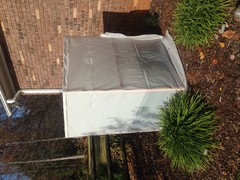
Original Author11 years agolast modified: 11 years agoJust to update, my tree is still alive and doing well after two consecutive winters with temperatures falling below 10F. This year I erected a "phone booth" around the thing to protect it and to keep it from getting squashed from the tarps and blankets that I used to wrap it with in previous winters. As an additional note, one growing unprotected at the Cox Arboretum in Georgia, likely did not survive. Time will tell.
- 11 years ago
Scpalmnut, that is great news. Also it's excellent news those reports of a Pinus maxi in Niagara and in Georgia.
How cold do you think it got at your the tree when it was wrapped in winter? Perhaps 20-25ºF? Was it only thin plastic wrap, or something thicker?
Great news anyways, because here winters are never below 25ºF, so we can definitively try the pinus maxi ! scpalmnut
Original Author11 years agoI think it would laugh at mid 20's for sure. Yes, it was enclosed in a wooden frame with plastic stapled to it. On the nights where it dropped into the teens or lower, I would also turn on a halogen work light and a string of Christmas lights that I had inside the enclosure. Not sure what the absolute minimum temp it got to inside on the coldest nights.
- 11 years ago
Well, it is one thing to have your pinus maxi covered in plastic in the lower 10s but without much humidity (it does get that in the cold winters of the desert climate of central Mexico), another thing is to get a food frost of lower 20s but with humidity, that forms ice crystals on the plant.
It's a good plastic encasement, but a pine tree needs to grow tall and wide, it cannot stay for longer in such wrap. (But I understand the logic, I am attempting the sameto grow a mango tree at my zone 8b climate)
I think a maxi pine seedling might suffer heavily or die (not sure), a grown tree might catch disease if unprotected, I would be sorry to estimate that.
But perhaps I am wrong and this species does well with lower 20s and frost. Especially if those Niagara and Georgia reports are true.
I will certainly know that after the next winter !I will get mid20s next January, moist frost, and I will see how will my 2year old seedling do.
I would say maxi pine is suitable to zone 10 for sure. Perhaps zone 9 and zone 8, certainly if freezes are dry, not sure if frost forms. Zone 7 will probably kill the tree eventually. That's my guess.  10 years ago
Many years ago a friend of mine gave me several 3' grafted P.maximartinezii. I had a seedling of an age (here in South Australia) where it was already making pollen & only took these as he didn't want them. The rootstock was surprisingly P.pinea. This was surprising as P.pinea is or I believe from my reading, is out on its own in the pines. These thrived & made excellent growth. The scion overgrew at the union somewhat as the bark of the maximartinezii was thicker & sort of corky. Inspired by this success I put P.torreyana & sabiniana on P.pinea. Both made strong healthy unions & grew to maturity. All the above were ultimately lost to divorces (very regrettable as we can't import pines from the Americas anymore) but my point is that if you wish to try species outside their natural environmental range maybe try grafting on hardy species? There certainly seems to be a wide compatibility among pines if my experiments were anything to go on.
Peter
 10 years ago
Just saw scpalmnut at the ACS National Meeting in Ohio and his tree is doing great. He has forgotten more about horticulture than I know, and so it doesn't surprise me that he was able to make this survive and thrive.
- 10 years agolast modified: 10 years ago
Wow..and coming from a Californian as well. (sorry, had to make the joke - you are one of the good Californians!) I really didn't ever want to see this thread bumped, but I'm glad to see it bumped for "my side". Funny timing cause I was of late deeply musing about what I see as the "politicization" of the plant vs climate adaptation aspects/issues of horticulture - as everything else in the world is becoming sadly politicized - but I won't go into it. I really wish Gardenweb had a forum for the "philosophy of gardening" or something - but maybe I'd be the only one posting there. LOL!
- 10 years ago
I hesitated about adding to it but I thought that it was important to note that the plant was doing well. And to reinforce that the poster is an accomplished horticulturist. One of the reasons that I prefer interacting with fellow gardeners in person is that no one at these meetings gets snippy and I learn so much from the other people.
- 10 years agolast modified: 10 years ago
"is that no one at these meetings gets snippy and I learn so much from the other people."
Good point there; alas my in-person interactions with certain advanced horticulturalists have not always gone as I would have hoped, in the long run...but again I digress! Thanks for the great update. I will say, generally, it's not just an issue with gardeners...all sorts of people with shall we say complex interests tend to be very opinionated about certain subjects related to those interests. And it just is what it is and you have accept it on some level. So, when some famous collector accuses me of being "taker" for not joining a certain plant society, and cut me off from communications, as absurd as that is you just have to accept it as an unfortunate part of what made the person a great collector. (not to say every horticulturalist is prickly, but that some definitely are. Just as I knew a biology professor in college who accused psychology of being a pseudoscience...etc. etc.)
But I go back to a point I've been making here since the early 2000s, if every plant were _only_ adapted to conditions just like its native range...clearly, there would be no such thing as horticulture. Or what we know today as horticulture. I'm reminded of when I first overwintered Fuchsia regia in the late 90s, through some fairly cold winters, and then using whatever means you could back then investigated the climate of where it came from in Brazil. (was wikipedia around?) It's basically like, the climate of Johannesburg, South Africa, but even milder. And one thought, there's simply no reason this plant should be so hardy. But it is.
 8 years ago
Arghhh...bumping again, (maybe not so wise), but my plant, which I put in the ground in the ground last November, in the most sheltered place I could find, made it through our (mild) winter of 2016-17 and has put on nice growth this year. I"m pushing it in terms of winter temps; the dry summer should be very much to its liking. If this winter turns out to be severe, it is the one plant that I have that I will cover. I have also seen it growing at the Crombie Conifer Preserve in Guerneville, which unfortunately is no more (the Preserve; I can't speak to whether the plant is still there). Appropriately, I planted it near a Callitris oblonga, given to me by.....wait for it....scpalmnut!
- 8 years agolast modified: 8 years ago
Curious as to why you think Sonoma County is pushing it "in terms of winter temps", if one was growing in South Carolina and presumably survived the polar winters? Maybe I misunderstood something about SC Palmnut's location or cultivation of the plant? (does he have a greenhouse?) Anyhow, no doubt your low dewpoints will be more to the liking of something from the Mexican cloudforests.
I think there's never a problem with bumping if you have substantive addition to an existing thread. Which this is - especially since you'd met scpalmnut in person. What I find slightly funny is the world of horticulture isn't a very big place, even in the Bay Area, and I wouldn't be surprised if you'd crossed paths with floramakros at some point. In spite of never belonging to any social media sites, I have pretty good google-fu and had at the time tracked down her real ID. Now _completely_ forgetten other than a general sense of who she was and why she (probably) had apparent axes to grind.
I am actually glad that whole melee happened because it forced me to think about plant adaptation in an even more scientific way than I already had been doing.
I wonder what happened to mcpotts because he or she was growing some interesting things in central VA.
- 8 years agolast modified: 8 years ago
Ok ok had to read through this sucker again. SCpalmnut was indeed massively protecting his, even though it's outside. Help me out here, what's the appeal? LOL. I don't see the exotically dripping needles of Pinus lumholtzii, for example. The fluffiness of the needles seems to lose its distinctiveness as the plants age. This, for example, would hardly turn any more heads than a plain old Pinus patula: https://www.rarepalmseeds.com/pix/PinMax.shtml
- 8 years ago
David you're such a downer :) (sgt. dave chief of the bump police!!)
In my experience there is no species to match the elegance, & spectacular delicacy of the juvenile P.maximartinezii foliage, not to mention the amazing almost luminescent blue color. Yes the mature needles are short, stiffish & morph to grayish rather than the electric blue of the juveniles but the change is no more pronounced than the one which besets us as we lose our youthful beauty, firm skin, lush radiant hair & bright hopeful eyes to become old gnarled & twisted & end up as decomposing worm ridden stumps! The old mature maximartinezii trees (I've only seen pics) are striking in their own right with their complex branched structure & majestic silhouettes. Also this species would be worth growing just for its name! To be able to proudly show off a specimen & say "here is my Pinus maximartinezii" is one of the great pleasures of horticulture!!
This species is hardy here though as I said above doesn't withstand the divorce lawyers. I have a friend in central Victoria a few hundred miles from here who has 4 trees which are well established & decades old though as of last season hadn't "coned" yet to use his terminology. I intend to graft some next winter to enjoy their un-matched beauty again! From memory It's possible to induce juvenile foliage by grafting & then cutting hard.
- 8 years agolast modified: 8 years ago
I really should have planted the P. maximartinezii next to the Acer maximowiczianum!
- 8 years agolast modified: 8 years ago
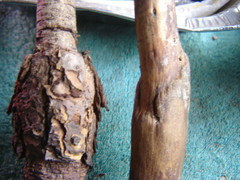
For your interest here is a picture of 2 dead (through neglect & lack of water) P.maximartinezii on P.pinea grafts. You'll see from the picture that I had the overgrowth order reversed in my comment above & it was indeed the stock bark which overgrew (my memory has long passed its juvenile vigor). The graft on the right has the bark removed & shows that although the union looks rough from the outside it is actually relatively smooth & appears very strong & quite compatible. I have no reason to believe that this combination wouldn't be viable in the long term. The young plants were very vigorous from memory & made 5' by their second year. These unions pictured were 4 years old at their untimely death of thirst & were still displaying full juvenile foliage in 8" pots.
- 8 years agolast modified: 8 years ago
"Yes the mature needles are short, stiffish & morph to grayish rather than the electric blue of the juveniles but the change is no more pronounced than the one which besets us as we lose our youthful beauty, firm skin, lush radiant hair & bright hopeful eyes to become old gnarled & twisted & end up as decomposing worm ridden stumps!"
And I'm a downer?
Maybe a form could be found that, like various other conifers, retains its juvenile foliage forever, or at least for much longer.
- 8 years ago
:) Yep you should have Sara & for good measure put some Mielichhoferia mielichhoferiana underneath!!
- 8 months ago
Just checking if any of you are still living?
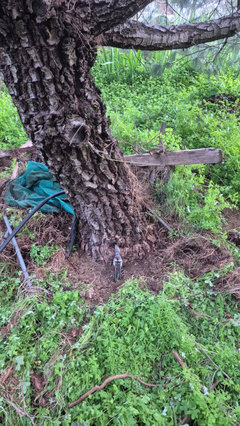
I have a remarkable update on this subject: A friend living only a few miles & a few hundred feet up (altitudenally) from me has recently revealed that he has a now mature Pinus maximartinezii well over 30 y/o which is from the very same batch of grafts (originally grafted by my late friend Peter Nitschke) illustrated as dead bodies above. It is about 2' thick in the trunk & the graft union is quite smooth though the now cracked & plated barks are so distinct in color & pattern that said union is very obvious.I recently set a few grafts from this tree, some on P.wallichiana & some on P.pinea a good percentage of which seem to have taken. Nothing too amazing about that I hear you say, however the 2 grafts on P.pinea are on 20y/o rootstocks, one which was still in an 8" pot & the other larger one had escaped the pot & was rooted in humus accumulated over concrete paving. The potted one is grafted at about 8' up on the tip & the larger one is grafted also on the tip but at 15' up. Whats remarkable is that the taller P.pinea was transplanted from the paving to a nearby circular walled garden bed completely bare rooted. So this 20 y/o Pinus pinea was moved bare root & then immediately grafted on the tip with a P.maximartinezii scion. The graft is still partially bagged & protected by shiny foil above but I am in the process of un-wrapping it day by day. If it survives ongoing I will publish photos etc. I also have video of the transplanting process. If anyone's interested I can post photos of the big P.maximartinezii which this spring was covered with male cones but I haven't seen any female ones. Mind you the nature of the beast is to fruit at the top of the tree & on the tips of the branches so it's going to be hard to spot untill they get big anyway. My strategy in grafting up high is to try to 'fool' the grafted trees into thinking they are older & taller to encourage them to cone in my lifetime. Many years ago I did the same with Pinus torreyana & sabiniana also on P.pinea with which they both made a strong & smooth union.
I also grafted 5 Pinus pinceana on P.wallichiana & they have taken & grown away nicely. I have put aside 40 odd P.wallichiana stocks to graft American/Mexican piñón species as although there is now a total ban on import of Pinus material to Australia I have a friend with a large arboretum in which many of them grow.
- 8 months ago
Peter_out...yes some of us are still alive! I suspect the plurality of prior participants here are merely not visiting gardenweb anymore. Its heydey is over. Of course, some of them could be deceased.
If anyone's interested I can post photos of the big P.maximartinezii
Of course!I wish I could teleport you to Maryland. I have some conifer grafts I'm going to have to attempt myself later this winter.
- 8 months ago
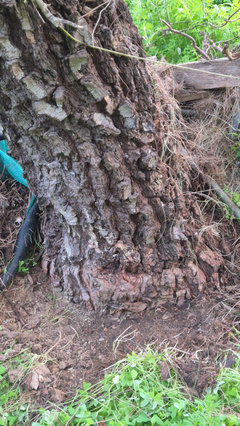
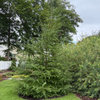
Base of grafted tree showing distinct transition from P.pinea rootstock to P.maximartinezii
- 8 months ago
Thanks. I see it, but it's really not too bad or noticeable. Nothing like this! https://www.houzz.com/discussions/6516394/the-first-time-you-notice-something-that-s-been-right-under-your-nose
Do we get a picture of the whole tree? - 8 months ago
Yep as soon as l can locate it amongst thousands, may be easier to drive up & take a new one!
- 8 months agolast modified: 8 months ago
Wow, this is an interesting bump -- I even commented, but don't specifically remember this one. Alot of interesting characters, some who have left. Whoever floramakros was, they were pretty persnickety.
PS To add alittle more pinterest (see what I did there), when traveling thru the central valley in CA, picked up a big Coulter pine cone, and put it on the fireplace shelf in VA. About 10 yrs later after moving to west MD, happened to look inside and notice 2 gigantic pine "nuts". Curious, in early spring, I soaked them in water a couple days, and planted out. Both of them sprouted, and in fact went thru the following winter and grew even more the next season! Unfortunately I didn't protect them, and during a cold event that succeeding winter, deer chewed them both to the ground.
- 8 months ago
I have the dubious qualification of having been knocked out of a Coulter pine by a falling cone from high up (the cone not me) l was about 6 or 8 feet up. . .the big spikes split my scalp even though l had hair back then & l bled like l'd beed shot in the head. . .an asian woman walking down the nearby road saw my blood soaked face from a distance & crossed to the other side of the road & scurried away not looking back :) The cone still hangs from my ceiling as a reminder of my near death P.coulteri experience!
- 8 months agolast modified: 8 months ago
@peter_out, tho I really have no chance of growing pinyon pines, I've always admired them as being so tough and drought-resistant. If fact, in many areas of the American great basin, they are the only tree that can survive on the bone-dry sandy slopes, averaging at most 5" annual rain. And they provided food for the native people (and wildlife) there, perhaps one of the only things that made those areas survivable.
- 8 months agolast modified: 8 months ago
Yes it took the first european settlers some time to understand the significance of the various piñón species of the west & mexico & that understanding has generally faded away into history. The piñón pines were the most important component of the environment perhaps after shelter to the indigenous people for thousands of years & vast areas were cleared for mining fuel & grazing in a single generation by short sighted 'invaders'. . . .in different ways similar shames were committed here in Australia. . . it seems it was the way of most areas colonised by Europeans so even though l'll never see them mature propagating these small hardy trees feels like a tribute to their cultural & environmental significance
- 8 months agolast modified: 8 months ago
Peter_out - are Pinus pineas very common in SE AU? Though I might have seen one 'here or there', they certainly didn't seem common in Melbourne; they should grow really well there...and one would think they'd be more popular for the picturesque form.
From what I remember, the common Northern Hemisphere conifers seemed to be...
Monterey Cypress
Cedrus deodara
and what I think were Pinus radiata in plantations
Here's a funny discovery in Google. A place selling larches as Christmas trees, "for the cooler parts of Australia". Could work because they will be in leaf in southern hemisphere summer! Otherwise, a larch would make an awfully strange Christmas tree.https://www.spruced.net.au/shop/european-larch-larix-decidua-potted-tree
- 8 months ago
P.pinea is very common in South Australia & until 30 years ago produced masses of seed but these days the cockatoos destroy them all before they can ripen. I have a mature one here but not a single seed in decades thanksvto black cockatoos. I used to pick up 5 gal bucket of seed in 1 hr back then now it's just shells. Well it's a bit warm for larches where l am, maybe in Tasmania. . .there's larches near here but in a very protected deep valley with damp soils. I agree, larches are a bit open foliaged for xmas trees. . mainly specially grown & shaped Pinus radiata are used here.
- 8 months agolast modified: 8 months ago
" I agree, larches are a bit open foliaged for xmas trees "
I think you forgot that in northern hemisphere winter, they'd be a bit non-foliaged for xmas trees.
https://westmoorarboretum.org/european-larch/
Funny about the cockatoos taking a few years (decades?) to figure out how delicious Pinus pinea nuts are. Are there other examples of the native parrots taking that long to learn about a new, northern hemisphere food source?
I can see them being more common in South Australia simply because of the perception that the climate is more 'Mediterranean' there, which it is...but they would be fine in almost all of Victoria. I did see a couple but, not widespread.
I have 2 small ones newly planted, so fingers crossed for a mild first winter to help them get established. One in North Carolina survived -9F in 1985, but I suspect they are going to be struggling for their first few years up here.

bengz6westmd