Software
Houzz Logo Print
janroze

straight vs curved paths

17 years ago

Do you prefer/have straight or curved garden paths and why? If you don't have the kind you want, what do you do about it?

I have a straight cement path on the E side of the house and I hate it. It would be too costly to remove. But there is more than one way to skin a cat (sorry cat lovers) and these are times to be creative.

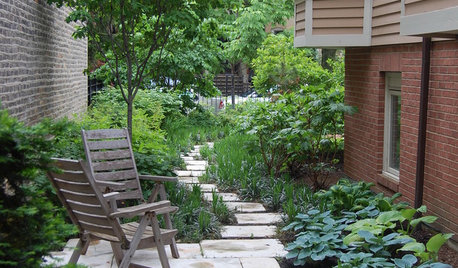
In this VERY narrow side yard, I am considering several things: instead of trimming plants to keep them off the path, I may encourage them to grow over it, in fact plant even more on both sides-not just the house side like now-and cover it completely, so visually it won't exist in the summer.

This will offer several opportunities: more space to plant; a curving path of stepping stones framed in pebbles,which I love, beyond this garden area; a wee bit more garden on the far side of the path with clematis, lilacs and an ornamental crab apple tree.

When the frost kills it all, I can clean the dead foliage off the walkway and still use the cement path for the snow blower to clear the way to the patio for hauling in fire wood. Plus, the snow will cover the stones, so it won't look like I have two paths side by side-at least most of the time.

What do you think? Do you have other ideas? All suggestions are welcome, even if you think they might be silly, they may be usable, in whole or part, for me.

gramma jan

Comments (17)

  • 17 years ago

    I have straight paths in front of my home. My yard is very small, and this keeps things flowing well - plus the straight path is historically accurate to the age of my home which has not been updated on the exterior since the 50's (and everything is pretty much kept to that 50's look). However, the back yard and new yard will all have less linear pathways. Not long meandering curves - again, I still want them more defined like they would have been in the 20's-50's here in the city, but more rounded...a circular path in one area, feeding a straight line into another area, then feeding into a more gentle curve area...I guess once you get in the back I feel the plants will be tall enough to do what I like. In the front areas which feature lower plants or more utilitarian paths, the lines are straighter.
    No matter what, I like spillage.

  • 17 years ago

    You can always use pavers to build small curved section along your path. A place to sit some containers, a bench, a tiny fountain. Or just an open space to stop and smell a certain rose.

  • 17 years ago

    I love curved paths ones you have to follow to see what is around the corner, the anticipation of what you might find makes them so appealing. I have one curved gravel path where I have planted welsh poppies and columbine right in the path along the edge, with grasses, black mondo grass and lady's mantle also planted in the gravel along the front edge of a small pool.
    Unfortunately the way the rest of my garden is laid out I have to deal with straight lines, but I've planted in these paths too, I think it softens them to some extent.
    The piece of garden I'm still trying to get the way I want it is going very slowly, the path from the pergola to the enclosed area (my secret garden) is fairly wide and straight so I definitely want plants that will spill into this path to soften the edges. One side of the path used to be my michaelmas daisy border, the other side is divided into two smaller beds.
    Something always seems to interrupt me just when I get my teeth into this project, I have to leave it and by the time I get back to it what I have done has to be done over.
    DH is going to help DS2 work on his cabin the later part of the month for a few days so for these few days I'll be on my own, please keep your fingers crossed for me that it doesn't rain, I plan to hang a gone fishin sign on the door, pull the plug on the telephone and hopefully get at least some of the work done.

    Annette

  • 17 years ago

    I've had a couple of those straight concrete paths before and they turned out to be a blessing in disguise. When I became ill, I was still able to get around a bit without too much assistance because the path was straight and flat.

    You can create the illusion of slight curves by planting alternating plants that spill over the edge of the path with plants that simply soften the edges. Cheryl

  • 17 years ago

    Sometimes a straight path is not a bad thing. We've read so much hype about 'curved' paths that we're seeing squiggles in tiny lawns that would be better left straight.

    When I'm going from point A to point B, I don't want to zig and zag, I just want to get there. I sure wouldn't want a meandering path for carrying in firewood, or dragging hoses.

    I like Tom's idea for creating a little bay along side a path. If the path is narrow, you don't want too many billowing plants hanging over, but they could flow over onto a curved area of stone or pavers and not be in the way.

    I was flipping through an old magazine this morning that had straight primary paths with diamond shaped stepping stone paths inserted into the overall plan across the straight paths. Triangles on each side instead of curves, so to speak.

    You could have circles across a straight path, too. Think of them as 'pearls on a string.'

    I love ideas for Making Pretty. Wish I had the stamina to execute all of them.

    Nell

  • 17 years ago

    I think both straight and curved paths look nice, depending on how they are used. I, and I am sure, tend to think of straight paths as being too formal for a cottage garden. But I kind of think it is a nice juxtaposition. The formal path lends some structure to a style of garden that can tend to be a little wild.
    But I do love curved paths the best. I love long and winding paths where you cannot see what is around the bend (wish I could create that!). And don't even get me started on woodland-y paths!

    I LOVE the idea of softening the edges of your path by planting things to drape and billow over. I try to plant close to the edge of my path to achieve just that (sometimes the plants don't always cooperate though, lol!).

    I also have a strange sidewalk in my back yard that goes from the backdoor to the slab of concrete where the shed is. It is a really stupidly made sidewalk. I guess the person that laid it out did not learn that the fastest route from point A to point B is a straight line, lol! It takes you twice as long to get to the shed taking the sidewalk than just cutting across the lawn! Not to mention the trees have started to grow in the way, so if you did walk the sidewalk you would get hit in the face with shrubbery. So this year I started putting potted plants on the sidewalk. I have terra cotta with basil, herbs, and eggplant. I love the look of it and will do it again next year.
    Make sure to post pics once you get your path done gramma Jan!
    CMK

  • 17 years ago

    GGG I know what you mean about small lots, that is part of the frustration in trying to achieve a curve on the side with the spillage many of us love.
    Token guy, I love your suggestions "containers, a bench, a tiny fountain." Sometime it pays to rethink. I used to think accessories such as that would make it too crowded. Now, I think the fountain or some med. sz'd attraction might be just the ticket to take one's eye off the long narrow shape by making you stop and notice in the middle.
    Midnight, I have my fingers crossed-sounds wonderful.
    Glad, I love the idea of 'Walker's Low.' Is it or lamium invasive to the point of killing other plants? I have always planted it in the pot.
    Sea, I hope you have the physical strength of the sea now. If not, at least the spiritual strength to give you courage through the tough time. I like your point and another reason to keep the concrete, but hide it for now during the summers.
    Nell, I had thought about breaking up the long straight path in that way too, if I understand what you are saying. I thought, briefly about taking a section out here and again to replace with something more interesting. Alas, it takes too much energy to even seriously consider.
    Oh tinny, you make me laugh. Long and winding paths on this lot--don't I wish. Don't you wonder sometimes what others had in mind or if they had one. Posting, that's another story. I may try again, but honestly, I find it very time consuming, probably cuz I am so lousy at it and also I need to learn from scratch, as I have forgotten. I drove everyone nuts with questions about "how to" the last time and hate to put them.,..& me through that again.
    gramma jan

  • 17 years ago

    I think what you have is Necessary, and it can be easily dealt with! Curving paths in the garden serve the purpose of slowing the eye down, in order to enjoy the view, appreciate the differences in plant texture, color, and form. You can work with the cement path, which you acknowledge is pretty handy, to take in the groceries, get to the woodpile, pathway through the snow from house to car in winter, etc. If you are able to, mark a broad, smooth curve in the grass on the other side of the walk, away from from the house, and plant the bed as though the walk exists for your convenience (which it does), in other words, don't let it dictate where your garden begins and ends! I like the idea of putting another path wherever you need one, in another material, like stone. That sounds pretty.

  • 17 years ago

    Curved paths are more romantic, but straight paths are more practical. I prefer straight paths, because they're easier with my garden cart and with the snowblower in the winter.

    One thing I tried this summer was to put an arch at the end of my path in the "fairy" garden, to give it a focal point and divide the area from the back yard. (It's really a shade garden for my nieces to play in.) I like the arch so well, I'm going to try one in the vegetable garden next year, to break up a long path. I can still get my cart through (we don't use the snowblower in this area) and it's nice to have the flowers.

    If it's a narrow path, an arch might work, even when hauling in wood, etc. The arch I have is 42" wide and about 8' tall, black metal with grid pattern on the sides. I got it at Fred Meyers and they're half off right now. Just a thought :)

  • 17 years ago

    Tall things can do the same thing curves do. They can block the view beyond making you want to go down a straight path. If you can see everything from either end, why bother going down that path unless it takes you to a place you want to be. I like curved paths in my yard. I have lots of room and there is ample space for the lawnmower. I'd like to have a more formal area, but more for gathering. I'm thinking of putting a patio off the rose garden. But you'll have to travel some curves to get there.

  • 17 years ago

    I've got lots of short straight paths going through the beds that separate my various areas of lawn. And, one long path with a curve in the middle going through a huge bed that wraps around a corner of the house. These paths are all made of dry laid flat stones so they look nice enough even though they don't curve much.

    My front yard has typical 3' wide, straight-as-an-arrow, cement sidewalks. I'm trying to soften the edges of these with plants, but not all the plants are cooperating.

  • 17 years ago

    When I think of straight paths, I think of strict structures like Italian gardens or Japanese home gardens. However in a narrow side yard, there's not that much choice but to create a straight bed but which you can create the illusion of curves by careful placement of cobble stones, statuaries, or jars, bench, trellis. If you put in the structure first before the planting, you can get a grip on how the side yard will look especially if you have a window nearby that looks out onto this area.

  • 17 years ago

    Hands down ... curved paths. They soften the look and add interest. Hopefully will have one to show off soon. Getting ready to build a brick pathway from my garage through the side gate to the lower deck in back. Right angle would be the easiest but I just can't do it. Bricks will match the walkway in front. The back will have all grass paths ... curvy ones, LOL.

    Judy

  • 17 years ago

    Judy brings up a good point. A right angle brick path is easier, but what happens to the right angle? Is anybody going to walk to the end and take a sharp right? No, they'll cut off that last few feet, right across the bed.

    That's the kind of curve that makes sense. Some university poured all the concrete paths after students made paths in the grass, taking the shortest routes.

    My doctor's office has a pretty planting of KO roses along the sidewalk that leads up to the entrance. People were taking a shortcut through the rose bed. When I was last there, the groundskeepers had placed a small concrete bench to stop traffic through the planting.

    Do you ever wish you'd made more walk-throughs in a long bed, or more access paths in a really deep bed?

    Nell

  • 17 years ago

    I like the effect of the curved paths - here is the gentle curve through my daylily beds:

    And here is the curve on the wide border that I am currently redoing along with the path:

    But sometimes straight is the best way to go: The path that joins front and back.

    {{gwi:749109}}

    kay

  • 17 years ago

    I love all your ideas and your pics of your garden paths look great. I know mine won't come close, but after reading everything here, I keep thinking of how I have been developing Tom's idea in my mind. I can visualize my straight cement walk with a stepping stone path bulge off to the side opposite the house. In it will be the bird house and bath, a sm bench and it will either sit on the edge of a tiny garden or on the edge of a "fairy garden" of miniatures.
    gramma jan

Sponsored
Peabody Landscape Group
Average rating: 3.5 out of 5 stars8 Reviews
Franklin County's Reliable Landscape Design & Contracting