Software
Houzz Logo Print
bevinga

Did you lose azaleas last year?

18 years ago
Hi,

I'm just wondering whether or not any of you lost azaleas during the summer drought last year? Mine are blooming/budding and I can tell which ones have died and which ones haven't...really I could tell before but was hoping for a tiny bit of life to still be in them for the spring. Not happening. I've lost around 7-8.

So if you lost some, are you going to try to replace this year or will it be futile to even try, considering that it's supposed to be another hot, dry summer?

Thanks!!!

Beverly

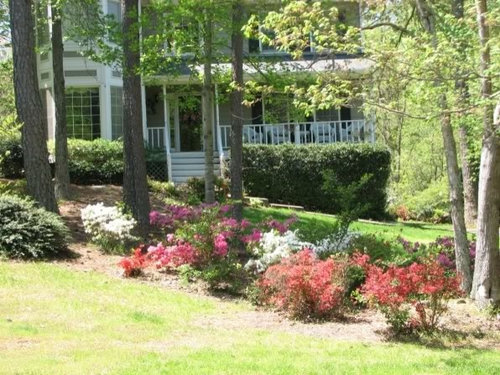
Here's my yard in 2006:

Comments (9)

  • 18 years ago

    Yup, I lost two. They were in a really bad spot to begin with, so I won't be replacing them in that location. 7-8 is more of a blow.

  • 18 years ago

    I lost one, and won't be replacing it. The intention is to build a shed where they are so I was planning to move them. I'm looking on the positive side - one less to move. :-)

    It does leave a small hole. If I were leaving them there, I'd probably replace it in the fall.

  • 18 years ago

    I unfortunately tried to add 5 more azaleas last year and lost all of them. I will not try again until the drought stops.

  • 18 years ago

    Oh dear, I have planted about 10 azaleas and 2 rhododendrons so far this spring, and plan to plant more of both, along with other shrubs. We bought the house last summer, pulled out a huge area of ivy in the fall and were left with just bare earth for a front yard. So I've been planting!

    This makes me really nervous. I was planning on catching veggie-rinsing water, shower water (the water that runs while I'm waiting for it to warm up, not soapy water), etc, and using that to water during the drought. We have a mostly shady yard in the summer (lots of tree canopy above). I'm hoping for the best, but maybe thats naive.

  • 18 years ago

    mayland, be sure to mulch them well (not too close to the trunk but spread it out wide). They need cool roots.

  • 18 years ago

    Thanks Esh, they are planted in a mix of potting soil and tree mulch (we had several trees taken out last year so had lots of mulch left). but I will add some additonal mulch over the whole area.

    Bevinga, your azaleas were beautiful - and looked well mulched!

    What is the best type of mulch for keeping in moisture -- bark chip or pine straw?

    And, does anyone have suggestions for flowering shrubs that are drought-tolerant and do well here?

  • 18 years ago

    And, does anyone have suggestions for flowering shrubs that are drought-tolerant and do well here?

    Keep in mind that even the most drought tolerant plant needs adequate moisture the first year to get established. Starting with smaller plants is a good idea as they will expand their roots better/faster than larger plants. Be sure to give them wider planting holes and don't amend the soil too much as they need to get used to the native soil.

    Native viburnums are very adaptable - Mapleleaf viburnum is perhaps the most tolerant of dryness, even dry shade. Viburnum dentatum is probably more widely available and comes in several cultivars. I have also had good luck with Viburnum cassinoides.

    Other native shrubs to consider: Ninebark (Physocarpus opulifolius and there are several wine colored cultivars), Elderberry (Sambucus species - although it is happy in moist areas, it does pretty well in drier conditions). I have purchased both of these shrubs at Home Depot in the past. Chokeberry (Aronia arbutifolia 'Brilliantissima') is also nice. All three of these shrubs can get big and they can sucker, so site them in a area that can handle that.

    As for mulch, I like pine bark, but my dog eats it so I do pine straw. Hardwood mulch is also good.

  • 18 years ago

    Thank you, Mayland. I always mulch with pine straw. Here, it seems to be a bit more economical and I've got a whole lot of mulching to do. I think that last year I ended up buying about 50-60 bales of straw. I probably won't do that much this year; I'm not going to put as much in the back as I did in the front. I have even more azaleas on the side (to the left in the picture) and in the back (you can barely see a coral and pink azalea on the right-hand side of the picture). I have been sick about losing so many, too. The 7-8 I lost are just in the front. I haven't really gotten out and counted all the ones in the back, although there's not as many lost in those areas.

    I thought about mulching with bark in 2006 but there were rumors that some of the bark we got here came from the "Katrina" area trees that were chipped up and some came with termites. I don't know if that was true or not, but didn't want to take the chance, so we stayed with straw.

    I planted four small rhododendrons two years ago and they did beautifully the first year. I thought they would be fine last year as long as I kept them watered on our alotted days...I lost all four of them. The funny thing is that I planted a larger one last year and it lived! At least I hope it is going to live...this will be its second year like the other four were and I've found a few dead limbs on it.

    Esh_ga...finding those dead limbs on my year-old planted rhodie...does that mean I'm probably looking at losing the whole plant, or do I just need to clip off the dead limbs and pray for survival? It's such a pretty white rhodie and I don't want to lose it!

    I have just recently heard that you don't need to amend the holes too much...I'm glad you mentioned that so now I know it's true. What was the older saying, "$100 hole for a $10 plant?" LOL!

    Thanks!
    Beverly

  • 18 years ago

    Bev, as far as dead limbs on the rhododendron ... the good news is that it is not a definite predictor of death. The bad news is that you'll just have to wait and see. In the meantime, make sure it has plenty of mulch and water as needed if we don't get rain. You can clip off the dead branches (clean the blades afterwards as always to prevent any spread of disease).

    Remember for azaleas and rhododendrons (both in the Rhododendron genus), plant them slightly higher than ground level to make sure they have good drainage and tease apart any circling or tightly packed roots, spreading them out to the sides when you plant it. "Soil conditioner" (name brand is Nature's Helper) is an excellent amendment for good drainage. Since the root ball will be slightly higher than ground level, apply a good layer of mulch (shredded pine bark or hardwood mulch) to cover the difference in the two levels. But don't get the mulch too close to the trunk.

    The link below is a good page on rhodos and azaleas.

    Here is a link that might be useful: Henning's Rhododendron/Azalea page

Sponsored
Miller Woodworks
Average rating: 5 out of 5 stars23 Reviews
Franklin County's Trusted Custom Cabinetry Solutions