Software
Houzz Logo Print
girlgroupgirl

Native Evergreen Shrubs for various locations...

19 years ago

Ok, maybe Esh will let us pick her brain about

some nice evergreen shrubs that are native.

We started with Mountain Laurel that buford mentioned.

And of course there is always mahonia which I happen to love. I just planted several on a slope in the back yard area which I am planning on going totally native. (I have lots more slope and many other areas - both sunny, part-sun, shade and part shade to fill up. Mainly for privacy!!

What else, and please also mention a bit about the shrub: height, where it is best situated etc.

GGG

Comments (2)

  • 19 years ago
    last modified: 11 years ago

    Well, I just happen to have a list ... I do include a few evergreen trees that have dwarf or narrow forms that might be suitable for some needs. If someone knows of others, please add them on.

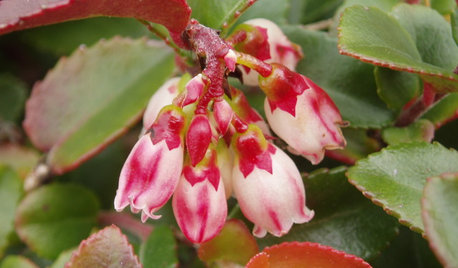
    Kalmia latifolia, Mountain Laurel: large shrub/small tree but dwarf forms are available (Elf and others). Shiny, handsome leaves and beautiful flowers that are attractive even in bud, extending the "bloom" time. No berries. Blooms in late spring. Morning/early afternoon sun with protection from hot afternoon sun is best. Shade tolerant but needs some sun to bloom best.

    Illicium floridanum, Florida Anise: medium shrub up to 10 feet tall but can be pruned for a smaller height. Aromatic foliage, red blooms and attractive star shaped seed pods. Handsome, glossy leaves that resemble rhododendron. Shade tolerant.

    Illicium parviflorum, Anise Tree: large shrub/small tree up to 20 feet tall but can be pruned to maintain smaller height. Aromatic foliage, white blooms and attractive star shaped seed pods. Handsome, glossy leaves that resemble rhododendron. Accepts more sun than itÂs cousin, Illicium floridanum.

    Rhododendron catawbiense: large shrub up to 10 feet. Pinkish/purple blooms in late spring, many cultivars available, including a white one (ÂAlbumÂ). Large handsome leaves. Shade tolerant but needs some sun to bloom best.

    Morella cerifera (used to be Myrica cerifera), Wax Myrtle: large shrub/small tree but dwarf forms are available (ÂDonÂs Dwarf is one, 4-6 feet). Aromatic foliage, small grey berries which birds eat. Tolerates full sun and partial shade.

    Leucothoe axillaris: medium shrub up to 6 feet but slow growing. Foliage is glossy and emerges reddish in the spring and bronzes in the fall. Tolerates moist, shady conditions like streambanks but is also at home in the garden. White flowers in late spring, no berries.

    Agarista populifolia: formerly considered to be part of the Leucothoe genus, this shrub is larger than Leucothoe axillaries, fast growing up to 10-12 feet eventually. Tolerates shade and accepts heavy pruning, even when used as a hedge. White flowers in late spring, no berries. Good candidate for shady evergreen screen when a tree is too much.

    Ilex vomitoria, Yaupon Holly: Tree and shrub forms, including a weeping tree specimen, ÂPendulaÂ. Several dwarf forms are available, including ÂNana and ÂSchillingÂs DwarfÂ. Small leaves, no spines, red berries which birds eat. Hollies are dioecious, requiring male and female plants for berries (can cross pollinate with other hollies that bloom at the same time, even if the plants are in your neighborÂs yard). Partial shade to full sun.

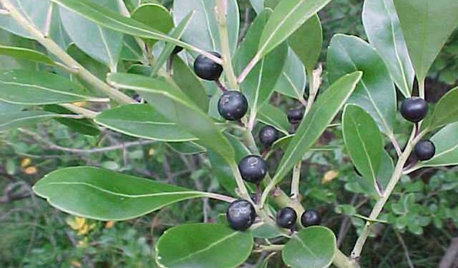
    Ilex glabra, Inkberry Holly: Medium shrub up to 8 feet, but slow growing. Cultivars such as ÂShamrockÂ, ÂCompacta and ÂDensa are available. Bigger leaves than Yaupon holly and no spines; blue/black berries which birds eat. Tolerates wet soil. Hollies are dioecious, requiring male and female plants for berries (can cross pollinate with other hollies that bloom at the same time, even if the plants are in your neighborÂs yard). Partial shade to full sun.

    Ilex opaca, American Holly (technically a tree): one dwarf form is available, ÂMaryland DwarfÂ. Typical holly leaf, red berries which birds eat. Hollies are dioecious, requiring male and female plants for berries (can cross pollinate with other hollies that bloom at the same time, even if the plants are in your neighborÂs yard). Partial shade to full sun.

    Prunus caroliniana, Carolina Cherry Laurel (technically a tree): can be a large tree (20-40 feet), but this plant is popular for screening and the cultivar ÂBright N Tight is widely available. Small white flowers and glossy leaves 2-3 inches long. Leaves should not be eaten by livestock. Tolerates partial sun.

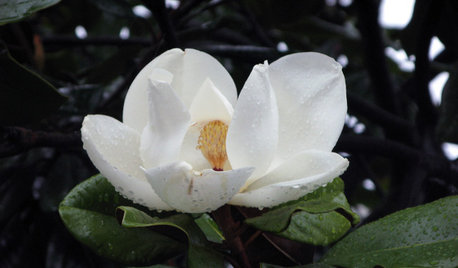
    Magnolia grandiflora ÂLittle GemÂ: smaller than the species tree, this dwarf still grows up to 20-25 feet at maturity, 8-10 feet wide. Full sun for best performance, but this will tolerate partial sun. Flowers at an early age.

    Mahonia aquifolium, Oregon grape holly: native to the western parts of the US, this is not a holly, it is actually a member of the barberry family. It can grow 7-10 feet tall in time. Looks best in partial shade. If you are planting this, be sure that you get M. aquifolium and not the imported Mahonia bealei which is naturalizing itself into unwanted areas.

    Evergreen shrubs that are not native include nandina and ligustrum/privet. These have become naturalized over time in the Southeast.

  • 19 years ago
    last modified: 11 years ago

    If you're into conifers...
    Dwarf white pine and hemlock or dwarf hemlock. They should be easy to find. A couple to add from the northern side of the piedmont. Since we're including Oregon grape holly, here's some more distant natives... Dwarf arborvitae, dwarf conifers such as dwarf blue spruce and dwarf norway spruce. Vanderwolf pine.

Sponsored