Software
Houzz Logo Print
laylaa_gw

Need ideas whats blooming now for bees

17 years ago

I am trying to make my property native bee friendly which requires having something blooming all the time. Right now I am in a bloom down time - in between spring and summer blooms, so looking for something to plant to help bees during this period. I have 4 viburnums, 4 Florida leucothoe in flower but that's about it. They are new plantings, small and need a few seasons to be valid for bee habitat. I'm not really a flower gardener (I grow woods) but might have to start. What is blooming in Georgia right now? Trees count, anything a bee can use counts.

My interest is in natives or native hybrids, non invasive. Thank you in advance!

Comments (29)

  • 17 years ago

    Right now I have Penstemon, Coreopsis, and Salvia coccinea blooming in the sunny area..

    Mountain laurel is also still blooming. Rhododendron catawbiense is just opening. Elderberry will be blooming soon.

    In the woods, I have Chamaelirium luteum (Fairy wand) and Tiarella blooming; Amianthium muscitoxicum (Fly poison) is about to bloom.

    You might find the bloom charts (for perennials) on the GNPS website helpful. Here is the Summer one, the spring one is linked below. Here is the Fall one.

    Here is a link that might be useful: GNPS spring blooming chart

  • 17 years ago
  • 17 years ago

    Mountain laurel is a good idea, thanks. I haven't planted any yet but intended to. There are several things on the verge of blooming but if I put up homes for bumble, mason and leafcutter bees, I want to calculate a continuous food source to the best of my ability. Everthing is new planting so dates will shift next year but I'll do my best.

    Sun is not something I have a lot of but probably enough for penstemon, which I love. There is also itea virginica and oakleaf hydrangea (Alice) in bloom. As far as the woods, they have been thinned over the winter (ongoing as IDs are made). I doubt the floor has seen a drop of sun in years, it has not been healthy, so woodland flowers are beginning to grow. Just starting to see what's going to be there but don't know if they will survive all the cut tree root fungus. Here's to hoping!

    The links to the bloom time lists give me a more precise idea on when exactly a lot of the shrubs here that are too young to bloom will do so in Georgia, thank you.

    humm...the UGA list surprises me. Ligustrum sinense? I just finally killed the last of mine.

  • 17 years ago

    Well, what makes bees happy doesn't necessarily make us happy and privet is in full bloom all over the place. I happen to love it and the way it smells but only have rotundifolium planted by me.
    And bees do love japanese honeysuckle and kudzu blooms so obviously you need to discriminate.

    Basically anything with a flower gets lots of bees at my house and the native red maple are among the first to bloom each year and will draw bees. Flowering trees, including hollies will be buzzing.

  • 17 years ago

    I'm sorry, I forgot to add what's blooming now: lavender, roses, salvias, catmint, azaleas, dianthus, annuals, and clematis are the big ones.

  • 17 years ago

    You're right laylaa, I do also have Virginia sweetspire and Oakleaf hydrangea blooming now. Hydrangea arborescens will be next. Also blooming (or finishing) is Hearts a Bustin'.

    Although most of viburnums have finished blooming, a very slow V. dentatum (species) is still not ready yet - perhaps a couple more weeks yet for him. I'll be curious to see if he sets any berries by his lonesome. In the past, he has set a few.

    Black cohosh is just making bloom spikes now; last year I had one that was very popular with bees!

  • 17 years ago

    right now in my yard i have blooming...

    - Delphium
    - Oak leaf hydrangeas
    - Virginia Sweetspire
    - Fothergilla (Mt Airy and Gardenii)
    - Dwarf Nana Coreopsis
    - Dianthus (two varieties)
    - Salvia (Rhea, I believe)
    - Daisy Gardenia (just starting this weekend!!)
    - All of our roses
    - Coral Honeysuckle vine
    - Petunias
    - Lady in Red hydrangeas (just starting this weekend!)
    - Heuchera "Silver Scrolls"
    - False Solomons Seal
    - Tiarella [foamflower]
    - Daylillies (we have 4 varieties)

    Blueberries just wrapped up 4-5 weeks ago.

    Grapes wrapped up "bloom" phase (if you want to call it that) about 2 weeks ago, and fruiting has been going on ever since, with some grapes around BB size.

    Fothergilla has dropped all of its last blooms over the past week.

    Mayapples also have been closing blooms over past 2 weeks as well.

    In the next 2-3 weeks, i expect to start seeing blooms on my Purple Coneflowers and Rudbeckia, along with my Anise. All of which are HUGE bee attractors, especially the Anise.

    That's about all I got for my house.

    Although I'm sure 1-2 others will come to mind that I'm totally missing right now :)

    WAIT! One more thing - go to the GNPS website, see the "Native Plant" menu items and click "Plant Charts" to see bloomers for different seasons. The link is here, just below this line...

    Here is a link that might be useful: GNPS website

  • 17 years ago

    Also, all three varieties of Ninebark we have on the side yard are and have been blooming for a few weeks now also.

  • 17 years ago

    I don't see very many honey bees around my garden. But there are a lot of Bumbles. But they are not attracted for blooms so far. My neighbor has some salvial blooming and he gets a lot of bumblers. I have wildflowers, daisies, potato flowers, squash.. but so far no bees. I guess too much rain dicouraged them or got their homes flooded (Grin)

  • 17 years ago

    I have lots of what you have all already mentioned plus:

    Larkspur
    coreopsis
    russian sedum
    gaillardia

    and not many bees either. A friend who is a fruit gardener has like two cherries on his Stella cherry as there were no bees to polinate for him! There are no blooms on his pineapple Guava either because of cool temps....so I think that would be an issue!

  • 17 years ago

    Maybe the bees moved? My nanking cherries and blueberries were pollinated to high heaven. I harvested about 500 cherries today. I think it has to do with my neighbor's holly tree blooms profusely in sync with them and it generates tons of bees. We have a strong crop on the blueberries too.

    The only thing I have seen a honey bee on all year was my salvia, and that was yesterday. I never see honeybees. I wish we had a hive near us.

  • 17 years ago

    I think my resident Bees are cooped up in their abodes, waiting for the rains to end, like yours truly!
    They have been very busy so far this spring, as I noticed the Hollies are overloaded with berries. The birds will enjoy their efforts this coming winter!
    They are missing a special treat right now, as the Confederate Jasmine 'Madison' on my rickety arbor is in full bloom!
    I also have thousands of other blooms waiting, waiting.....

    I have found that the native species of Aster are magnets for the European honeybee. I have a large colony of Symphyotrichum georgianum (Aster georgianus) on a dry, sunny hillside at the rear of my property and when they bloom in the fall, I have observed hundred of honeybees at one time, collecting nectar from them.

    I left, uncut, a couple of patches of Clover in my lawn, for the Butterflies, but none have appeared this spring.
    This is white clover and bees usually ignore it.

    Cool weather is descending upon us, so we may not see a return of the bees for a few more days.
    Rb

  • 17 years ago

    Forget to paste the string of plants in bloom back into my post. I cut those before invoking the spellckeck, because that dummy doesn't recognize Latinized English names and it speeds up the process to cut and paste them. A senior moment!

    Plants that are now in bloom...
    Aquilegia, Dicentra, Stylophorum diphyllum (few), Vaccinium darrowii, Lyonia lucida, Rhododebdron (hybrid native Azaleas), Heuchera villosa, Hydrangea (4 species, 2 native),
    Iris pseudacorus (I), and the non-natives; Epimediums, Spirea x 'Shirobana', Hosta, Begonia, Nerium oleander, Mandevilla, Serissa foetida, Camellia (few), Cornus kousa, Disporum sessile, Satsuki Azaleas, Disporopsis sp. and a small shrub that has panicles of pink flowers, whose name I can never remember! Plus, some KO Roses, whose ancestry is so convoluted that nativity could not be determined!
    Rb

  • 17 years ago

    Wow! Lots of great ideas, thank you! I forgot larkspur and delphiniums for the bee flower bed. Need more salvia - the pity! Now I have an excuse to feed my salvia addiction. The only one I have is container grown black knight, about to bloom. Coreopsis is just looking at me, healthy but no blooms.

    Lyonia lucida is blooming but about the size of a grapefruit. Not sure about this plant, really like it but it's the only one I have that's struggling, reacts strongly when there hasn't been rain for two days. It's one of the few evergreen shade tolerant shrubs I could find and hopefully future winter bird coverage. Agarista populifolia here should be the perfect bee magnet so I am really counting on it for this time of year.

    I haven't seen bees either and I have been looking. A few bumbles is all. I had far more bumbles last year. There is a large farkleberry about to explode into bloom which I plan to monitor that as an indicator of local population. Last spring was wet as well and we had a yellow jacket invasion, very few bees. Please, no repeats! Oddly even with the lack of sun I have had flocks and flocks of butterflies and moths.

    There is tons of false Solomons seal here, blooming is minor. Woods need some breathing time and next year will be better. Fothergilla, more oakleaf, mayapple are already on my to-plant list, black cohosh (Actaea racemosa? Beautiful plant) and ninebark were added. They are perfect for my environment.

    esh - Viburnum nudum has not bloomed for me yet. Winterhur will in the next few days, Count Pulaski lagging way behind. I'll have to re-work the nudums.

    satellitehead - you harvest cherries already? That's amazing. Cripes, I need some nankings.

    Hopefully my blueberries will fruit - I moved two 8' highbush late winter and they took it amazingly well, flowered. Hollies set berries fine considering they are new plantings, yaupons just flowered so we shall see. Wild cherries are fruiting insanely, so are native hawthorns. My one much loved, gnarly little native crabapple has no fruit but this is it's first year. Hopefully wax myrtle will fruit but I can not tell yet. All my berries are for birds.

    For anyone who may be interested in pollinators or helping native bees, I use the Knox Cellars Native Pollinators System Nester 74 for mason and leafcutters. It's very simple and effective without having to become a bee keeper, hives, equipment and all that. They also carry a beginner guide book and bumble bee house.

  • 17 years ago

    Clover! Last year, I had a patch of clover in my grass that was covered with sweet, fuzzy little honeybees! The clover has spread this year, and instead of doing weed and feed to encourage grass, I am mowing around the patches of clover and letting them grow. I haven't seen bees on it yet, but I am hopeful. Last year they loved it!

  • 17 years ago

    Ok, I forgot another one.

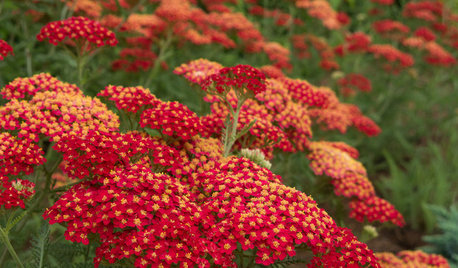
    Achillea. We have a fire-engine red/orange Achillea in the front yard also that is in full bloom. And it actually grows really well, I was quite surprised. There is a house near the police precinct (Zone 3) @ Cherokee Ave and Atlanta Ave in Grant Park that has Achillea as well, and Salvia if my memory recalls (that'd be a feat), they cut it down in summer and replant the driveway bed, as I recall. Never understood that. Guess it gets too ratty for their taste? Ours doesn't, it's been wonderful.

    The bees LOVE our Georgia Speedwell (Blue Border Speedwell?), it blooms similar in time and style to Anise Hyssop, although Anise reseeds like mad. We usually see more carpenter (bumble)(bees than anything, though.

    And oye, vey! The carpenter bees were out like mad this year. We have holes all throughout our eaves b/c of those little bastards. I walk out around the house every day and see sprinklings of sawdust throughout the ground and in spiderwebs. I can't help but think this is bad for the house, and wonder what can be done about it without hurting the little guys.

    @Laylaa, Thanks for the link on the pollinators, checking that out now.

  • 17 years ago

    I guess they were actually Carpenter bees that I'm having a problem with. I didn't realize that there was a difference between the two (they look alike!)

    Weird part is, the carpenter bees are boring holes in painted wood. Being that it's just the eaves and not a structural support, I guess I'll get over it, but ...

    I think I might try my hand with the Mason bees. That looks like a neat idea.

  • 17 years ago

    Blooming in my yard right now:

    Penstemon
    Iris
    Peonies
    Roses
    Clematis
    Delphinium
    Blue Cornflower
    Verbena
    Nandina

    I haven't seen too many bees so far this year, it's mostly been bumble bees buzzing around the Nandina.

  • 17 years ago

    this won't help you now but, since you mentioned nectar sources for every month, winter honeysuckle in my yard is a good plant for the honeybees in late winter/early spring. it is very popular with them on warm days when the highly fragrant flowers perfume the area and little else is in bloom except camellias (which are apparently ignored by the bees). i have a bee-tree in the woods so assume these come from very close by.
    i have been growing it for a number of years and never found a stray seedling. it is on tennessee's exotic invasive species list but no other southeastern state so use your own judgment if planting.

  • 17 years ago

    I doubt you did see offshoots. According to invasive.org, it is primarily spread into the forests (where it spreads happily, probably unnoticed) by birds and other animals that eat the abundant fruits/berries. It tends to pop up around disturbed soil, so if you haven't disturbed the soil around the plant, my guess is you wouldn't see too many shoots.

    FTR, Lonicera fragrantissima is not only listed in TN as invasive, it's also listed in TX on initial search. I would guess other states have it listed as well.

    Here is a link that might be useful: More info from invasive.org

  • 17 years ago

    jeff_al - hellebores bloom in for bee food, I use those, and bees (and yellow jackets!) do like my Winters Star camellias quite a lot. I have four huge ones, so that confuses me. Maybe they take what they can get?

    If by bee tree you mean Korean Tetradium daniellii, it is something I have opted not to plant due to it's invasive status. I do have plants bees like during beebee tree bloom time so do okay. A trouble free, sterile Hydrangea paniculata 'Unique' is an attractive option I have which works, blooms for me mid summer to fall. Plus Tetradium daniellii would just look odd in my American woodland. :)

    satellitehead - the mason bees are extremely easy. Twice a year maintenance is all it takes, and it's fun to see their little mud plugs show up in a house. Get the book, you'll be an expert in no time.

    Thanks for the lists everyone, it's actually been a huge help on my micro-climate bee project.

  • 17 years ago

    So many good ones already listed; the only one I have to add is the native baptisia. Mine have already started to bloom, and I have seen a number of bees hovering around them.

  • 17 years ago

    never said i found no "shoots" but found no separate seedlings. it is not a vining plant like l. japonica and does not run. the clump has expanded somewhat from the central base but that is it as far as invading around my area. i'm not trying to encourage anyone to plant invasives but just giving an observation from experience. i walk the woods around the house regularly and don't find strays of this plant there. very few seeds mature on my plant and i pick them off. they are easy to see when they turn from green to red.

    layla, i meant i have a bee hive in a tree in the woods. they took up residence in a cavity of a live tree several years ago. that is what i meant by "near by". i guess they ignore my camellias in winter since most of them are c. japonicas in rose-form, formal-double or similar and don't have the open shape with exposed stamens. my c. sasanquas that bloom in the fall are attractive to insects, though, since they present the pollen in a more easily accessible position.

  • 17 years ago

    jeff_al -

    i'm not trying to encourage anyone to plant invasives but just giving an observation from experience.

    I personally did not take your posts to mean you were encouraging planting anything invasive. I also am not of the opinion that "native" instantly means "great". Native muscadine grapes, smilax and cherry laurel, all of which some people love, are plants I would not grow for anything. All are invasive in my micro-climate. My garden is designed for wildlife and all three are outstanding for this and still I won't let them near my property. Had horrid problems with all, while my non-native goumi has never given me a moment of trouble. Your own observations count.

  • 17 years ago

    Bees love my (nonnative) hollies (one of them looks like burford holly, the other is unknown). Perhaps some of the native hollies? Ilex glabra (inkberry) blooms around now, I think. Maybe i. vomitoria (yaupon holly), too. The females make berries.

    Mike

  • 17 years ago

    Also: sourwood (oxydendron arboretum) blooms in June. Bees must love it since you can buy sourwood honey. It's a beautiful tree, in bloom or not and nice red fall color. Of course it may take a few years to establish.

    Mike

  • 17 years ago

    I keep hoping to find a sourwood tree as I ID things around here. Beautiful plant. My whole world is on the "few years to establish" plan right now anyway. :)

    I have NO BEES. It's making me nuts. For the first time in my life I hand pollinated some berry plants. This area has every reason to support a wild hive or at least loner species. I have no toads either which is strange. I spray nothing, people around me don't either thank goodness.

  • 17 years ago

    Talking about bees, today I noticed that a lot of them honey bees were out, but mostly on clovers and none on my flowers and plants.
    In liue of working bees I have been polinating my cukes and squashes myself. Otherwise I won't be getting any fruits. So far so good. With the tomatoes I don't worry too much because their flowers are hermoaphrodite. Wind and breezes can do the jobe. Even ants are good. But with cucurbitas, having separate male and female flowers, often far apart, you would definitely need bees or you have to do it yourself.

    Cyrus

  • 17 years ago

    Right now the bees are crazy for the wild roses growing along my fenceline. I'm not sure what kind they are, I doubt they are multiflora, because they are so double, but they've been in full bloom for about two weeks now.
    In general I find that the best way to keep the bees around is to let the "weeds" grow and bloom more or less freely in the areas that I am not actively cultivating. Of course not everything gets to stay-e.g. ivies and such, but for the most part there is always something in bloom, usually a volunteer, to keep my resident bees (mostly carpenter bees and wasps) happy and well fed.

Sponsored
Peabody Landscape Group
Average rating: 3.5 out of 5 stars8 Reviews
Franklin County's Reliable Landscape Design & Contracting