Software
Houzz Logo Print
civicminded0400

Cold Nectar and Hummers

18 years ago

I keep one gallon of nectar in the fridge and use it when I change out the feeders. At first I was worried that the cold nectar could have an adverse affect on the birds and would only put it out at night so the nectar could warm up overnight. One afternoon I was home so I changed out the feeders and the birds didn't seem to mind the nectar being cold. It almost seems when I first brought the nectar out the birds visited more often for a while. I suppose it doesn't hurt them?

Comments (23)

  • 18 years ago

    My thoughts are not wether its cold or hot , but when Its been in the sun for a while the nectar proerties begin to change , so the fresher the nectar the better.

  • 18 years ago

    I mix the nectar up in 1 gallon jugs and keep it in the fridge too. I've wondered if they wouldn't like it cold, but I've never really noticed them preferring it one way over the other.

  • 17 years ago

    hummmm....thinking cold kool-aid or warm!!

  • 17 years ago

    I do the same about keeping a gallon jug of nectar in the fridge and using it to refill my two feeders in an alternating pattern. During the heat of the summer, the hummers seemed to prefer the cold nectar to the nectar in the feeder at ambient temperature. I figure they, like us, prefer cool things to warm things when it is in the 90s outside.

  • 17 years ago

    I too think my hummers like cold nectar...when I change the feeders, I always have one or two hovering waiting for me to hang it back up. I think they like to cool off whenever they can, and cold nectar fits that bill.

  • 9 years ago

    tbug666 The correct mixture IS 1 part sugar to 4 or 5 parts water which is comparable to that of natural flower nectar! More doesn't mean better and can negatively impact a hummingbird’s metabolism.

  • 9 years ago

    Arin Flinn Not necissarily true. I have many plant species that match or exceed the 1-3 ratio, and they are first on the menu when the hummers come to feed. I mix 1-3 during migration, breeding and egg incubating. When the babies fledge, I switch to 1-4 to encourage the fledgies to explore flowers (like they really need my help!). Flowers have natural minerals and other substances that boiled sterile solution does not. I switch back to 1-3 during fall migration, to give them a little extra for the long voyage and cooler nights.

  • 8 years ago

    I put out feeders this year for the first time. I only have 3 up right now and they’re going through about a gallon a day. There are too many to count. We live in the woods in Oklahoma. I’m going to put more feeders but can they be fed too much or will they stop before that happens? I’m not kidding there are so many my husband says they’re becoming a nuisance but I love them. There are green ones and some with red ring around their neck.

  • 6 years ago
    last modified: 6 years ago

    Wetlands & Wildlife Care Center

    http://www.seaandsageaudubon.org/BirdInfo/BirdProblems/HummingbirdCare.pdf

    So now I’m horrified after reading the above link.... I’m can admit here, that over the course of 6 years I may have probably unintentionally Slowly Killed many hummingbirds by my lack and total ignorance, by not properly finding the right information that I should have been following. “Fungus Infections”from improperly maintained feeders correctly WILL KILL (not maybe) your hummingbird a slow agonizing death! Read that again... slow agonizing death if not properly maintained. When I started, I was only googling what and how too feed them. the rest I thought a no brained (Food 4:1) and wash the feeder out WHEN super low or EMPTY during the winter and when summer empty it out about every four days and refill.... WRONG! The food Ratio is correct, but not the rest of that story. So, winter is here again and I was shocked to find I have a Rufous at my feeder this winter, normally he should be gone months ago with the rest of them. I haven’t seen the female around, so I assume he’s a stray... so I don’t know why he’s here except for the possibility... it’s because of the fires in California, since that’s approximately where he supposed to be. Anyways... I was googling about my Rufous and what to do differently if anything and what is TOooooo cold of liquid in temperature wise, that is comfortable for a hummingbird to drink in these temps or should drink... that one is still a HUGE mystery and I’m still searching the internet for that answer. Just because your liquid isn’t frozen does NOT mean it’s ok to drink. If your hummers drink too cold not frozen liquid it could cold stun your hummer. In areas where the nighttime temperatures only dip slightly below freezing your hummingbird nectar may not freeze as the sugar solution has a lower freezing point than plain water. However, it's better not to have your hummingbirds drink very cold nectar; this can actually cold-stun them. But during my search, I came upon the experts from Wet & Wildlife Care Center.... that’s when I found out I was a possible serial killer of hummingbirds. The only things I did 100% correctly from another national wildlife site was 4:1 ratio & what I do in the winter time for my hummers. I bring feeders in the house, and then put them back out just before sunrise... if it’s below freezing I put hand-warmers under the two wool socks I put on my feeders in both sides of the feeder. Hummingbirds are often within a couple of hours of starvation and death. They have to feed every 10 to 15 minutes, and need to find food almost immediately after waking up in the morning, or they can die. Hummers are set to sunrise like clock work. “6:45am-8:00 am” depending where you live.

    So during nighttime temps below 38*degrees I bring Feeder inside. Remember.... “Your Hummers are hungry and cold”, DON’T WAIT in the winter to rehang them back outside if not at sunrise... if you do your going to have dead hummingbirds on yours hands. They NEED to eat as soon as they wake up after coming out of torpor state. If you take their food away at night, you best be setting your alarm or just leave it outside if you can’t. Don’t kill your hummingbirds, because your too lazy to get up early, they are a precious gift that keeps giving. This winter I have around 12 Rubies and one Rufus, and during the summer around 30+, Rufous, Anne’s, Calliope, Black Chinned, Broad-tail (fun to watch them expand their tail, just like the Rufous, too make themselves look bigger) I have some hummers I have yet to identify but will one day. I love... love... my hummingbirds! I will take better care of changing time and washing the feeders more diligently then before I don’t want to be responsible for a slow death of my hummers and their babies. It horrifies me to think that I was that negligent in their care. No more cutting corners and don’t fill to the top, fill half full or under in summer time (eyeball it) and diligently clean soap and HOT water every two days, Winter every week.... this is where I screwed up for six years. Awful care in my part after reading this article from wildlife on hummers. Just remember temps do matter and great hygiene is the key to a hummers life. Good luck!! Stunned hummers link:

    https://www.worldofhummingbirds.com/firstaidstunned.php

  • 6 years ago

    I doubt the temperature of the sugar solution is of any concern to the birds. It certainly doesn't seem to be in winter, as my resident Anna's are at the feeder first thing in the morning and as long as there is light. The sugar solution will not freeze unless the temperature is well into the low 20's, which is rare here, so I never bring them in at night. Certainly the nectar in winter flowering plants they visit is not heated but at whatever the ambient air temperature is so why not the feeder nectar as well?

    btw, not putting out a feeder in winter for year round hummers is not a death sentence! They would not be wintering over in your area if the temperatures were not suitable and there were not plenty of food sources. If hummers had to rely only on humans as a food source, summer or winter, they probably would be extinct!

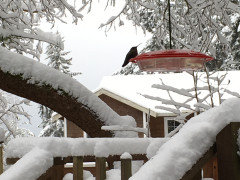
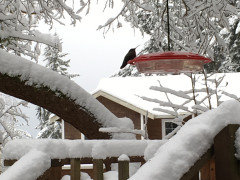
    This one of my favorite photos to illustrate that hummers - Anna's in particular - have a huge tolerance to cold weather and cold feeder syrup :-))

  • 6 years ago

    Yes, if you stop feeding your hummingbirds in the middle of winter... you will definitely kill some hummingbirds that wake up and rely on your feeder that you started. Don’t start and stop, start and stop during winter. To say you won’t kill your bird In winter is a false statement. you may not kill all of them... but you will kill some of them. I have been feeding my hummingbirds all year round for 6+ years and winter is brutal for hummers. I left town last winter for four days and gave the Responsibility to my husband and son, and on my return I had three dead hummers on my deck. I was furious that they didn’t feel as strongly as I do about taking care of my birds, they left the feeders out 24/7 and two of my feeders were empty out of 8 feeders. I have a enormous amount of hummers all year round, so I do know what happens when there is not enough food or when you quit feeding them. Summer is totally different, since they have an abundance if options available to them. So I argue that assumption that if you stop feeding your hummers during winter if you started feeding in winter, that you won’t kill your hummer if you stop... is completely wrong and dangerous Information to the life of your hummingbirds. Dont quit feeding during winter!!!! Just don’t!

  • 6 years ago
    last modified: 6 years ago

    I have no idea where you are located or what kind of hummingbirds you are referring to but dead hummers from lack of consistently full feeders in winter is just not a correct assessment!! They do not rely just on feeders if they overwinter in your climate.....if there wasn't an adequate source of natural food year round, they would not be overwintering there at all. In fact, they likely do not rely on them at all and just consider them an easy to access treat! In winter in particular, a very minor portion of the Anna's diet is nectar - most of it is insect-based proteins. In fact, a number of ornithologists estimate that spiders alone account for 60-80% of a hummingbird's diet regardless of the time of year.

    Suggest you check your facts a little more closely before making statements with such certainty.

  • 6 years ago

    I did check the facts and you are correct that that is not their only source of food. But that is not what I’m talking about, did you read the literature I provided? Every literature I have read, says don’t stop feeding during winter if you have already started feeding them. They rely on the sugar water during scarce food in winter time, it helps them get through the winter. I’m not trying to argue what they’re total diet is, it’s not just a treat, it helps them get through the winter on top of their diet. I think the wildlife information pages wouldn’t tell you what you should be doing with your hummers if it wasn’t true. When you put up a feeder, you are providing them an easy access to only the sucrose part of their diet. This is very important when flower nectar is in short supply. Hummingbirds expend energy very quickly. They are always just a few hours away from starvation. Feeding hummingbirds is a very important part of being able to watch their antics. It can be quite amusing for you, and life saving for them. Hummingbirds have such a high metabolism and need to drink lots of nectar every day. In some cases, especially during migration, a well placed hummingbird feeder can be very important to their very existence. So, in a sense, feeding hummingbirds is not only rewarding, it is also public service to the hummingbirds. please for anyone interested go to:

    Wetlands & Wildlife Care Center

    http://www.seaandsageaudubon.org/BirdInfo/BirdProblems/HummingbirdCare.pdf

    and link:

    https://www.worldofhummingbirds.com/firstaidstun and make an informed decision by clicking on the tabs. Good luck and enjoy your hummers throughout the year.

  • 6 years ago

    But my point is that where hummers overwinter naturally, there is not a shortage of non human-provided food sources. Otherwise, the birds would not remain here during winter. Feeders are a great supplement but they are not the reason the birds hang out all winter. Here in the mild coastal area Anna's prefer, there are a number of native plants that flower in winter that the hummers favor, as well as scores of more exotic ornamental nectar producers planted in area garden - daphne, sweet box, winter honeysuckle, heather, witch hazels, Mahonia, camellias, winter blooming clematis, hellebores. I still have hardy fuchsias in bloom in my garden!!

  • 6 years ago

    I was searching out the same question bc my husband poured cold nectar, that I’d made, in the feeder and said it wouldn’t hurt them. But what I found out is that it stuns them. I’m supposing it’s like brain freeze. Not certain of anything, just what I found.

  • 6 years ago

    I'm curious too concerning sugar water stored in fridge, not to warm it in microwave bc it breaks down the molecules, dont put cold nectar out bc hummers will be stunned, how long to let the nectar warm up from the fridge before it begins to go bad to place it in feeders?

  • 6 years ago

    Heavens!! This is not rocket science :-) Just let the nectar sit on the counter for a while until it approaches room temperature. Or at least loses some of its chill. Outside in summer temperatures it will lose any chill plenty fast!!

    And I'd appreciate an explanation of why microwaving - which I don't think is necessary for warming but is a perfectly acceptable way of making simple syrup that is the foundation of hummer nectar - is deleterious.

    btw, since I entertain hummingbirds all year long, I have never found cold nectar - even icy cold nectar - to be any kind of a deterrent to feeding or something that shocks or stuns the birds.


  • 6 years ago

    Great, thank you, love the hummers & would hate to harm them

  • 6 years ago
    last modified: 6 years ago

    I think where the confusion is, is at what temperature is the liquid too cold for your hummingbirds to drink “comfortably”, without stunning themselves. I’d say 40’-37’ degrees to be safe, is a good number to fall back on temperature wise.

    Really, It’s the temperature outside that should dictate, on how you take care of your hummers.

    Winter time for the last 7 years now.

    As a Rule for me... since I feed all year round, is if temperatures keep dropping below 37’, this is what I do.

    1.) I wrap my feeders in winter, with double red wool socks, during low temperatures, that stay at around 32’ or lower. It helps to keep them from freezing throughout the day. Less work for me.

    2.) 37’ or below, I bring my feeders in every night, and set them on my counter in a cool spot. By morning they are room temperature, and then I rehang them right before sunrise.

    3.) If it’s colder than that... say around the 20’s all day, I put hand warmers under the socks, to keep from freezing, or I will rotate my eight feeders, by taking one or two inside to room temperature and so on.

    4.) I can’t state it enough.... clean... clean... clean your feeder regularly!

    Summertime

    First good News is that your refrigerator temperature of hummingbird liquid WILL NOT stun your hummingbirds, when you take it out to feed them... unless your refrigerator is freezing your milk (good indicator), IT’S NOT too cold to use as is. In the summertime the cool liquid from your refrigerator is perfect! They’ll flock to it!

    (Make sure that your stored liquid has a secure lid, so your not getting any smells or bacteria coming from your refrigerator mixing in with your liquid)

    Note: I hang in really shaded areas, clean them now every 2 days in the summer, with light soap and water. And depending on how many birds I have, I only fill them less then half full. Otherwise, I’m just wasting liquid that I pour out every two days. If temperatures exceed 65’-70’ You have to make sure you find a really shaded area, so their liquid isn’t directly in the sun and heating up throughout the day, otherwise It will go bad. So, check on it, on extremely hot days... you might want to change it out more regularly in temps that are continuously above 90+

    Hummingbirds are susceptible and die of a slow, agonizing death from beak rot, from dirty feeders with bacteria living in the feeder where they drink .

    After reading heartbreaking literature about cleaning, I have made some changes. I take that opportunity, to wash my feeders every 3 days during winter and every 2 in summer. Some clean every 5-7 days in winter and summer.... that is wrong... wrong.. wrong. I wasn’t that bad on my cleaning schedule, but I should have been cleaning them more frequently, especially during summer! Hope I helped with some of the questions on this feed.

    here are two good sites

    https://www.seaandsageaudubon.org/BirdInfo/BirdProblems/HummingbirdCare.pdf

    https://www.worldofhummingbirds.com/nectar.php

  • 6 years ago

    gardengal48 I have that same feeder, just curious if you tried that brand or style in a different color? I bought the purple one, same style. The cashier at the bird shoppe said hummers didn't care. Well my hummers do. I'm going to trying and exchange it for the red, but just wondered.

  • 6 years ago

    This is probably the 9th or 10th feeder I've had over the years that looks like that - or close to it - but I can't say as I've seen any other colors than the red garnished with yellow. And sometimes with a bit of green :-)

    But the birds are attracted to any bright colors - yellow, orange, pink, purple - in addition to red, so they should be visiting your purple feeder as well. Sometimes they just need to get used to something new............

    Come to think of it, I did have an all yellow feeder once and a blue blown glass one.......didn't seem to make any difference.

  • 5 years ago

    Hummingbird researchers reported that the birds did seem to like the 3 to 1 ratio, but when they collected hummingbird urine and tested it, the one that were getting a 3 to 1 ratio of water to sugar had kidney damage. Please just feed them the 4 to 1 ratio. Everything else you do for them is great.

Sponsored