Software
Houzz Logo Print
jayco_gw

Staking a weeping Japanese maple

19 years ago

I have a three-year-old 'Green Mist' which I kept staked last year in order to make sure it would keep an upright leader before doing the weeping thing. It's now about 2 feet tall. Can I remove the stakes, or do I need to keep making them higher to keep the trunk upright? Sorry for this ignorant question, but I've never grown a weeping small tree before. Thanks!

Comments (19)

  • 19 years ago

    You will need to continue staking until the desired height is achieved. Some limbs may venture upward by chance, but if left untrained they will grow quite random and crooked. More than likely the new growth would fall over and begin to weep almost immediately (unless it is an unusually small amount of growht).

  • 19 years ago

    Thanks-- but I'm still a bit confused. The tree came to me already in a weeping shape, an upright leader which then curved downward. So I staked it at the uppermost point of the vertical part. So do I keep trying to inch that up, or will it grow taller as the tree grows? In other words, did I make a mistake by not trying to make the weeping portion of the leader stand straight up when I first got it?

  • 19 years ago

    (Stake to desired height) answers all your questions.

    Dax

  • 19 years ago

    It will inch higher over many years, but only in a small proportion to the amount that it will grow horizontally. Some weeping cultivars can grow upright more than others (such 'tamukeyama' or 'inaba shidare' as apposed to 'crimson queen'), but generally they all need to be staked to the desired height and allowed to weep.

    There is a bit of random growth that can put some height on the weeping trees, but it is unpredictable and unreliable. Therefore, it is recommended to stake the longest limbs (assuming they are small enough to be bent) up to the desired height and allow cascading branches to grow from this leader. Any unusual upward growth can then be trimmed off if it gets too high.

  • 19 years ago

    I thought part of what determined how upright or weeping a tree became was the graft? High versus low? Or am I woefully mistaken?

    Please educate me!

    melanie (with the damaged Aconitifolium a few posts down...)

  • 19 years ago

    It's been in a weeping shape ever since I've had it, and I didn't yank up the weeping portion of it right away -- was that what I ought to have done? Because now the weeping portion of the main stem is about 1/2 an inch in diameter and is quite stiff. I feel I would have to mangle it to get it to stand up straight, and it's doing so well, I would be reluctant to mess it up.

    Would it be possible to coax another branch off the main trunk into growing more upright instead? Or does it have to be the leader? Forgive me for the ignorant questions but I've never trained a tree before.

  • 19 years ago

    mattlwfowler--

    Thanks for the info. I learn something new every day! I work at a garden center...most of the JM's at the center have the low graft you describe, but the tallest 'Tamukeyama' has a high graft, which is, indeed, hidden by the weeping growth.

    My 'Waterfall' has a low graft...as does the 'Viridis' I covet.

    I don't think the GC buyer has found a commercial nursery that propagates soley by rooting cuttings...and my guess is that even if we did, the price point would be too high. Customers already gasp at the prices of our JM's...and I think the prices are pretty reasonable. All about educating the public, I suppose.

    melanie

  • 19 years ago

    Matt, thanks for that post. It was very helpful. Here is a picture of the tree:

    http://www.michaelstiller.com/jayco_maple.jpg

    I think it has a very pleasing form right now, and I don't want, in my inexperience, to ruin it. I really love this tree. So what would you advise? Would you take one of the branches near where the leader starts to weep, and stake it up? Or just leave it? I think I would like it to get maybe six feet high and make a mounding shape.

  • 19 years ago

    Oops, I didn't get that right, try this:

    Here is a link that might be useful: {{gwi:1041374}}

  • 19 years ago

    Hard to say...I would personally leave it be as it doesn't look like there are any limbs that could easily be trained.

    It will be a long time before 6 ft is achieved, but it should eventually get there.

  • 19 years ago

    I don't know what you have wrapped around the trunk ( if I am seeing right)...or why ( rabbits??) but i'd get that off pronto...cage it if necessary ... many JM's.. I might say most have thin bark and you are putting out a welcome sign for fungal bark disease and bugs..it is not advisable IMHO to do such... David

  • 19 years ago

    Thanks, David. I did put that on because rabbits had eaten off some of the bark. It is relatively loosely wrapped perforated plastic. But I guess I should take it off and put a cage around the trunk. Does anyone know how old the tree has to be before the rabbits will leave it alone?

    Thanks again to everyone for your replies, which are very helpful to me.

  • 19 years ago

    When the bark is mature, like as in a mature, tree.

    At nurseries, the bark guard is left on until spring and then (put back on the following fall).

    David's 100% correct and it's done with not just Japanese Maples, but all deciduous trees. I only cage plants in the spring through fall that are too small and can be stepped on or hammered by my dog chasing a ball or something... or kids. Even at the growing fields, cages and bark protectors were not placed on/over conifers. That's still playing russian roulette though per the saying goes... political correctness now-a-days!!! And I'm German/Swedish/English just in case anyone wants to "cap" ON me!

    Dax

  • 19 years ago

    Thanks, Dax -- so you're saying it's okay to use the bark guard over winter? I don't get why it would be bad over summer but not over winter? Can you clarify? And what kind of cages do you recommend? Can you just make a collar of chicken wire or somethinng? I'd rather not cage the entire tree, because then I can't enjoy it!

  • 19 years ago

    I will let Dax answer this although I agree with him over the winter only ...But you have more of a plastic wrap type guard ...if I am seeing right wrapped around snugly ... that wiould not be good either summer or winter ...but the hard plastic springy stuff with holes is ok in winter ..I appologize if thats what you have ...but the pic looks like a thin perferated platic wrap ..that would not be good at any time. David

  • 19 years ago

    I didn't even look at the pic. I answered soley on David's post and he already answered the question to mine or anyone's satisfaction. Tomato cages for "your own personal situation" are sufficient. That's what I use and at all heights. Be sure the kids if you got em (I do not) are aware of the sharp edges that can be created on any fencing material - well maybe not chicken wire.

    Dax

  • 19 years ago

    MatWlFowler,

    I am interested in the wiring you mentioned above.
    Do you happen to ahve a source where I can read more about it? I'm searching as I type, but it's always nice to have a recommendation.

    I have over 100 JMs, some of which I want to train taller (I've got them staked) while they're in their tiny, 12'' to 2' size. That way, in my odd space, I can plant underneath them.

    Thanks for your time,
    Christine

  • 19 years ago

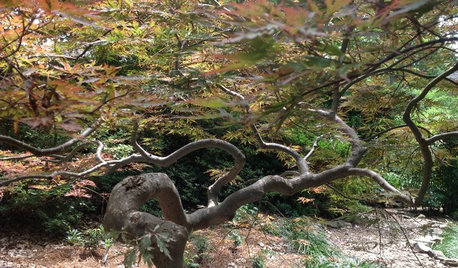
    Stake Away! Yes, you most certainly can. Here is one of our maples, a Crimson Queen that we purchased 25 years ago in a 5-gal. can. About once a year we made sure there was a branch headed up, and tied that (loosely) to a thin bamboo stick, tied to the trunk. Ours looked much like yours at first with a couple rather thick branches headed sideways, and this poor little skinny branch held upright with a chopstick. Eventually the leader gets thicker. A couple times when we selected a new leader it snapped off, but then we found the next best one. You need to do it when you have a supple little branch.

    These two photos started out mega pixels, and I dumbed them down to under 60kb to post here. I hope you can see in the close-up how the trunk has formed over the years. The first pic has chicken wire up, as raccoons have come in recently to decimate the baby tears ground cover.

    {{gwi:1041375}}

    {{gwi:1041376}}

Sponsored