Software
Houzz Logo Print
andi3216

new hosta bed...mulch...foundation?

19 years ago

I know this question may be better suited for a different forum, but I like you guys and am curious what you think... I want to add a large hosta bed to our front yard. The garden would be up against the foundation of our house. My husband's concern is that he was told that it is not a good idea to put mulch up next to the foundation because of the dampness, ants, etc. Currently we have landscaping rock with plastic underneath (no plants!) there. We'd remove it (I know - lots of work!!!) and then plant the hostas with a mulch around them. Have any of you done this or have this already? Any thoughts, ideas, suggestions???

Comments (21)

  • 19 years ago
    last modified: 11 years ago

    We like you, too, Andi---already!! :O)

    I'm doing that, myself, right now! I think if you stay below the brick line you'll be okay! You know, if you have brick
    it usually is sitting on a block foundation! If you have siding, I think it'd be the same, just stay well below it!

    I haven't gotten the mulch and compost in it yet, but I'm hoping I will before long! You know, I just realized we have
    that situation in our backyard already and it's never presented us with a problem! But, it is below the brick line!

    Love to see YOUR results--when you're done! Also, loved your *family* pics. on 'the other side?'

    Below is a link to a thread where this situation was discussed in amongst other discussions about compost, etc.

    Here is a link that might be useful: Mulch, compost, termites--and bears, oh no!!

  • 19 years ago
    last modified: 11 years ago

    first.. what is the interface between the house and the ground ....

    remove the rocks.. yuck .. remove the plastic .... and excavate enough soil so that by the time you add the mulch [dont forget to angle it down away from the house..no need to pool water there].. you are only against the basement wall .. cinder block or see-ment .... do not put mulch against brick/siding/clapboard... etc ...

    if he thinks there aren't any bugs in the rocks and under the plastic .. he must be living on a river.. de nile ... lol ... there are products made to insure they aren't there ... and plastic isn't going to stop them ...

    dig hole .... insert hosta ..... add mulch .. be done.. good luck

    ken

  • 19 years ago
    last modified: 11 years ago

    The references I have read suggest leaving at least 4-6 inches of height between the soil level and any siding or non-cemetatious building materials (others recommend as much as 18 if you have wood siding). 18 inches is probably overkill, but the rule is there because there is a higher humidity close to the ground, and it can promote algae, moss, and fungal growth on your building materials and promote decay.

    Another thing to consider is that the area around the foundation is usually full of LOUSY subsoil. I would check that out and see if you need to add some good compost or other amendments. I can REALLY tell a difference in the growth I see in beds where I did amend versus where I did not amend.

    Finally, do a little web searching on watering around the foundation. I think you'll find that it is recommended that you provide even watering around the foundation, and keep it somewhat away from the house to prevent uneven settling due to watering. So, that might affect your plant placement. I'm sure others have not even considered these things and have done fine, but I live in a VERY old house, and like to remain cautious.

    All the best,

    Homer

  • 19 years ago
    last modified: 11 years ago

    (Ken forgot his mantra... and water water water!)

  • 19 years ago
    last modified: 11 years ago

    Thank you all for your help!

    We do have that maintenance-free siding and the mulch would be going up against the cement basement wall - but it's pretty close to where the siding starts... I'm going to attach a few pics to hopefully illustrate our situation better. Even right now, our dirt underneath is only 2" from the siding... and I just dug a little the dirt out to take this pic and it is LOUSY - so many chunks of concrete! Oh boy, what did I get myself into???? ;)


  • 19 years ago
    last modified: 11 years ago

    Can I add that you could leave 2 feet between the wall of the house and then start planning with the size hosta in mind. If you have a hosta that will get very large, you will need to add to compensate half of that plant. Say that you will plant a hosta that gets 72 inches in maturity, you will want to plant 24 + 36 = 60 inches away from the wall. It is a good idea to leave 2FT so that you can walk behind and clean the windows, or the gutters of the house. That would be the same with any other plant you are planting wether bush or perrenial. Hope this helps. Don't be afraid to curve the beds to give them interesting lines( a garden hose helps!).
    Mary

  • 19 years ago
    last modified: 11 years ago

    You can plant large hosta quite a distance from the house and still have foliage near the house leaving some space if you want to get behind the plants. Some plants would cover this whole rock area without changing anything.

    I'm too lazy to take all that out.

  • 19 years ago
    last modified: 11 years ago

    I too live in an old house...80 years old. It's brick foundation and cedar shake siding...but the foundation is "tall"...
    The "termite guy" told me that as long as there are rotting tree roots in the ground, termites aren't going to be building those little tunnels and eating your house. My house is in an area where there were and are big old trees.
    If I were you, I would get that nasty rock and plastic outta there...
    Widen that bed and make it a nice curve. Ignore the 18 inches closest to the house....cover it with a thin layer of mulch and don't even dig into it. Plant everything at least 18 inches from the house....2 1/2 feet is better. One of the hallmarks of a beginning gardner is "trench planting"...everything in a spot 2 feet wide close to the foundation!
    Then design a nice group of plantings....with a small tree...perhaps a red bud or a Japanese maple and add your hosta and your shredded pine mulch...water....forget it until next week and water some more.
    Who told you it wasn't a good idea not to have mulch near the house because of ants and dampness? Do you think it isn't damp under that plastic and rock?

  • 19 years ago
    last modified: 11 years ago

    lindac - I had to laugh (or cry) when I read your comment about one of the hallmarks of beginner gardening - "trench planting"

    Like this?
    {{gwi:1060728}}

    Terrible, I know - the hostas are frying agains the siding of the house, and are planted way too close together. But they were my "first" hostas, and I still love 'em. The whole side of the house is going to be next year's project! Does it look like I have room for the Sum & Substance I want so badly? :)

    Andi3216-
    I feel your pain - we removed tons and tons of rock this spring. Not fun! But well worth it -- good luck to you!

    Meg

  • 19 years ago
    last modified: 11 years ago

    I don't ever plant anything in a straight line but that is me, don't you like it. Would it make you uncomfortable to not be neat? If so, do it your way.

  • 19 years ago
    last modified: 11 years ago

    meg first.. yikes.. plant the whole left side of the sidewalk in garden .. jeez.. of what use is that little strip of grass ... i mean really .. not only do you have to drag the mower of there.. then it appears you need the weedwhip or trimmers .. jeez.. kill the grass.... excavate a bit near the walkway .. and then cover it all with mulch.. and NEVER mow it again ...

    next Andi .. i have moved rock ... I WILL NEVER DO THAT AGAIN .... LEAVE IT THERE ... its properly angled ... it nearly carefree ... etc ...

    install a line or two of brick retaining wall to hold the rocks to the house or even a 4 x 6 length of treated lumber ... many options ....

    then establish the bed line.. 10 or 15 feet away from the house.. avoid a straight line that mimics the house ... if you can post a picture of the whole front of the house i could give better ideas ... you can buy a can of landscape paint.. it shoots down for ease of use.. or use your hose for bed design ideas ...

    at the end of the first work day ... spray all the grass with roundup .... and go have an adult beverage of your choice and dream about the new bed ....

    the next morning... after a couple pots of coffee ... since one adult beverage was way to good and too enticing to stop ... after the muscles loosen and the head clears ... get the wheelbarrow moving.. and move the couple yards of mulch that you had delivered the day before ... and just place it on the round upped grass ... to a depth of 3 to 4 inches .. so that when it settles.. it will be about three inches .... stop applying the mulch about 6 inches from the edge of the sprayed area.. and leave the interface from the lawn to the mulch natural .... unless you like building retaining walls.. if so, add a course of two to mimic the level of the siding ... proper installation is imperative .... the wall should curve.. but IMHO .. it should be level to the line between the cement and the siding ... the structure will solidify the house to the property ... below is a picture of my retaining wall .. it nearly killed me.. but it does punch a WOW!!! factor ....

    in a month or two .. some of the grass will survive and poke through .... NEVER PULL OUT WEEDS ... by bringing soil up through you mulch... you will be introducing weed seeds.. and a multitude of problems.. IMHO .. just spray the weeds/grass ... and let it rot there ...

    since you went whole hog ... and build a bed 9 times more than you need.. you will have fun for the next few years filling it up .... or in the case of hosta addicts... a few weeks.. lol ...

    give me a picture of the whole front of the house.. and i can photoshop it for more ideas ....

    good luck

    ken

    a course of two bricks.. on the edge of the sidewalk .. mirroring the line of the house .. look close ..
    {{gwi:438661}}

    same wall opposite direction
    {{gwi:241765}}
    bigger wall.. good luck ... in my world.. do the job right.. go overboard .... but never have to do it again ... never start by saying.. oh.. i can make it bigger next year ... lol.. that year never comes.... but the hosta never stop coming ... lol.. ken
    {{gwi:244854}}

  • 19 years ago
    last modified: 11 years ago

    No straight lines here! I have big plans for that space... we are going to bring it out quite a bit and wind it around the front walkway and side of the house - make room for lots of hostas. :) This is just what the previous owner had done with the house... not too imaginative! It is going to be quite the project but I think it will be worth it in the end.

  • 19 years ago
    last modified: 11 years ago

    Ken, I must have been writing my post as your were sending yours! I like the idea of the round-up, sounds easy enough - and the drink while dreaming of my new hosta bed! :)

    I do think that we will take the time to remove the rock... I hate it! I know it's so much work, but once it's gone it's NEVER coming back!! My husband will help so it shouldn't be too bad... we have even been looking into renting a landscape rock-vac - $165 for a day, but saves a TON of work - we'll see if we actually spring for it though.

    When I get home this afternoon, I will post a couple of pics of the whole area, so you can see what we've got to work with. Thanks for your help guys!

  • 19 years ago
    last modified: 11 years ago

    Imagine the conversation The Creator might have had with St. Francis on the subject of lawns:
    GOD: Frank, you know all about gardens and nature. What in the world is going on down there? What happened to the dandelions, violets, thistle and stuff I started eons ago? I had a perfect, no-maintenance garden plan.
    Those plants grow in any type of soil, withstand drought and multiply with abandon. The nectar from the long lasting blossoms attracts butterflies, honeybees and flocks of songbirds. I expected to see a vast garden of colors by
    now. But all I see are these green rectangles.
    ST. FRANCIS: It's the tribes that settled there, Lord. The Suburbanites. They started calling your flowers "weeds" and went to great lengths to kill them and replace them with grass.
    GOD: Grass? But it's so boring. It's not colorful. It doesn't attract butterflies, birds and bees, only grubs and sod worms. It's temperamental with temperatures. Do these Suburbanites really want all that grass growing there?
    ST. FRANCIS: Apparently so, Lord. They go to great pains to grow it and keep it green. Beginning each spring by fertilizing grass and poisoning any other plant that crops up in the lawn.
    GOD: The spring rains and warm weather probably make grass grow really fast. That must make the homeowners happy.
    ST. FRANCIS: Apparently not, Lord. As soon as it grows a little, they cut it ~ sometimes twice a week.
    GOD: They cut it? Do they then bail it like hay?
    ST. FRANCIS: Not exactly, Lord. Most of them rake it up and put it in bags.
    GOD: They bag it? Why? Is it a cash crop? Do they sell it?
    ST. FRANCIS: No Sir. Just the opposite, they pay to throw it away.
    GOD: Now let me get this straight. They fertilize grass so it will grow. And when it does grow, they cut it off and pay to throw it away?
    ST. FRANCIS: Yes, Sir.
    GOD: These Earthlings must be relieved in the summer when we cut back on the rain and turn up the heat. That surely slows the growth and saves them a
    lot of work.
    ST. FRANCIS: You aren't going to believe this Lord. When the grass stops growing so fast, they drag out hoses and pay more money to water it so they can continue to mow it and pay to get rid of it.
    GOD: What nonsense. At least they kept some of the trees. That was a sheer stroke of genius, if I do say so myself. The trees grow leaves in the spring to provide beauty and shade in the summer. In the autumn they fall to
    the ground and form a natural blanket to keep moisture in the soil and protect the trees and bushes. Plus, as they rot, the leaves form compost to enhance the soil. It's a natural circle of life.
    ST. FRANCIS: You better sit down, Lord. The Suburbanites have drawn a new circle. As soon as the leaves fall, they rake them into great piles and pay to have them hauled away.
    GOD: No. What do they do to protect the shrub and tree roots in the winter and to keep the soil moist and loose?
    ST. FRANCIS: After throwing away the leaves, they go out and buy something which they call mulch. They haul it home and spread it around in place of the leaves.
    GOD: And where do they get this mulch?
    ST. FRANCIS: They cut down trees and grind them up to make the mulch.
    GOD: Enough. I don't want to think about this anymore. St. Catherine, you're in charge of the arts. What movie have they scheduled for us tonight?
    ST. CATHERINE: Dumb and Dumber, Lord. It's a real stupid movie about.....
    GOD: Never mind, I think I just heard the whole story from St. Francis

  • 19 years ago
    last modified: 11 years ago

    Find what you like and use it. A lot of photos!

    I found reading theory and viewing Japanese gardens helpful.

    {{gwi:284860}}

    {{gwi:315023}}

    {{gwi:284859}}

    {{gwi:284858}}

  • 19 years ago
    last modified: 11 years ago

    Thanks you all for sharing your thoughts and photos! Keep 'em coming! I need the inspiration... and any suggestions are always welcome.

    Here is what I have to work with... Now, Ken (and most others - myself included!), I know how you feel about the maples - unfortunately they are there to stay. :(
    But, I followed EO's advice, researched and purchased many tree bags coated with spin-out - i'm including pics of those as well. They should work out very nicely.

    A spin-out coated tree bag - they come in all sizes!
    {{gwi:1060735}}

    The bag opened up and turned inside-out so the coating is on the outside.
    {{gwi:1060737}}

  • 19 years ago
    last modified: 11 years ago

    Will be interesting to see the results over time?

    Measure twice cut once, surely this preparation will pay off.

  • 19 years ago
    last modified: 11 years ago

    I think it will be awesome, when you'e done and you'll soon forget how difficult it was! Hard to laugh now,
    but you will later!!!

    I can't wait to see the results! I can almost see it now, with your photos, and it will be worth it all!!

  • 19 years ago
    last modified: 11 years ago

    Esther_opal, thanks for posting your photos. Your hostas are very nice but I have rock-envy! You have some great rocks along the path, water run and falls. Where did you get them from? Did have them on the property already or did you buy them?

    Diane

  • 19 years ago
    last modified: 11 years ago

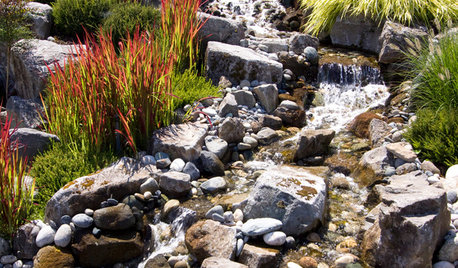
    Indiana brown stone common is this area, the rock we used for the additions to the log cabin (200 odd yrs old) were picked up on the property. Some of the larger ones we bought from excavators in the area, in fact we had a delivery this week. Patsy stopped and inquired what the builder was going to do with the rocks on a job, he was going to the land fill with them, ugh. He brought them here instead.

    Note the rock outcrop steps beside the water feature. I took that straight out of a Japanese rock book. Notice there appears to be different sediments, we chose slightly different colors to appear like as if it just eroded where it is.

    You may notice that some are sitting on top of the ground, never do that says the Japs, plant them. Now that I mention it start looking at rocks in landscapes that are just placed on top of the ground, they do not look as natural as those buried. The Japanese bury rock as much as 3/4 in the ground, wish I had some of them to do over. I'm not going to dig holes and bury them now but should have. Just went back to the photo of stone step outcrop and see the large stone to the right, it looks silly sitting there on top of the ground, right?

    Also notice the little group of rocks in the corner of the cedar retaining wall. The flat rock in the front is the kneeling stone, the 2 on either side are the sentries then the taller one in the rear is the temple stone. Now find the small water feature with mouth rock in the middle, I echoed the same effect with procumbens nana (kneeling stone) dwarf Alberta (sentries) weeping spruce (temple).

    Now back to the Japanese books on rocks in landscaping, replicate some of those beautiful rock landscapes using plants as rock.

    Consider this, a little mountain range using pointed rock grouped like a distant mtn range. Remember to bury them, do as I say not as I did.

  • 19 years ago
    last modified: 11 years ago

    May I make one suggestion? After you get done with all that hard work turning your blank slate into a lovely garden, consider painting your front door a great color that really pops! It's amazing how much the color of your front door can add to the total look.
    Take a ride through some neighborhoods and check out the colors of doors for ideas that will look good with the color of your house. : )