Software
Houzz Logo Print
lorne47

Serious hosta pest

14 years ago

We have several large hosta gardens. Three of them have had a problem for about four years. The problem is some bug will drill a small hole in a leaf in the middle of the stem about an inch from the base. This will result in the leaf falling down. In some cases the drilling continues up the stem. Some hostas will suffer this fate to many leaves while others maybe to only a few leaves. Some of our hosta gardens are not affected. We use 10% ammonia solution in the spring and have no slug problem. Insecticide sprays don't seem to have any effect. Can you help. We have exausted many other help sources to no avail.

Comments (21)

  • 14 years ago

    Well, this is probably no help....I have a big slug problem, and in my garden, it's the slugs that bore the holes in the petioles, collapsing the leaves. Caught them in the act, many a time. they will either eat a hole all the way through, or gouge out a channel and weaken the petiole that way. Possibly cutworms? They typically just destroy leaves for me, I thought they were know for taking down leaves at the base of the stem?

  • 14 years ago

    Firstly, we need a picture to be able to see the kind of damage you are talking about.

    What do you mean when you say you have "no slug problem". The 10% ammonia is great, but it doesn't last all season from one Spring application.

    It could be slugs, it could be cutworms, it could be earwigs. You are going to have to go out at night with a flashlight to find out. For earwigs you can put a rolled up newspaper at the base of the plant and check it in the morning to see if they are hiding inside.

    Don't forget the pic.

    Steve

  • 14 years ago

    The problem is some bug will drill a small hole in a leaf

    ==>> can you get a picture of the drill itself ... and the bug holding it

    ken

  • 14 years ago

    lol ken I hope its a dewalt

  • 14 years ago

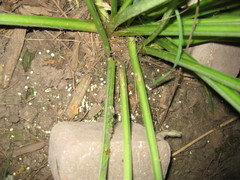
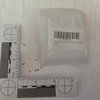
    I have posted a picture as requested by Steve Mass.

  • 14 years ago

    Lorne,

    When I look at that picture, it is hard for me to see where the holes are. Look at those three petioles that go directly down over the rock. The one that is furthest left appears to have some kind of growth part way up the petiole. Is that typical? It also seems to be broken right at the ground level (like the one next to it), not one inch up as your description mentioned. Is this common also?

    My guess is you are dealing with cutworms. To be sure you probably should try to identify these at night by flashlight. I would first try Spinosad as a control. Read the link below.

    Here is a link that might be useful: Cutworms fact sheet

  • 14 years ago

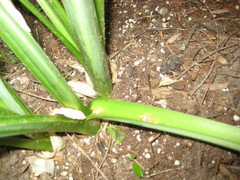
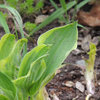
    Here is a picture of the holes which is a common first condition. Later we get further damage as in the first picture. We went out at 10 pm last night with the flashlight and found nothing at all. We also placed damp rolled up newspaper in five separate locations and found only one earwig this morning in one of the papers.

  • 14 years ago

    Lorne,

    Thanks for the close up picture.

    It looks like the petiole is still firmly attached to the crown, but is just weakened by the hole in it. Is that true?

    It also appears that the hole in the petiole does not go all the way through. Is that true or does that vary based on the plant?

    I have to say based on the closer look that I'm not sure it is cutworm damage. A cutworm would more likely do more damage than that.

    Two more questions:

    Have you noticed any damage to the leaves also? If so can you show us pictures of that?

    When do you first notice the damage? Does it happen in the early Spring? Do you get more damage during a time of a lot of rain or wetness?

    Steve

  • 14 years ago

    Does the hole actually go into the stem? Have you cut one open to see if there is a worm inside (eg like a squash borer)? You might need a systemic imsecticide.

    Sandy

  • 14 years ago

    in 25 years of hosta growing.. i have never heard of using a systemic on hosta ...

    did i miss something???

    i have always considered that slug damage ... but the peeps here.. have begun to blame other things ... so be it ...

    ken

  • 14 years ago

    Why not? Orthene and Orthinex systemics are recommended for spraying hostas with foliar nematodes, why not for cutworms and other sucking chewing biting pests? If you use pesticides, it would work.

    Unless you plan on eating your hostas.

    Sandy

  • 14 years ago

    so nematodes in hosta are a LABELED use of said chemicals????

    whatever.. i didnt intend to naysay it.. i simply said.. i wasnt aware of it ...

    when you get 20 years into hosta... one tends to not really be that intimately involved with them ... lol ... i start focusing on the conifers.. when august rolls along .... as far as i am concerned .. hosta prime season is over ...

    good luck OP!!!!

    ken

  • 14 years ago

    If you aren't paranoid enough about what might be wrong with your hosta, here is a site with great pictures.

    http://www.extension.iastate.edu/Publications/SUL14.pdf

    But wait for it: article about using Orthene and Orthinex: scroll down to page three:

    http://www.stlouishosta.org/newsletters/11-05.pdf

    There are a few other articles also. Hostas may not be specific in the label, as Bob Axmear stated in one, but systemics work.

    Sandy

  • 14 years ago

    Sandy,

    AFAIK, there is not pesticide that is available to the home gardener that lists foliar nematodes on its label. There may be some peeps who use it off label, but that's a different story.

    Ken,

    It may in fact be slug damage, although with slugs I would expect the hole to go all the way through the petiole, not just be on the surface. Also I would expect to see some holes in the leaves as well. It would be unusual for slugs to eat pets and not eat the leaves also. Still I think the slimeys are the most logical suspect.

    Steve

  • 14 years ago

    There was information the last years on this forum that Chris from Hallsons recommended Merit against foliar nematodes. I sprayed that liquid Bayer insecticide containing Merit on three hostas which showed the presence of foliar nematodes and stopped that attack.
    This year I started early in April and again end of June placing that Bayer granular fertilizer with insecticide under all hostas. I also sprayed twice the liquid insecticide version on the leaves and will do it again next week, which is 2 weeks before nematodes usually show up here.

    I am using :
    Bayer Tree & Shrub Protect & Feed, granular, systemic, contains Imidacloprid = Merit,
    Bayer Advanced Complete Insect Killer, liquid, systemic, contains Imidacloprid = Merit.
    These insecticides show on the label that they kill leaf miners.

    Bernd

  • 14 years ago

    You are correct, Steve, none of the systemic pesticides approved for home garden use list foliar nematodes on their labels. However, I did find several web sites that strongly suggested that using them on their hostas as well as other perennials for this problem would be an effective solution. And why not? Works for anything else that eats plants, including leaf miners and other insects that work on the insides of the plants where surface insecticides can't touch them.

    Yes, Bayer was recommended as well as the Ortho products, also DiSyston, but that one is intended for commercial use.

    People just have to remember that systemic products (Roundup included, tho it isn't an insecticide, it is systemic) can be absorbed into the skin of a human as well as a plant, and take precautions using them with protective clothing and gloves, even a mask. A little more care is needed with this class of pesticides than say, Sevin or pyrethrins.

    Sandy

    Sandy

  • 14 years ago

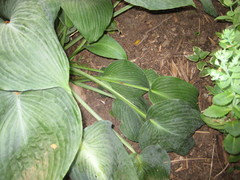
    I have included a picture of a hosta that has many leaves affected. I have hostas with as many as 50+ leaves with most of them down on the ground. We have, as you can see, little or no leaf damage. This problem starts when the hostas are full grown in mid-June. in most cases the first thing you see is a hole about an inch above the base and is usually all the way through. After several days there may be further damage as I have shown. We have tried slug bait but have not seen any dead as a result. I can't say this problem is effected by wet conditions. This has been a five year problem with no solution yet.

  • 14 years ago

    Well, you've got me stumped Lorne. It if were slugs you wouldn't necessarily see any dead ones from the bait. You'd have to look at night to see if they were chewing your petioles. The other possibility is that it is some kind of fungal disease like anthracnose. If this is something that has been going on for 5 years, I think I'd send in a sample to a plant disease lab at a local university. They might give you an answer.

    Here's an experiment. After frost this year take one plant that has been affected a great deal by the petiole damage. Remove all the foliage and then dig it up. Remove the soil from the root ball and then give it a full bath in 10% bleach and water. Take it to another part of the garden where you haven't seen any petiole damage and plant it there. If it grows without damage the it was a fungal disease.

    Steve

  • 14 years ago

    I also have perhaps 3 or 4 hostas which have leaves lying down like that with the bottom bit into it. Probably some squirrel was sucking out some liquid to cope with the heat and no rain. Bernd

  • 14 years ago

    Bernd might have something there. This morning as I was having my morning coffee along the riverbank I saw a squirrel licking what little moisture there was from the mornings dew in the cracks in the old utility poles the park uses for railings in its parking areas. Desperate acts during desperate times of all of Gods creatures, great and small.

    Les