Software
Houzz Logo Print
josephines67

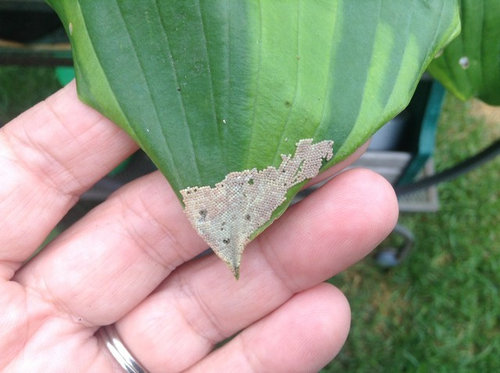
What is this???

This was not here two weeks ago! I just spotted it while admiring the variegation on Jewel Of The Nile. I removed it in one piece by sliding a knife blade between it and the leaf. The underside is perfectly smooth. Strange. Anyone know what this is?

Thanks for looking.
Jo

Comments (26)

  • 13 years ago

    i may be crazy, but it looks like insect eggs to me.

  • 13 years ago

    I don't think you're crazy, Roxanna, I think those are insect eggs, all right. What kind, I do not know.

    Don B.

  • 13 years ago

    Neatly rowed insect eggs, but who's?? Maybe good bugs...maybe bad.
    IMO, scrape them off the leaf and get rid of them
    (unless someone can identify the laying insect as a "good" one for the garden).
    There are too many to chance it otherwise.

    Deb

  • 13 years ago

    I'm curious as to what kind of an insect would lay eggs in this fashion. . . . . . .
    Hoping someone can identify this...do we have a resident insectologist? Lol.
    Thank you for your input so far. :-)

  • 13 years ago

    Isn't there a bugs/pests forum? Post it and let us know! Looks interesting for sure.

  • 13 years ago

    I think it looks like a dried, skeletonized leaf.

  • 13 years ago

    I did a quick google of "insect eggs on leaves" and found the link below. While the picture is not the two-toned tan of your eggs, it has great photos to look at. Have a look at that search, or else try this one link given below.

    I'd like to know what they are. Ever since I identified the assasin bug nymphs on my fragrant hosta, I am reluctant to get rid of anything which could be beneficial.

    I leave the Gulf fritillary butterfly caterpillar alone on my passion vines, the nymphs alone (they tell me which fragrant hosta have the strongest scent, their stamp of approval if you will). Who knows but what the tiny green or brown tree frogs are laying those eggs. Or the tiny gecko/anole which lay masses of eggs too. But I don't see them until they hatch into 2 inch long little lizards. Where there is one set of eggs, there are probably others as well. So try to identify the nature of the parent.

    Here is a link that might be useful: insect eggs on leaves

  • 13 years ago

    Thank you, Mocc for the link...I studied it, then also googled...found a 2 yr. old thread on rosé forum which I bumped...it appeared not to have been resolved, so here's hoping someone on that forum might have some current info...worth a try. :-)

    I'm hoping eggs are from a beneficial insect/bug, otherwise it's a goner!

  • 13 years ago

    So....break off the leaf, put it in a jar with a little water to keep it fresh, tie a piece of cheesecloth over the top, put it in a shady window and see what hatches out.

    Sandy

  • 13 years ago

    OOps, double post, I hate it when that happens!

    Sandy

    This post was edited by mosswitch on Sun, Sep 1, 13 at 22:08

  • 13 years ago

    jo:

    2nd what sandy said.

    put the leaf stem in water to keep it fresh, or the leaf may dry, hindering the surveil rate of the eggs (which is why they lay so many)

    it is prob some type of moth. are the eggs round or ovate?

    typically mama lays them on the food source. but i don't know of any butterflies or moth that eat hosta leaves

    if no jar, stick in bottom of an empty aquarium. show us the larvae when they hatch.

    what type of trees are in your garden?

    that may help provide a clue.

    do you have any lilac bushes close?

    dave

  • 13 years ago

    Cutworms are not actually worms, but caterpillars; moth larvae.

    Not that these eggs are, but I just wanted to quibble with Dave ; P

    Don B.

  • 13 years ago

    post it in the forum at the link

    linking back to this post.. [in other words.. do a post there... that says.. please answer in the post at the link below]

    rhiz will tell you

    NEVER destroy anything.. until you its NOT beneficial ...

    ken

    Here is a link that might be useful: link

  • 13 years ago

    Well, I feel like an idiot and also like someone stole my candy! Idiot because I didn't think to shelter the jar ...left it on the patio table outside.

    I just got home from out of town, went to backyard to check on "eggs" as it had rained in my absence... And found it upset on the ground, also found other mischief....there is a very bad-a**black squirrel that was caught in the act of digging in one of my larger hosta pots days ago...needless to say, this science project is over, sadly. All that's left . . . dried looking thin whisp of what was . . . a network of very defined round eggs.

    Ken, thank you for dropping in and kindly providing the link. .. I posted the thread as you advised but dagnabit!!! I forgot to link..no matter, I'll report back here with any info....appreciate it.

    Dave, Jewel Of The Nile (the eggs were attached to one leaf) sat on a table under a dogwood tree..I DO have a Dwarf Korean Lilac in the vicinity, as well as a columnar Mountain Ash tree...some weigela, spiraea, honeysuckle shrubs as well. Funny you mentioned a moth...the other day I saw a rather elongated one, light brown in colour, flying around the deck...Usually we have the shorter, fatter versions flying around here. I will inspect all my potted hosta on the deck in the morning, just in case.

    I'm disappointed that I won't be able to see what would have come of those eggs. On the plus side, perhaps someone will recognize them.

    Thanks again folks. Keep you posted.

    Jo
    P.S. I had an idea that perhaps a grasshopper may have laid these eggs, then googled and found out info that nixed that idea.

    This post was edited by josephines67 on Sun, Sep 1, 13 at 22:29

  • 13 years ago

    If you haven't discarded what remains of the leaf and eggs, why not keep it and see what happens. I don't think the eggs need the leaf to sustain them. Anyway, what's to lose? And now we're all curious!!

  • 13 years ago

    This is what I salvaged...interesting black specs in between...but dry...

    I had a response from Jean at the garden clinic forum. She has identified them as moth eggs, type of moth unknown....but should they hatch, I'll be the proud owner of 100's of leaf chewing caterpillars! I think I'll dispose of them ASAP and keep my eye out for any other oddities in my garden.

    Thank you to all of you for your interest and assistance. :-)

  • 13 years ago

    You know, Jo, I'm thinking that you have several fragrant hosta? (And so do I...) and my fragrants have night pollinators which consist of a lot of moths in many cases.

    My musing is that perhaps these eggs are from the moths coming to your fragrant hosta. As for hosta not being a usual "host" plant for feeding the larva, maybe it is adjusting for its host plant being just close around?

    I'm responding like this because I've seen a lot of butterflies all over my garden. And when I walk into my nighttime garden, something big buzzed me and I've seen moths on the kitchen window at night, and moths around twilight too. Perhaps these are the eggs of the night moths.

    Just thinking out loud here. But I'd be curious to find out, if any of your eggs hatch, are they larva of night moths or not?

    Meanwhile, I'm keeping my eyes open for egg masses too.

  • 13 years ago

    Can you be my Muse too? LOL

    This is quite the coincidence, Moc! I've been wondering along similar lines...."what is different this year from last year?" More fragrance in the garden is one difference. Hosta fragrance is the newest introduction specifically.

    Other fragrance-emitting plants are dianthus, lilies, peonies, iris, coreopsis, sedums, to name a few and they have been here for a few years already.

    I have lots of butterflies and bees and birds visit my garden all season long..I figure I've got the beginnings of a pollen 'Mecca'...

    Some of my fragrant hosta are sitting in close proximity to where these eggs were laid. I also have a couple of fragrants on the deck outside the kitchen...you know. . . Cuppa coffee in the am and a few whiffs of hosta blooms to get this girl started on her day! Lol :-).

    I don't usually have the light on out back at night so the scent would beckon the winged creatures you think?

    I think your theory has weight.

  • 13 years ago

    if they are cecropia moth i think they would enjoy your lilacs.

    could also be polythemus moth

    grew em both as kid. huge green caterpillars, and i mean huge

    dave

  • 13 years ago

    Yikes! I saw some mean looking HUGE light green caterpillars (at least the thickness of my ring finger) back in the 1980's . . I was revolted by their size then . . . I grew up a bit more since then . . Lol.

    Dave, how long do these moths stick around? BTW, these moths you named are beautiful! I kept staring at cecropia!

    Who would have thought I'd be learning about moths on a hosta forum? :-)

  • 13 years ago

    moths will only live for a matter of days or weeks. they can't feed, per se.

    now the caterpillars will have voracious appetites, and, due to the time of the year, they will spin their cocoons and hatch in the spring. i've been known to go out in the winter to search for cocoons and bring them back, placing them in an empty aquarium so we can watch them hatch in the spring. you put a screen over the tank, plus there is minor maintenance like spritzing the cocoons with water over the winter so they don't dry out.

    great show for the kids/grandkids, tho in this day and age it is not instant gratification.

    ÃÂ.ÃÂ --~

    dave

  • 13 years ago

    Found a "story" of a hatching caterpillar they call Sam. Done by Auburn University. Some might enjoy reading it. PHilosophical topics to consider as a human being watching the little critter as a subject of half a billion years of evolution, worthy of survival as they say.

    Auburn is a few hours away from here, so this moth and the other one Bragu mentioned could be in my night garden. It is found everywhere throughout Canada and the US except for Arizona and Nevada. This moth Sam has a wing span of half a foot....6 inches.....so it could have been the large thing which landed on my white t-shirt one night in the hosta garden. It sure felt big!

    http://lifecycle.onenessbecomesus.com/story.html
    (It would not let me enter this as the URL, cannot figure why it was rejected, said not a URL)

  • 13 years ago

    The title of the story is
    "Oneness Becomes Us"....the story of Sam, a cecropia moth.
    I hate it when the internet gets choosy about accepting my URLs. It was copy/paste, for pete sake!

    Here is a link that might be useful: Oneness Becomes Us

  • 13 years ago

    If you google cutworm moth eggs, sure looks like those. On the other hand, so do tiger moth eggs.Or walnut moth. Or a handful of others. Only way to tell would be to let them hatch out and id the cats.And I would do it in a container so if they are cutworm moth eggs, you can destroy them.

    Sandy

  • 13 years ago

    Moccasinlanding wrote:
    "I'm responding like this because I've seen a lot of butterflies all over my garden. And when I walk into my nighttime garden, something big buzzed me and I've seen moths on the kitchen window at night, and moths around twilight too. "

    Mocc,
    The big thing that "buzzed" you could very well be a bat.
    I've stepped out at dusk/dark and been buzzed by our resident eastern red bats. It's a little UN-nerving when it happens, but they are interesting to watch.

    I can see them from my recliner constantly flying back and forth under the yard light most warm evenings.

    Deb