Software
Houzz Logo Print
nachbor

container veggies?

17 years ago

I am going to try my hand at growing some veggies in containers this year. I would like to know what kind grew best for you. I definitely want to plant tomatoes, bell peppers and jalepenos, and any other suggestions would be great also.

thanks,

Terri

Comments (6)

  • 17 years ago
    last modified: 11 years ago

    Hi Terri,

    When you are gardening in containers, the plants that grow best tend to be some of those that are smaller and more compact.

    For bell peppers, I'd recommend either "Blushing Beauty" or any of the mini bell peppers. "Blushing Beauty" only gets about 18" to 24" when grown in the ground and stays slightly smaller in a container. It is the most heavily-producing pepper I've ever grown, and the first year I grew it was during the 2005 drought, which was a very tough time for gardeners. The mini bell peppers all give you very small peppers, but lots of them. Some mini bell peppers are about 1" by 1.5" and others are as large as 2" x 2". You can find seed for Blushing Beauty and the mini bells at several online sources (but not necessarily in stores, depending on how wide of a variety of seeds your local nursery carries). One seed source I can think of off the top of my head is Tomato Growers Supply Company. (www.tomatogrowers.com), which I know has Blushing Beauty. The mini bells can usually be found at Seed Savers Exchange (www.seedsavers.org) and other places.

    For jalapenos, almost any one that you like would grow well in a container, and a couple that I like because they produce large jalapenos and lots of them are Jalapeno "Much Nacho" and Jalapeno "Grande". Both of these produce larger-than-average jalapenos. If you want a milder jalapeno, you could plant "TAM Jalapeno", and if you want yellow jalapenos, you could plant "Jaloro", both of which are very compact plants and ideal for containers.

    For tomatoes, you'll have better luck in containers with determinates than with indeterminates, although indeterminates will grow well and give you tomatoes--but they won't get as big or give you as many tomatoes as they would if grown in the ground. Determinates could be grown in a pot as small as 5 gallons, but larger is better. Indeterminates need really large pots, certainly nothing smaller than 10 gallons, and 20 gallons would be even better.

    Here's some determinates that do well in containers:

    "Bush Early Girl" VFFNT hybrid--I probably get the most fruit per plant from this one--almost more fruit than leaves. It is an early season tomato.

    "New Big Dwarf"--Even though this is a hybrid, it is a really old one, dating back to the early 1900s, so I consider it an heirloom hybrid. The plant will only get 2' to 3' tall but will produce very large, very tasty, deep pinkish-red tomatoes. When grown in the ground, the tomatoes are often in the 10-16 oz. range, but when grown in a container, I usually get them in the 6 to 10 oz. range. They have an undeserved reputation for being a "late" tomato in some parts of the country, but in my garden (whether growing in the ground or in containers), they usually produce fruit quite early--between 60 and 70 days from their transplant date, so it is an early season tomato.

    "Homestead 24"--One of the reasons you'd grow this one is that it can take the heat and keep producing well, which cannot be said of all tomatoes. The fruit are red, globe-shaped and very resistant to cracking. It is a mid-season tomato.

    "Rutgers"--This is an old variety, developed in the 1920s. It produces a lot of tomatoes per plant and they are pretty tasty. You can eat them fresh, cook with them, or can them. It is a mid-season tomato.

    "Sioux" or "Super Sioux"--These are two very similar varieties, with Sioux being the original variety and Super Sioux being an improved variety that is said to have more disease resistance. This has outstanding flavor and is a heavy producer of smallish tomatoes--aout 5 to 7 oz. It has been grown in Oklahoma since the 1940s and is a mainstay in many gardens. It is a mid-season tomato.

    Here's some indeterminates that have grown and produced well in containers for me:

    "Royal Hillbilly"--A favorite of The Tomato Man (Darrell Merrell) and recommended highly by him, this plant produces heavy yields of deep pinkish-purple, fairly large (for our climate) tomatoes. It is a late season tomato.

    "Arkansa Traveler" (also known as "Traveler" or "Traveler 76")--This late-season tomato continues to produce well late in the heat after many other tomatoes have stopped producing. The tomatoes are a pinkish-red and are usually in the 6 oz. range in my garden. In a climate with more moisture, the fruit might be a little larger. They have great flavor.

    "Dr. Wyche's Yellow": An old Oklahoma heirloom from the Hugo area, this plant continues to produce well in the summer heat. The flavors are a golden-yellow and get 10-16 oz. in the ground, but slightly smaller in containers. It is a mid- to late-season tomato.

    "Nebraska Weding": An old heirloom from Nebraska, this grows well in the heat and produces medium-sized, orange tomatoes with incredible flavor. It is one of my favorites.

    "Black Krim": This heirloom from Russian has fantastic flavor and produces good (but not huge) harvests of dark maroonish-red tomatoes with green shoulders. Outstanding flavor and a pretty heavy producer. It is a mid-season tomato.

    "Cherokee Purple"/"Indian Stripe": These are very similar. Cherokee Purple is easier to find and Indian Stripe is a heavier producer. (I get my Indian Stripe seeds from Victory Seeds.) The tomatoes are a dark mahogany-color, about 8 to 16 oz. (larger fruit early in the season, and somewhat smaller ones later in the summer). Outstanding flavor. I think "Indian Stripe" has slightly better flavor and disease-resistance than "Cherokee Purple", but both are great. They are mid-season tomatoes.

    FOR SMALLER TOMATOES: These generally produce tomatoes in the 2 to 4 oz. size, so their fruit is larger than the typical cherry, but not as big as slicers/beefsteaks.

    "Porter", "Porter's Pride" or "Improved Porter": From the old Gene Porter and Sons Seed Co. in Texas (sadly, now defunct), these small plants produce tons of dark pink, tasty tomatoes and the heat doesn't slow them down at all. Often, in August, "Porter" is the only tomato (other than the small cherry, grape and currant types) that still sets fruit even in awful heat. The fruit are tasty too. They are mid-season tomatoes.

    "Jaune Flamme'" or "Flamme'"--This is an early to mid-season tomato that produces an abundance of small (2 to 4 oz.), orange, good-flavored tomatoes. It is very productive. In years of extraordinary rainfall, their flavor drops off, but so does the flavor of most other tomatoes.

    SMALL TOMATOES:

    "Black Cherry": Although it is not absolutely ideal for containers, it is simply the best-tasting cherry tomato around. In the ground, these get 7' to 10' tall, but in a very large container (I use old cattle feed tubs that are about the size of a whiskey half-barrel for them), the plant will only get about 5' tall. Covered in dark maroon cherry tomatoes that have superb flavor. It is an early season tomato and will produce all summer long if kept watered. If I could only grow one tomato plant period, it would be this one.

    "SunGold": This was my favorite cherry tomato until Black Cherry appeared on the market, and it is still high on my list. "SunGold" produces tons of bright orange cherry tomatoes that have exquiste flavor. It is an early-season tomato and produces all summer long if kept watered. Some years (usually in rainier years) the fruit crack a lot, but they still are quite tasty. An improved version is available. It is called "SunSugar FT" and is it said to have improved crack-resistance and disease-resistance. I've grown them side by side and really couldn't see much, if any, difference in the two.

    "Grape": This is a very, very productive red, grape tomato that continues to bear well all summer long. The fruit are tasty and the plants are very disease-resistant. This is an early-season tomato and it grows very well in containers for me. If you want to grow a "pink" rather than a "red" grape type tomato, grow "Rosalita".

    PASTE:

    "Martino's Roma": This is a determinate, heirloom paste tomato that is a very heavy producer of red paste tomatoes with outstanding flavor. It is a mid-season tomato.

    "San Marzano Redorta": Outstanding flavor, great production, slightly larger tomatoes than regular San Marzano. It is a mid- to late-season tomato.

    "Opalka": The best-tasting paste tomato, this heirloom variety is good enough to eat fresh but also great for cooking and canning.

    "Window Box Roma": This is a very small (16" to 18" tall) plant that produces heavy crops of bright red paste tomatoes that are also good for fresh eating. It is a mid-season tomato.

    As far as other plants to grow in containers, you can grow almost anything that you like to eat, with the exception of plants that produce very large pumpkins and corn. There are even some dwarf corns that can, techically, be grown in containers, but you'd need a minimum of 12 to 16 containers, with one plant each, to get good pollination.

    Bush cucumbers like "Pickle Bush" or "Salad Bush" grow well in containers, or you could frow a vining type like "Homemade Pickles" in a container if you grow it upward on a trellis or tomato cage.

    Bush beans can be grown in containers, and some that we like are Royalty Purple, Roma Bush, Contender, Provider and Top Crop.

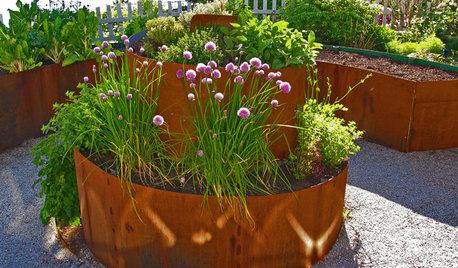
    Remember, too, that you can grow almost any herb in containers, including the various basils, lemon balm, sage, chives, chamomile, dill (fernleaf only gets about 16-18" tall), rosemary, parsley, etc.

    You can even grow watermelons or pumpkins in containers, if you choose a very small bush-type watermelon like Bush Sugar Baby or Yellow Doll and a very small decorative-type pumpkin like Jack-Be-Little, Lil Pump-Ke-Mon or Baby Boo.

    You can grow the dwarf okras in containers, using a variety like Little Lucy or Baby Bubba.

    There are many varieties of all kinds of vegetables that are bred for container gardens and some of them are worth growing, although some of them really are not. Last year, because of our ongoing drought in southern OK, I decided to try the "Huskey" line of ISI tomatoes because they are ideal for growing in containers. I grew Husky Red, Husky Gold, Husky Pink Husky, Husky Red Cherry and Husky Gold Cherry. Of those, Husky Red Cherry was the most productive and best-flavored but had very tough skin. (The tough skin might be my fault, because I grew them in a container sitting in a very hot location--on a sunny concrete slab with a metal barn wall behind the south-facing plants.) I wasn't that impressed with any of them though and now I know why this line did not catch on with gardeners when it was introduced a few years ago. Although the rugose-leaved plants are very sturdy and lovely, the fruit are only average in flavor and all had tough skins that got tougher as the summer went on.

    I hope this response gives you some ideas.

    Dawn

  • 17 years ago
    last modified: 11 years ago

    dawn,

    THANKS FOR THE GREAT INFO.. THIS WILL DEFINITELY HELP...

    TERRI

  • 17 years ago
    last modified: 11 years ago

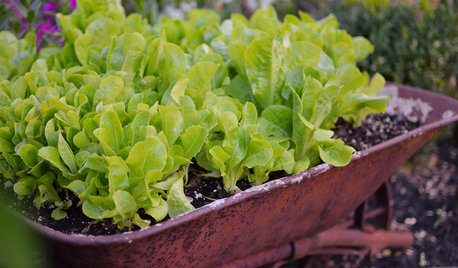
    Don't forget the salad greens!

    Here is a link that might be useful: {{gwi:360971}}

  • 17 years ago
    last modified: 11 years ago

    Dawn I searched for this because I wanted to know what the existing soil was that is in the containers you described in your planting tomatoes from Texas post. You said you add compost and manure to the soil. Is this purchased potting soil or some mix of yours?

  • 17 years ago
    last modified: 11 years ago

    Helen,

    If you have ever read about Al's Mix on the container forum, that's where my container mix got its' start. I adapted Al's mix to suit my needs here in our hot, toasty and dry climate. For veggies, you need really well-drained so, so Al's Mix works better for me than pre-packaged soilless mixes that have fertilizer included in them.

    Last year, we discussed the container mix and my changes to it extensively last year in a thread on growing tomatoes in containers. So, instead of retyping it all over again while half-asleep and, yet, wide awake at an unreasonable hour of the morning, I'll find and link the previous discussion. If you have any questions after you read it, just ask them here and I'll do my best to answer them.

    Dawn

    Here is a link that might be useful: Growing Tomatoes in Containers/Soil Mix

  • 17 years ago
    last modified: 11 years ago

    Jalapenos and most kinds of cherry tomatoes (or grape) would be great choices for most containers. I've done it with tomatoes.

    Probably limit yourself to one plant per pot, unless you've got some really, really large containers!

    If you're just using regular potting soil, your plants might benefit from a little compost or manure mixed in.

    Don't neglect them, though. Containers aren't very forgiving. Especially in the heat of an Oklahoma summer. Water, water, water.

Sponsored
Kuhns Contracting, Inc.
Average rating: 5 out of 5 stars26 Reviews
Central Ohio's Trusted Home Remodeler Specializing in Kitchens & Baths