Software
Houzz Logo Print
tracydr

Squash/melons in containers?

14 years ago

Anybody grow squash or melons in containers? I have flat out run out of room. I'm considering expanding to an area of the yard but that will take a large amount of gravel moving, tilling, manure and work on my part. In the meantime, I'm running out of time, especially for summer squash and melons.

I'm in zone 9b and my planting calender recommends no later than April for squash and watermelon, although I can plant muskmelon later.

I want to plant trombocino and cushaw, which I understand are space hogs. Also, would like to get watermelons ( Ali baba) for the first time ever. My other squash, costata romesca, is also a space hog.

Thanks!

Comments (11)

  • 14 years ago

    Tracy,

    I've done it and it isn't easy. I've grown them in molasses feed tubs, blue plastic children's hard molded plastic wading pools and whiskey half-barrels. You need a really rich soil-less mix that will hold moisture well because these plants greedily gulp up a lot of water in order to create their own water-laden fruit. I've grown Cocozelle and Costata in containers as well as yellow straightneck squash and a winter squash called Black Futtsu.

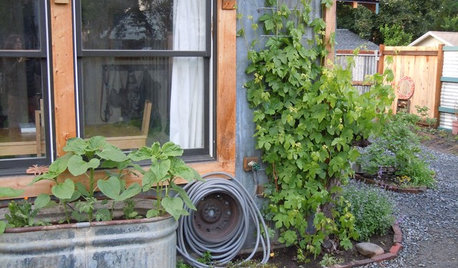
    With watermelons, I used Bush Sugar Baby, Sugar Baby, Yellow Doll and Blacktail Mountain. I let them trail over the edges of the containers and spread out on the ground, which was heavily mulched with soil conditioner (basically pine bark fines and humus mixed together). I don't know if it would be possible with Ali Baba, which is a much larger melon and vine. It is pretty drought tolerant though. I'm not even sure if it will be possible with cushaw. I've grown orange, white and green cushaws and those vines ran for 15 or 20 feet and climbed all over everything in the garden. They were in the ground. I don't know if you could provide enough food and moisture to a cushaw in a container unless it was something like a 200-gallon galvanized metal stock tank with the bottom rusted out (for good drainage). I think I have grown everything under the sun in my 20-year-old galvanized metal stock tank and nothing in it has failed. It takes a lot of soil-less mix to fill up the stock tank. Trombocino is really vigorous too.

    I think it likely that the cushaw and trombocino, as well as the Ali Baba watermelon, would just produce smaller plants and perhaps smaller fruit---getting as large as the available soil and moisture allow. With a regular feeding schedule, I bet you could get some good results if the heat doesn't flat out burn them up there.

    There are some smaller melons and squash bred just for containers. Thompson and Morgan had a bunch of new varieties bred for containers in their catalog last year or the year before.

    Dawn

  • 14 years ago

    Thanks, Dawn. Sounds like it will be easier to move all that gravel in my yard and haul a bunch of manure. Ugh!
    Oh well. At least I have a couple of weeks off!

  • 14 years ago

    Hi Tracy, with Dawn's help last year, I chose some cuccurbits to grow in containers. I just don't have the ground space. Well, I didn't get to grow them last year, but am going to do it this year. I already have seeds started of cukes, zucchini, yellow, and scallop veggie squashes - don't like winter squash. Most are bush types unless you run into Tromboncino, which is a huge, vining squash. I won't be growing that for obvious reasons.

    As for pumpkins, I chose Windsor, which is a patio type. I got the seeds at Swallowtail Gardens, and they have a lot of patio or container veggies. It is described as, "[m]niature, deep orange pumpkins reach 4-5 inches across and are arranged on the stems of upright growing 2 foot tall plants. The fruit is great for decorating and makes a wonderful pumpkin pie."

    The melon I am growing is Minnesoto Midget. Although this one is a vine, it is supposed to only grow about 3', and the golden yellow fruit is about 4". Noted as being a good one for container growing.

    Dawn mentioned Yellow Doll Watermelon and I will be growing that, too. Yellow-fleshed fruits reach about 3-5 pounds and this is a good one for container gardening as well. It is considered a "compact vine". They need to be trellised and Dawn advised me to use pantyhose to "hold" the fruit, as it expands nicely as the fruit grows. Not supporting the weight of the fruit can lead to a broken, damaged vine. The yellow fruit is described as "sweet and crisp".

    This is all of the info I can provide sibce I have yet to grow them to fruit and then reap the tasty benefits.....I hope, I hope, I hope!

    Susan

  • 14 years ago

    Tracy I grew Trombicini one year in a container, but it was a big tree pot about 3 feet across. I had three plants in it and a five foot tomato cage for it to climb up. It went up five feet, then down five feet, then about 15 feet across the lawn. Each time we mowed we moved the vines so it didn't have a chance to root in the ground. It produced very well, but it will take over your space if you allow it too. It is my favorite squash used as a summer squash, but I had one vine that was not good and the squash was a little off color and the rind was hard, so plant enough seed so you can yank one out if it turns out that your vine doesn't produce good fruit. I suspect that mine had a different kind of winter squash parent. The squash is normally thin, light green in color, and all of the seeds are in the bulb, with none in the neck. If you pick them at 16-18 inches long, you won't even notice the seeds in the bulb, but if you let one get larger than that, you may just need to use the neck and discard the bulb. The skin is tender and the meat is a buttery color. I cooked it many ways and also made squash relish from it and it was great for everything.

    Dawn gave me a Hales Jumbo cantaloupe one year and I grew it in a ten gallon nursery pot and I think we ate 6 or 7 melons from that one plant. It was growing outside my fenced garden area and some type of animal also ate one, well, half of one.

    I have never had good luck growing cucumbers in a container, but some people seem to do it just fine.

  • 14 years ago

    Thanks, all. Here's another option. I could dig holes as if planting trees, add my composted manure to the hole and drop seeds every 10 feet or so.
    It's not really the space that's a problem, it's cultivated space.
    I have a big, sunny area that I'd like to use, now that I got rid of two huge, dead line trees. Problem is that it's got about 12 inches of pea gravel, a layer of plastic and heavy clay underneath.
    The bonus is that this area is flood irrigated every two weeks for nearly free. ($67/a year) and this is. The area I want to plant is a low area which gets a lot of water and sun.
    I have enough manure to plant hundreds of melons (3 horses), so that's not an issue. It's just the work involved.
    Do you think this would work better than pots, since the roots would stay cooler? Would certainly save tons on water!

  • 14 years ago

    In your climate, I believe I would plant in the ground.

  • 14 years ago

    Soonergrandmom, I agree. I think in the ground is best. Plus, I can use my irrigation, which saves lots of water and money/time.
    Wondering, do y'all think my tree-hole idea with manure compost will work?
    I could probably git it done this weekend!
    I'm one manure trailer load from finishing my last raised bed, then I can plant all my wonderful peppers. Sweet habaneros, chiltepans, anaconaguas. Yummy!
    The bed I used for the big stuff last year is full of celery and Irish potatoes. They are taking their own sweet time, that's for sure. But boy, I do love having that celery! Im skeptical of the potatoes, having heard you can't grow them in AZ. But, I've heard that before!
    My "squash" bed was redesignated to sweet potatoes because for some reason I got it in my crazy head to order 30 sweet potato slips. That will take just about exactly a 16x 8 bed. So, this is how I ended up with nowhere to raise my squash, melons, cukes and even my long beans.
    Crazy thing is, my husband doesn't even really like sweet potatoes. I ordered a couple of bland, white varieties, in hopes of changing his mind. Also, some nice sweet ones and purples for me. I'll eat them for my lunches and bake with them. Love sweet potato pies, rolls, bread and my husband does love my baking.
    Oh, and, I need to expand to another garden, anyway. My husband just decided he likes artichokes, after tasting his first home grown artichoke.
    Have you any idea how much room an artichoke takes? Those guys are huge!

  • 14 years ago

    I agree that if the ground is an option, it would be best, and that's especially true since you have an endless supply of horse manure.

    When I was a kid, the best melons in the world were sold in Fort Worth stores but came from growers in Pecos, TX, which as I recall is pretty desert-like. Melons love sandy soil. I don't know what your clay is like, but if I dig a hole like that for a tree, I put unimproved native soil right back in after I plant the tree. Otherwise, I've created a "bathtub effect" where the hole with improved soil holds water like a bathtub since it drains better than adjacent unimproved clay and then all the water sits there wherever it hits the unimproved clay...like water in a bathtub. So, if you improve the soil and plant melons, mound up the soil slightly above grade level to protect the roots from soaking up too much water or sitting in too much water from the flood irrigation. Remember that excessive moisture for melons kills their flavor. Completely.

  • 14 years ago

    I do remeber those TX melons. We would always go to Denison in June or July to see my grandparents and other relatives. Oh, the watermelons! Nothing like them in CO, where I grew up!
    Dawn, I know that bathtub effect all too well.
    I usually make a mound for just that reason.

  • 14 years ago

    Just for S&Gs, I may put some trombocino and costata seeds in a couple of straw bakes. What the heck?

  • 14 years ago

    I figured you knew to mound, but mentioned it in case other folks reading the thread were about to go out and create a clay bathtub because they haven't gardened on clay before.

    About the straw bales? Why the heck not? You've got nothing to lose but a little time and a few seeds.

    Don't you think the melons really were tastier when we were kids? Some years I get melons from the garden that probably are just as good (usually in moderately dry years, but certainly not in wet ones) but in my mind, nothing can match the Pecos melons of my youth.