Software
Houzz Logo Print
oppalm

A is for ............

19 years ago
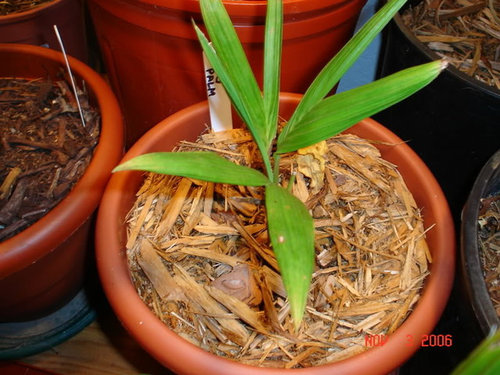
Archonotophoenix Alexandrae (King Palm Seedling). this bad boy was 12 months old on 12/31/2006.

Comments (40)

  • 19 years ago

    12 months old? Oh Oh, then the 3 Purple Crownshaft King Palms I recently got in a trade are gonna be S-L-O-W as they are about that size. Another palm to chalk up to "Hope I live to see it".

    Here's one of my favorites from the group I bought last April, it has really been growing and has a new spear coming out now--Aiphanes caryotifolia

    {{gwi:1115085}}

  • 19 years ago

    bihai

    Purple kings grow fairly fast..

    Most kings grow fast from what i have heard !

  • 19 years ago

    Topher, where's your "A" photo?

  • 19 years ago

    All I know how to post is links...........

  • 19 years ago

    Ah hah so you don't HAVE an A photo of a palm. Well, how about another tropical plant you are having success with?
    Alloschimidia glabrata
    {{gwi:1115086}}

  • 19 years ago

    bihai, I think you have a serious sense of "adventure" with that Aiphanes , since they're one of those spined palms I believe, but I've also considered trying some species with spines, since they're so interesting, though in a limited space like mine, I'd be bumping into those spines all the times most likely!

  • 19 years ago

    Yes they definintely are armed, but not so much as as my Salacca magnifica. The Aiphanes is planted by the greenhouse stream, the photos of mature specimens are simply gorgeous and I envisioned it overhanging the stream when I put it there. The stream is narrow, and can be crossed by stepping over at several points, so the spines won't get in my way for MOST things!
    Post an A photo, bird!

  • 19 years ago

    Areca Catechu...I need one, preferrably one this size.

    {{gwi:1115087}}

  • 19 years ago

    I am at work can't get to my photobucket account
    but will post one tonight....

  • 19 years ago

    That's a lovely specimen there, and it seems after looking at various palm photo sites often, I can't always remember what the more mature specimens look like, but that's beautiful in my opinion and worth having.

  • 19 years ago

    I don't have A. catechu, but sure wish I did! I have an A. vestiaria Yellow crownshaft (but too young to be showiny the yellow yet) and a "regular" A. vestiaria which are showing great promise. I don't have ANY palms the size of that A. catechu...all mine are BABIES.

    Asterogyne martiana
    {{gwi:1115088}}

  • 19 years ago

    I must say your photos are a treat bihai and I'm wondering as well, what the tall shoots to the left background in the photo are and they do look like they grow from rhizomes perhaps, and may be gingers of some sort? I note that my two different costus species both get those fattened portions about soil level that sort of resemble bulbs, though they' just the modified rhizomes!

  • 19 years ago

    LOL Bird they are a ginger but not a costus. Those are the red legs of a 16-20 ft tall Etlingera elatior "Red Torch".

  • 19 years ago

    Agave angustifolia marginata.

    had it for about 8 months now. pretty good growth rate from about 6 leaves, oonly shot out 1 pup so far, (doesn't seem as invaisive as I have been told they were. ( I heavily mulched and did newspaper weed barrier though)

  • 19 years ago

    Very lovely! I have been looking for a trade of the variegated Agave "Cornelius" that they show in the Plant Delights catalog. I really like variegated agaves.
    Arenga hookeriana
    {{gwi:1115090}}

  • 19 years ago

    I am impressed Bihai-your palms look really healthy! Are these in a greenhouse? Those torch ginger stems look skinny for torch ginger-are those new shoots? How tall is your grhouse? I have a torch ginger too, but I have to keep it in a container, and I am thinking eventually it will have to be in a 50 gallon or so, and even then I am not sure that it will bloom. All my grhouses have shelves in them for commercial growing :( I need/want to build a grhouse with 30' high ceiling for things like torch ginger and palms etc! Maybe I should just move back to Hawaii...lol

  • 19 years ago

    I must say one thing I find difficult and so demanding of large containers all the time with those plants with speading rhizomes , like the gingers, and the heliconias is that they always crowd the sides of the container in no time and seem to want never to fill in available space towards the center of the pot where the original rhizomes were planted a year or so before. Makes it necessary I guess to keep potting them up to ever bigger containers and I'm not going any bigger with the space considerations I have as well as the cost for those very large containers. That makes it necessary for me to divide the clumps and start over though I think they tend to flower best if undisturbed and allowed to form subatantial clumps perhaps. Just the situation as I see it, but it doesn't make growing those large plants any easier. In many cases on checking the rootball of my costus, I find the rhizomes have hit the sides of the conatiner and then instead of making a turn horizontally, they'll travel all the way to the bottom of the pot where they refuse to grow new shoots and just sit there! Oh well, but you can't tell them how to grow unfortunately!

  • 19 years ago

    Terry, thank you for the compliment! Yes, I am a greenhouse grower. I have grown 4 different etlingeras, Red Torch, Pink Torch, Heiroglyphica and Yamamoto. Of those 4 (all of which bloom or did bloom profusely) Pink Torch was the largest growing. It was so large growing that I had to eventually remove it completely from the greenhouse when it topped 20 ft in height and the stand was over 15 sq ft in space consumption. The diameter of some of its stalks was 10-12 inches, maybe more, and its individual stalks reached 25+ feet in height. I removed Yamamoto as well,because it was also a space hog. I have kept the Red Torch and the Heiroglyphica because they are not as aggressive and have the prettier plant...the red coloration of the Red Torch stems and the neato leaves on the Heiroglyphica are more desirable than the plain green of the Pinks. Also the Heiro is a tulip torch, very dainty, and neither of these has shown sighn of taking over like the pinks.
    It is my understanding that the Red used to be the "common" Torch Ginger, then was eclipsed by the Pink, which was considered "rare", but now the red is the rare one and much less frequently found for sale.

    Bird, I grew all these plants (the 4 torches, 7 different alpinia purpuratas, and about 60 varieties of large growing heliconias) in containers for approaching 10 years before I built the greenhouse. Your assertion is 100% correct. They fill the pot very quickly, you keep upsizing, and once you reach about a 30 gal tub, you have nowhere to go up anymore unless you have a crane to haul the plant around. When I planted all my heliconias and gingers into the greenhouse, they were already mature "stands", many of which had bloomed. Once they got into the ground, they took off and started spreading like wildfire. They grew into each other, varieties that were only supposed to be 7-8 ft topped 15 ft, they shaded each other and everything below them out and developed pest problems that were almost insurmountable...when you have that much dense foliage it is almost impossible to treat anything. You almost had to have a machete to hack your way through the greenhouse. So, I removed ALL of the heliconias and sold/traded/gave them away, except one large grower and 2 small growers. Now my greenhouse is extremely diverse with plant types,pest outbreaks are easily controlled, its light and airy but still with that "jungle" feel, and I am much more happy with it.
    I was highly enamored of heliconia as a genus for a long long time but forced myself to collect other things and I am very glad I did.

  • 19 years ago

    Oh Bihai....you are crushing my dreams!!! lol I knew when I got the torch ginger-and of course i have the pink, that it was not a very realistic plant to grow here. When I lived in Hawaii-both the pink and the red were very common. Now there is a white, though I have never seen one grow and I wonder how pretty it really is when the older petals start to turn brown against the white of the new petals opening up.
    When you grew the heliconias in tubs-did they ever bloom? I have a wagneriana and a yellow caribea that I just moved up to larger pots. Also a rostrada. I am not so worried about the size of the pots-though it does take two people to move them and it helps to have dried the pot out first before the move....lol. You are right-I would imagine that the pests would get unmanageable, although there are some good granular systemics that work from just applying them in the soil-expensive but good, that last 30 days or so. I love the smell of the torch ginger after you cut the stem-

    Also, I meant to ask you what your fert program is for the palms.

  • 19 years ago

    Terry,
    some of my heliconias (most in fact) did bloom in tubs. Rostrata is actually one of the easiest to bloom in a container, it will bloom sometimes in a 5-7 gallon container under the correct circimstances. The Caribaeas are the largest most massive growing of the commonly cultivated heliconias, and the hardest to get to bloom in containers. Wagneriana is a toss up, I had 2 different Wags and never bloomed them in containers. The easiest of the large growing varieties to bloom in containers are Strictas, some Bihais, and Latispathas. There are of course smaller growing ones (angustas, psitticorums, psitt x spathocircinata hybrids etc that will bloom more readily in containers) I would not waste my time with Orthotrichas, Champneianas, Chartaceas or Pendulas, although you MIGHT get Pendula Red Waxy to bloom in a container.

    I have grown so many different ones over the years that I may not remember all I bloomed in containers, but here are some:
    Banana Split
    Iris Bannochie
    Bucky
    Rostrata
    purpurea
    Orange Gyro
    Red/Orange Gyro
    Firebird
    Red Waxy
    Flash
    Tagami
    Roadrunner
    Valentine
    Richmond Red
    Chocolate Dancer
    Collinsiana
    Nappi
    There are others but I have long forgotten.

    I fertilize my palms with a palm fertilizer (granular, top dressing just scattered around the base) every 3 months, a little spritz of chelated palm nutritional ditto, and whatever Miracle Grow slops over onto them while I am fertilizing the other plants.

    This is my LAST A photo for palms, you guys better start posting some A's!
    Areca macrocarpa
    {{gwi:1115091}}

  • 19 years ago

    Bihai

    I will have to wait till b's

    I have no a's.

  • 19 years ago

    Hey Bihai! I see you're doing well (and glad you're still posting pics!--over in FL forum the alphabetical thing died!)

    PalmShaun--i'm not convinced that pic you have is of the Betel Nut palm, the leaves and all much more resembles that of a Veitchia. Mine have broader leaflets and the ends of the leaflets are more squared, not pointy.

    Fritoextreme--just so not to confuse you if you look up info in future, but the Caribbean Agave has a different name now--Agave vivipara 'Variegata'. It's same plant but older references will us. A. angustifolia.

    Here's my A's:
    trunk of Black Sugar Palm (Arenga pinnata)
    {{gwi:1115092}}

    Macaw Palm (Aiphanes erosa):
    {{gwi:1115093}}{{gwi:1115094}}

    Orange Crownshaft Palm (Areca vestiaria)
    {{gwi:1115095}}{{gwi:1115096}}

  • 19 years ago

    Paurotis Palm (Acoelorrhape wrightii)
    {{gwi:1115097}}

    And triplet of King Alexanders (Archontophoenix alexandrae)
    {{gwi:1115098}}

  • 19 years ago

    good to see you over here babes! great pix

  • 19 years ago

    THx, I see you have a Golden Crinum (C. xanthophyllum)--any way to get it direct sun so the new growth really yellows?

  • 19 years ago

    I may plant some outdoors (ie out of the greenhouse) as a test when it really gets out of control lol and I have to thin it. I have no idea about the hardiness of C. xanthophyllum. I have all my other Crinums outside and they are massive...they are all hardy here but the Xantho was hard to get so I haven't risked it yet

  • 19 years ago

    I think you should throw fire to the wind and plant it outside. Yes, I don't think it's as cold hardy as the larger crinums, but I've taken soooo many pups off mine in ground that I think in 10 months time, you'd be able to get a lot of new plants to save and replant out if you lose any from the followin winter's cold.

  • 19 years ago

    Its a good idea, I have a full sun space around a pond outside that I have been slowly filling in with stuff. I have some of the Black Mondo Grass out there, and the yellow crinum would make a pretty fabulous contrast. Eventually, MOST stuff from the greenhouse gets a trial outside. Some stuff does well, some stuff bites it bigtime. Things that prove root hardy over 2-3 seasons get removed COMPLETELY from the greenhouse so something new can be planted in their place, I mean, why waste the valuable zone 11-12 space on something that can make it outside in zone 8-9???

  • 19 years ago

    Here is an A.......

    Here is a link that might be useful: Attelea cohune

  • 19 years ago

    Archontophoenix purpurea

    Here is a link that might be useful: Purple Stem Palm

  • 19 years ago

    Happy Birthday Elvis. The King would have been 72 years old today January 8, 2007. Anybody got a jelly donut.

    You Floridians are a bunch of show offs. LOL. Your palm trees look magnificent. I am quite sure all your plants look terrific. I am quite sure your mosquitos are terrific.

  • 19 years ago

    usually by now we may have had some weather that was cold enough to set the skeeters back, but it has been almost 80 degrees here all week til today and they are still flying. Its supposed to get to 32 tomorrow night before it warms back up to about 80 again this weekend, but that's still not cold enough to do the mosquitoes in. So far this winter my propane bill for heating the greenhouse is pretty reasonable

  • 19 years ago

    oppalm, you know, they spray in the urban areas for skeeters, so encounters with mosquitoes seem few and far between, even in summer it seems (at least at activities I do--if I went out to a freshlake park, i'm sure I'd be dinner).

    And, our soils in FL are very quick at doing in the "lush" tropical palms--too sandy, or, edge on alkaline, so fertilizing is really vital.

    Crownshaft damage happens from windstorms, and can easily get bud rot and other fungi on palms, too. So there's always a challenge. Only the warm temps are on our side.

  • 19 years ago

    Bihai

    32 degrees Are any of your plants in trouble ?

    I heard a guy talk about snow flurries in florida any truth to that ?

  • 19 years ago

    Sorry, 32 didn't happen. My thermometer here at Chez Roper is at a lovely and quite balmy 42F in the back and 44F in the front (front has a slightly better microclimate). It IS, however, reportedly 35 out at the Regional Airport, about 10-12 miles distant, where they record the "official" high and low temperature.
    See, maybe I really AM in zone 9 now!!!!!!(ha ha ha ha ha)

  • 19 years ago

    Longwood-I think you're right! The leaves do look too pointy on that picture.

    How's this?

    {{gwi:1115099}}

  • 19 years ago

    Fritoxtreme, I think you answered a question about one of my new acquisitions! While visiting The Holy Land Experience in Orlando, I noticed a small to medium sized agave with white margined leaves that had an old flower spike that was LOADED with pups! I took a few home and potted them up, not knowing what species it was. Is it normal for this species to "bloom" pups? Do many agaves do this from time to time? Another question- Does anyone know if Agave angustifolia marginata have any degree of cold hardiness?

  • 19 years ago

    Yes, agaves are known for being "viviparous"--bearing live pups as well as potentially creating seeds. The pups develop on the spent floral stems in each little cluster on the spike, some abort, others grow and drop to ground and grow.

    And no, the Caribbean agave isn't that cold hardy--i've seen it brown and turn to mush in southern Orlando--which is zone 9b...

  • 19 years ago

    Before we do away with "A" and go on t "B" I had to post this photo. This is one of my absolute FAVORITE bromeliads. It was a gift from a very good friend in California, because its kinda tough to find. Its a Billbergia called "The Artist" and here it is in full glorious color, in bloom, with a large pup also about to bloom. I know it isn't a palm, but who cares?
    {{gwi:437125}}

  • 19 years ago

    Not to "wander" to far from the palm topic once again, but speaking of pups, I'd mentioned the many pups on my Costus barbatus not long after it grew to blooming size, though I've never had it produce them since, til recently, and I'm still wondering if the pups are produced under very specific situations only? Perhaps growing in overly dry soil, or something else triggers the production of pups on some gingers? I must add , since they're so easily to grow just from simple cuttings and also from dividing the rhizomes in the clumps, I guess the production of pups isn't a big deal unless you wish to propagate many new ones and I've not had the need to do so, but it is a very easy and quick way to get new plants . In some cases years back each shoot might have half the entire shoot from midway up to the tip covered at every leaf axil with a pup, so there were many of them!

Sponsored
Peabody Landscape Group
Average rating: 3.5 out of 5 stars8 Reviews
Columbus' Reliable Landscape Design & Contracting