Software
Houzz Logo Print
gldno1

Do You Know This Plant?

19 years ago
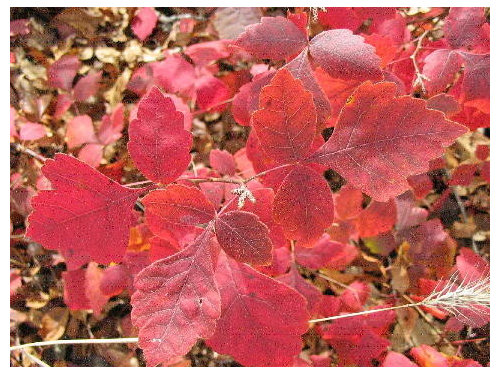
Recently we were up at Pomme de Terre Lake and saw this growing around the trees, mostly Oak. The color was so spectacular, I took a couple of shots. I don't know what it is. It was about 18-24 inches tall and growing in clusters all around the trees. I wondered if it was poison ivy, even though it was not vining.

Comments (13)

  • 19 years ago

    Wow that's RED! Very pretty. I think it might be fragrant sumac (rhus aromatica). The sumac I see growing around here is different, it has more leaflets so they don't look much alike.
    http://www.ag.ndsu.edu/pubs/plantsci/trees/eb38-41.jpg

    Here is a link that might be useful: Rhus aromatica leaves - google

  • 19 years ago

    gldno, Those are beautiful leaves and i think they are poison oak,same thing as poison ivy.I've read they try to imitate the leaves of the tree they grow under but always have three leaflets.

    Here is a link that might be useful: poison ivy, oak and sumac

  • 19 years ago

    I am leaning toward the rhus aromatica after Googling a MDC website that stated the following:

    "Poison ivy is a member of the Cashew Family (Anacardiaceae). Most Missourians have probably heard of at least three "poison" members of this family: poison ivy (Toxicodendron radicans), poison oak (Toxicodendron toxocarium) and poison sumac (Toxicodendron vernix). However, only poison ivy is common in Missouri. Poison oak is rare, and poison sumac has never been recorded here."

    Thanks for your input. I got very close and didn't break out which is another indication. I have poison ivy in the yard and often get into it weeding before I see it and almost always break out into a patch or two.

  • 19 years ago

    I got my order form this week for tree and shrub seedlings from the MO Dept of Conservation and noticed that fragrant sumac is on the list.
    I'm still trying to screen in my yard under some trees where it's very dry in the summer and thought fragrant sumac might work since it's supposed to be drought and shade tolerant. Do you think it would work for a screen or is the foliage all at the top? The order form lists the mature height at 8 feet.

  • 19 years ago

    Boy, G
    That really looks like poison oak to me!
    LLP

  • 19 years ago

    That IS poisen oak! I have both it and poisen ivy on this 80 acres of souther Mo. and altho Im immune to it, I try to get rid of it as soon as I find a patch. strong

  • 19 years ago

    There is also a poison sumac but from what I've read it is more native to farther South.

    This pic looks like poison oak.

    I'm highly allergic to both and have found that the best time to get rid of it is in the Fall.

  • 19 years ago

    Hi,
    I'm a botanist in MO and can tell you with 100% assurance that this is absolutely, no-doubt-about-it, Aromatic Sumac (aka Fragrant Sumac, aka Rhus aromatica). It is NOT poisonous and doesn't produce any kind of rash. In fact, if you crush the leaves up, they have an ALMOST pleasant smell, but not quite. : )

    You can distinguish it from poison ivy using two different characters: First, poison ivy has a petiole (stem) on the terminal (middle) leaflet of the trifoliate leaf. Second, poison ivy has irregular teeth and at least some of them will be somewhat pointed. Fragrant sumac has very regular teeth and they are rounded, as in the photo above.

    Here is the distribution of poison ivy, oak and sumac:

    Poison sumac - if you find this tree-like shrub (single stem), you are in a very high-quality wetland in the northern U.S.!!

    Poison oak - looks almost identical to poison ivy and, in the "ozarks region" would only be found in the southern extremities and not commonly.

    Poison ivy - found everywhere!! Very common and 99.9999% chance that if you break out in a rash in the Ozarks, it's poison ivy.

    Happy botanizing!

  • 19 years ago

    Fragrant sumac's leaves are all up at the top, with tall naked stems at the bottom. It is beautiful, though. Look all around by the sides of the highways, you'll see many different varieties.
    It's leaves look nothing like that pic. They are long and compound.

    Another tree around here that looks a lot like poison ivy is boxwood. When it's young, it's hard to tell them apart.

  • 19 years ago

    I don't mean boxwood, I mean box elder! Sorry.

  • 19 years ago

    Here's an easy trick to tell Box Elder apart from Poison Ivy: Box Elder has OPPOSITE leaves and Poison Ivy has ALTERNATE leaves. I used to get so mad at the freshman girls in the field botany class I taught because they'd come to a FIELD class wearing mini-skirts and high heels and then whine about being out in the woods. Since I'd told them repeatedly that field clothing was required for the class, I took them into an ocean of Box Elder seedlings down by a creek on campus. Then, I asked everyone what plant we were standing in, with a shocked look on my face. Of course, they all screamed "Poison Ivy" and starting doing an adorable dance in their heels, LOL. I let the charade go on for long enough to satisfy myself that they'd come dressed appropriately from then on!!

    Also, robiniaquest, I think we're talking about two different species of sumac. The one in the photo above is Rhus aromatica, but I think you're probably referring to the small tree-like Sumacs that we get (Rhus copallina and Rhus glabra). Those do have pinnately compound leaves and naked stems, rather than trifoliate leaves).

    : ) Happy botanizing!

  • 19 years ago

    I remember seeing a hedge of fragrant sumac at dam in Missouri. It was a nice facility and had an aquarium where they showed how they raise spoonbill fish. The plants on the grounds were labeled and I remember thinking that I would like to grow the plant. I never followed through.

  • 19 years ago

    Yes - you guys know what you're talking about. I didn't realize there was another type of sumac. I have been obsessed with the variation in the regular type we have around here everywhere. It would be just beautiful to plant an area with a nice selection of those.

    Also - thanks, botnerd, for the tip on distinguishing box elder from poison ivy. I used to call those things poison ivy trees when I was little, and my Dad kept telling me poison ivy doesn't exactly grow into a tree, but I swore it did! Later, I realized poison ivy had those hairy stems when they get big, and the trees didn't. Hmm... I'm not too bright. But maybe not as bad as your high heels-in-the-woods girls!

Sponsored