Software
Houzz Logo Print
regina_2010

Squash problem

16 years ago

Hi all - I have a beautiful row of BIG yellow summer squash loaded with blooms with baby squash approx. 2 to 3 in. long. I noticed that several different plants have one or two with the bottom ends rotting, turning to mush. I've never had this problem. They are not laying on the ground. I removed the bad ones and disgarded away from garden area. Any suggestions would help me save my squash, as they are my FAVORITE summer veggie. Thx in advance.

Comments (6)

  • 16 years ago

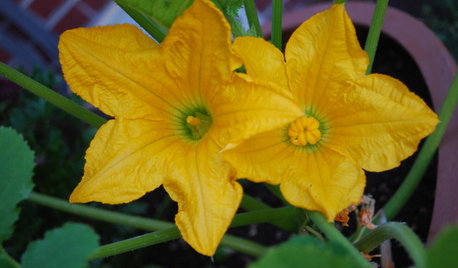
    Your squash are not being pollinated for some reason. If you look at your squash flowers, you'll see two kinds of flowers....male (plain flowers) and female (flowers with a little rounded fruitlet behind the flower). You have to have pollinators transfer the pollen from the male squash to the female squash. If pollinators are not finding your squash plants (assuming you have both kinds of flowers), you can hand-pollinate them quite easily, and George has a great explanation of how to do that on one of the threads here. Let me see if I can find it and link it.

    I'm going to submit this response and then go find George's 'how to' on another thread and link it here. I've hand-pollinated squash and cukes for years because sometimes the plants are so nice and lush that I think maybe the bees don't find the flowers. I always have plenty of bees and other pollinators, but sometimes it seems like they are goofing off or favoring certain flowers and ignoring others....like the squash and cuke flowers. Hand-pollinating squash only takes a minute...it takes much longer to explain it than to do it.

    If you look at your plant or plants and have only female flowers, you'll have to wait for male flowers to form so you'll have pollen. Sometimes the male flowers form first (which seems more common on some varieties than others) and then when the female flowers form, there's lots of male flowers around to do the job of fertilization. Sometimes, though, you get all female flowers first and have to wait for the males to show up.

    Dawn

  • 16 years ago

    OK, I found and linked George's tutorial on how to hand-pollinate squash.

    It includes the steps you go through in order to save seed. If you only want to hand-pollinate and aren't interested in maintaining the seed purity because you want to save seed, just skip all the parts involving masking tape.

    Hope this helps.

    Here is a link that might be useful: Geoge's Guide---How To Hand Pollinate Squash

  • 16 years ago

    Thx for the info, I did not know that. Very interesting. However, if I already have squash 2 to 3 inches long, wouldn't you say that pollination has already occured? I looked for bugs, none at the present time. There are squash growing on the same plant that appear healthy. I think when I went nuts spraying Sevin as a prevention, that I got it in some of the open blossoms? That's the only thing I can figure out. Sure hope that's the answer and I don't loose my plants and have to start all over. Lesson learned.

  • 16 years ago

    So, you have squash that are 2 to 3" long and then the blossom end turns a tan to brown color and then the squash shrivels and falls off the plant? That still sounds like a lack of pollination. The female squash will try to develop properly and then because they were not pollinated, they shrivel and drop off the plant. It happens all the time, and people think that because the fruits enlarged somewhat that they were pollinated, but that usually is not the case.

    The only other thing I can think of that it might be is choanephora fruit rot, which is a fancy name for a fungal disease that is essentially blossom end rot in squash. This is a disease that generally occurs only in high humidity/high moisture conditions. You should see two symptoms if this is the problem. First, the immature fruit will shrivel and turn brown and then, secondly, you'll see the development of a sort of yucky growth on the shriveled fruit. It will look sort of like bread mold. I do not know of any treatment for choanephora fruit rot once it develops. All you can do is try to keep the plants from staying too wet, so avoid watering if there is moisture in the soil.

    The way to tell the difference between a lack of pollination and fruit rot is that a lack of pollination looks like what you described, but the fruit rot goes further and has that moldy fungal growth develop on the rotted end of the fruit. If conditions are really wet and humid, it can progress upward and cover most of the brown, shriveled fruit. I'll find and link a photo of it for you to look at to see if it matches what you're seeing.

    In the future, to avoid this fruit rot, plant on raised beds with good drainage, space the plants far apart from one another to ensure good air circulation and take great pains to avoid overwatering. There's not much you can do if heavy rainfall occurs, but that's where the raised beds come in---they give increased drainage.

    There may be other diseases that cause a similar brown blossom end, but I don't know about them and have never seen them.

    Dawn

    Here is a link that might be useful: Image/Info Choanephora Fruit Rot of Squash

  • 16 years ago

    Some squash will grow a little, even if not pollinated. Then, they rot. I don't recall if there is a squash which produces large enough fruit to use, even if not pollinated. But I believe that there are such varieties of cucumber.

    Also, if the plant is stressed, it's possible that it will abort fruit set early on.

    George
    Tahlequah, OK

  • 16 years ago

    I am losing some of my small fruit to a rot that results in a furry or hairy covering that engulfs the entire 2-4" fruit. My plants have been producing prolifically for the past 10 days. Any ideas would be appreciated.

Sponsored
Peabody Landscape Group
Average rating: 3.5 out of 5 stars8 Reviews
Franklin County's Reliable Landscape Design & Contracting