Software
Houzz Logo Print
okiedawn1

Susanlynne48, I Have A Luna Moth!!!!!!!!

19 years ago

Susan,

Can you believe it?

I walked outside just a few minutes ago and went to hook up the water hose to the faucet so I could water some tomato plants growing in containers, and there it was!

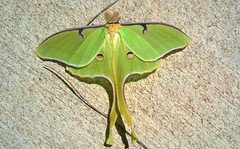
It is a male luna moth and it was sitting on a tall blade of grass in an area near the fence/power pole where we can only 'mow' with the weedeater, which I seldom do. I had intended to weedeat that area last Wed. but was out of gas, so I couldn't weedeat that day, and I have been too busy with the fire dept. since then to even think of weedeating. Now I am glad I didn't!

He is so big and so beautiful! My DH was at that faucet filling up the dogs' water bucket only a hour earlier and says he didn't notice the moth. So, I don't know if the moth just showed up, or if DH wasn't looking closely. The green of the moth is so similar to the green of the grass that it would be easy to miss him, but I have 'butterfly/moth radar' because I love them so.

I would love, love, love to see a female find him, so they can produce some more little lunas.

Have you seen any lunas this year?

Dawn

Comments (21)

  • 19 years ago

    I have never seen lunas in OKC, Dawn, unfortunately. I hear other people talk about finding them here, though. I think it's because I'm usually inside before dark, and I don't ever see them during the day, since they are primarily night-flying moths. I do keep my eye out for the cats and eggs on various food plants, but have yet to find any. These beautiful moths are highly subject to predation, which is why there are so few of them to be found.

    Males emerge 2-3 days before females, so he may be waiting for a female to appear. They can detect female pheromones from miles away. I hope there is a female soon to emerge.

    Also, he could be close to the end of his life cycle, too....wah!

    I'm sure you already know this, but these moths (silk or saturniids), have no mouth parts so they don't feed as adults. They survive on energy provided by food they ate as a caterpillar.

    Just in case you do get eggs, I've attached a list of food plants (which are numerous) from Bill Oehlke's website. I use his site a lot for the silks and sphingids. I have been in contact with him over the last year, providing photos and information on the sphinx moths, and also connecting him with John Nelson (a noted lepidopterist in Oklahoma) who recently completed the Moth Database for Oklahoma moths, including the catocalas that are found here. Bill has been doing research particularly on this family and is working on a state-by-state database of catocolas.

    His site has an absolute wealth of information on silks and sphingids, though, and he has helped me with identification and breeding info on the sphinx moths I have raised.

    YOU ARE SO LUCKY, GIRL!

    Susan

    Here is a link that might be useful: Luna Moth Host Plants

  • 19 years ago

    Oh, Susan, I do so hope that you get to see one of these beauties!

    I was so excited when I found it that I was shaking! I have seen them before, but back then I didn't know much about them, and didn't realize how rare they are and what a special treat it is to see one.

    Thanks for the list of host plants. Of the plants on the list, I know that we have the following: pecan trees, black walnut trees, white oak trees, smooth sumac, plum trees (both hybrid domestic cultivars and wild ones) and some kind of hickory, although I don't know which one.

    He has stayed in the same place all day, so maybe he is waiting for a female to come along and find him.

    I know they don't eat, and assume that large, plump body of his contains the food stores he will live off of for his few days here on this earth?

    If I happen to spot any eggs or cats, you know I'll let you know!

    Dawn

  • 19 years ago

    Dawn, does he look pretty "fresh"? You can usually tell by their appearance if they are fading from life. I hope he does find a female. If you find him with a female mating, get that female in a paper sack ASAP! She will lay eggs in it. You can cut tiny circles around the eggs and glue (don't use hot glue, heehee!) them to the bottom of a host plant leaf to hatch. Keep an eye on them and when they do, bring them in to raise if you want to. If you don't, they will likely be eaten by predators. Apparently, they're like a "gourmet hors d'ourvre" for them.

    If you can post pics of them, please do! I'd love to see your Mister.

    Susan

  • 19 years ago

    Susan,

    He looks fresh to me, but I am not an expert.

    I mean, he doesn't look faded and ragged like the old monarchs you see at times in the spring.

    If I find them mating, I will take the appropriate action. I was thinking that, if I capture the eggs, do you want me to send you some to hatch (if you have food sources available)? Maybe you and I are just dreaming, but wouldn't it be great?

    I did put a wire tomato cage around him to keep my kitty cats and dogs from bothering him.

    I tried to take pictures but they didn't turn out very well. He blended in with the grass so terribly well that he just looked like a green mass in green grass. My DS's girlfriend wanted for us to 'catch' him and take photos, but I was afraid that would scare him off. I will try again tomorrow to get better photos if he is still there.

    Do you know where he would have come from? Do they pupate on or underneath the same trees that are their food source? I'm trying to figure out if it would be worth my while to put on snakeproof boots and Deep Woods Off and traipse through the woods looking for more lunas? Do you think he is camped out underneath the security light on the power pole because he hopes a female will be drawn to the light during the nighttime hours?

    Do you realize that I have spent most of my time today thinking about him, trying to photograph him, showing him to anyone who stops by the house, writing about him, etc. etc.
    He has had all the attention today, and the garden has had almost none. That is not like me at all. Butterfly/moth fever is hard to control.

    I am seeing lots of sphinxes and clearwings, by the way. This seems to be primetime right now for the moths, and it seems to be primetime somewhat earlier than usual.

    Dawn

  • 19 years ago

    I think we are having lots more activity from the moths and butterflies this year, Dawn, because of the nice wet spring we had and the marvelous weather along with it. A wet spring means more host plant availability and prime conditions for a bevy of insects.

    I would try to raise them if it were me. You don't need to send me eggs - I'm too afraid something would happen to them.

    I read this on Bug Guide:

    " I read that the Luna Moth Caterpillar likes to hide in the leaf litter at ground level in order to make the cocoon.

    "My son and I went to where we found the caterpillar and picked a handful of leaves from each different variety of tree that was nearby.

    "We washed the leaves with water and after they were dry, put them in and enclosure with the caterpillar. Within about 2 hours it started pulling the leaves around it sort of like a sleeping bag. We watched for quite a while, it was fasinating. I guess the caterpillar makes something that sticks or glues the leaves in the right positing. By morning all the open places were sealed up.

    "If I read correctly I think it said the Moth should emerge in 2 to 3 weeks. Is this correct? I also read that it may choose to overwinter. So I guess if it's not out in a month when we have a winter guest.

    ...."

    I imagine any lunas raised this early in the year would eclose before fall and not overwinter. Those found in the fall would definitely overwinter in their cocoons.I cannot believe this! I am so, so happy for you.

    If you want to attract a female or male, you can also hang a white white from your clothesline at night, back light it with an incandescent light or black light. They will mate right on the sheet if you watch them closely. Then you can pop Mrs. Cecropia in a brown paper bag to lay her eggs.

    Seems like a lot of work, doesn't it, but I bet they're worth it.

    With the sheet trick, you're liable to see LOTS of different moths.

    Susan

  • 19 years ago

    First, the bad news:

    Well, around sunset last night I went out to look at the male luna moth and he was gone. I was so disappointed. I finally found him about 25 feet away, in our neighbor's pasture. He was alive, just barely, but was torn up and shredded like some sort of predator had gotten hold of him. I moved him to some tall, thick grass hoping he could at least die peacefully. This morning, he was not there, so I don't know what happened.

    I was so disappointed, and yet immensely grateful to have had a chance to see him at all.

    NOW, THE GOOD NEWS:

    While searching for yesterday's now torn and tattered male luna moth, I returned to the location where I first saw him. He was not there. However, another somewhat smaller one was and I believe she is a female. She has been in the same spot all day long today that he was in all day long yesterday. She seems a little tattered already. Just a small tear in one wing. I hope another male finds her.

    So, the joy of seeing two is awesome, but is tempered by the loss of the one.

    Dawn

  • 19 years ago

    Dawn, if you find her, put her in a paper bag and see if she will lay eggs for you. Do it at night and check the bag in the morning. If you're really interested in trying to raise them. If you're like me, sometimes you just have enough on your hands without trying to raise another species!

    The male may have been near the end of his lifespan anyway. They only live 2 weeks.

    Good luck, whatever you decide to do!

    Susan

  • 19 years ago

    Susan,

    She has hardly moved today, although she did attach herself to the tomato cage about 1' above the ground. (Then I surrounded that cage with 5 more cages to make it harder for a predator to get to her.) If she is still there in the morning, I think I might put her in a paper bag and see what happens.

    This is a very hectic time. It seems like every single thing in the garden, as well as the fruit on all the trees, is ripening and ready to be picked RIGHT NOW. So, tomorrow will be heavy on harvesting and putting food up.

    She isn't looking too perky. While working outside late this afternoon, I noticed she had ants crawling on her wings. I gently brushed them off. I wonder if she has already laid her eggs somewhere and is at the end of her life cycle? She seems quite a bit more lethargic than he was, and also more ragged. That is why I am thinking she is also near the end.

    I have to say that seeing them has been such a memorable experience. I have yet to see one single photo on the internet or in a book that truly does these moths justice. They are so beautiful and so delicate, and they have a beautiful quality to their color and texture that film cannot capture. I am awed by their beauty. And, of course, every time someone stops by the house, I have drug them over to look at the Luna moths these last two days.

    It's been a memorable experience.

    Dawn

  • 19 years ago

    Well, she was gone this morning, so I guess our Luna adventure is over.

  • 19 years ago

    Dawn,
    For the past week DH kept telling me about this really cool butterfly or moth he had seen at work. He just kept talking about it, and his description finally rung a bell with me. I googled 'Luna moth' and showed him some pictures, and he was excited to find out that's what he saw. I wish I had paid more attention to him the first day, as I would have had him take me back to his job so I could see it too. :) I've never seen a Luna moth but would love to. Anyway, just wanted to tell you your post here identified the "cool" moth DH saw at work.
    Thanks!
    Dawna

  • 19 years ago

    Hi Dawna!

    You know, I saw Luna Moths the first couple of years we were up here, but at the time I did not know that they were so rare. Then I didn't see any for several years, until this spring. Of course, knowing how rare they are and how seldom they are seen, I was very, very excited this time.

    It is great that your DH saw one and I wish you had been able to see it also. Now that you know they are in your area, you'll have to keep your eyes open for them. Ours like to hang out in the tall pasture grass, and they blend in with it fairly well. The first one that I saw looked like a pale green leaf until I got close enough to it to see it was a moth.

    We have had lunas at the fire station this year also, so they must be having a good year.

    Dawn

  • 15 years ago

    Hello. This is a wonderful conversation! I sometimes have luna moths in my yard. A few hours ago my mom and I were finishing up planting a pomegranate tree. It was dark, so we had the car lights shining so we could see. (We live out in the country, so it's nice and dark). All of the sudden when I just happened to look over to the fence, I saw it. I shouted, "Look, a luna moth! A luna moth!" My mom has never had the pleasure of seeing one before, only in the pictures I've taken. She was excited and kept saying how pretty it was, how happy she was to see it. I ran inside to grab the video camera. This luna was quite playful. It fluttered all over us. I think it may have been a female because it was smaller than the others who come around here. I wonder if there are any flowers that will attract them. I am glad you had the experience, Dawn!

  • 11 years ago

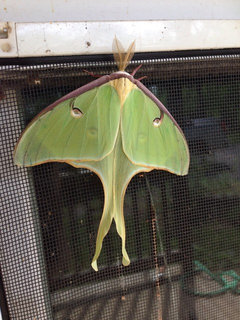
    I saw this on my driveway yesterday, 04/26/15 in Newnan, GA (just south of Atlanta, GA.) I knew it was special when I saw it, but I didn't realize how special it was till I started researching it!

  • 11 years ago

    PS-Can anyone tell me if it is a male or female?


  • 11 years ago
    last modified: 11 years ago

    I've seen several visit our moon plant in the past years. I'm not really a moth or butterfly person. maybe it was the large white flowers that attracted them. We did have a black walnut tree in the yard also, but I had to cut it down last year for fear of it coming down on the house in a storm.

  • 11 years ago

    big48fan, That is a terrific photo of a beautiful moth. I am no expert, but I think it likely is a male. Look at its antenna. See how thick and brushy they are? That is characteristic of a male. The female's are not as thick and dense. There's photos of both male and female antenna in the webpage I've linked below.

    Robert, I don't necessarily see them every year but probably see them 3 out of every 5 years. I remember them flitting around our porch light when I was a kid too, but hadn't seen them as an adult in many years until that spotting in 2007 that I mentioned in the original post. I love seeing them and am happy to know they are thriving in parts of Oklahoma like your area and mine. We have black walnut trees in our woodland, though not particularly close to our house.

    They also seem attracted to light at night because I sometimes see them clinging to the window screen outside the room where I have seedlings growing indoors on the light shelf. Maybe the fluorescent lights attract them because I don't see them clinging to window screens in rooms where there's just normal light bulbs in the light fixtures.

    Dawn

    Luna Moths


  • 11 years ago
    last modified: 11 years ago

    Thanks, Dawn, for your input! As I said when I posted the picture, I had no idea how rare it was to see one of these beautiful creatures until I started posting and researching! I feel truly blessed now to have had this encounter and thankful I ran for my phone and took pictures!

  • 11 years ago

    I'm so glad to have found this thread! We've had a Luna hanging out on the porch for two days, he clings to the window screen of one window. I was sad to think I had missed him the first night my DH saw him cause I was already in bed, but he has hung around. I wondered if he was a) newly hatched and just resting while he unfurled, b) waiting for a female to be attracted to our lights at night, or c) near the end of his lifespan. I checked on him about an hour or two ago and he was straight chillin and in very good shape, but just how he was fluttering against the windows and now the tips of his wings are a bit raggedy. I wonder if he was trying to escape a predator. I turned off the porch light and the lamp just inside the window, although not the rest of the lights in the house, so hopefully fewer other insects will bother him.


    In any case, I have always loved these beautiful creatures and have seen a few in my life in this area, but never here at this house. We do have sumacs and black walnut trees in the yard and I am slowly rehabbing the property that was much neglected before we bought in. I'm making it as wildlife friendly as possible- lots of natives and pollinator friendly flowers.


    The Dude Abides:


  • 11 years ago

    Lisa, Me too! I hope that she is okay.

    Aviastar, Thanks for posting the photo. I haven't seen any here this year, so looking at your photo was a nice reminder of how lovely these creatures are.

    When I was a kid in the 1960s in Texas, they were so much more abundant than they seem to be now.

    We live on acreage out in the country with abundant wildlife of all types, so I get to see tons of butterflies and moths of all kinds over the course of the year, but lunas remain fairly elusive. If I see 2 or 3 in a year, it is a big year, and some years I don't see any.

    Dawn

  • PRO
    11 years ago

    I just realized OP is from 2007! Still a great thread. Also of note is the much hated Sweet Gum tree is a favored host plant of the Luna moth. Many have been cut down in the urban environment due to the spiky balls. I personally love them. Great tree for wildlife. Amazing fall color. I even like the gumballs. They have seeds for birds and the kids love 'em. Make for great arts and crafts projects. I believe the decline of the Sweet Gum as a street tree is part of the reason you don't see as many Lunas today.