Software
Houzz Logo Print
borderokie

Plant identification

13 years ago

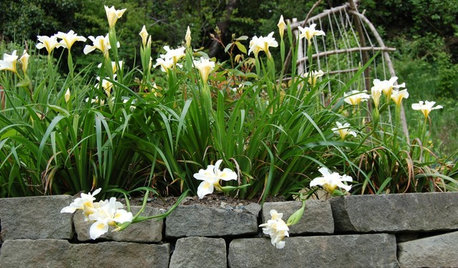
Can anyone identify this. It was given to me as a climing hydrangea. It is going on its 3rd year. Never has bloomed and is beginning to show up in the bed in other places. Just about ready to yank it out!

Comments (16)

  • 13 years ago
    last modified: 11 years ago

    If it is a trumpet vine if may climb everywhere

  • 13 years ago
    last modified: 11 years ago

    Larry - I thought the same thing when I looked at the pic. Yikes! That's trumpet vine!!!!

    Be ready to be diigent it you yank it. It's almost as evil as bermuda. And it has a tap root that goes at least half-way to China. If you yank it...be sure you get every little bit of the root. If it hasn't bloomed...I suspect it's in too much shade....which just means it's not going to be what you'd hoped and a pain. Pull any other runners you find also.

    Seriously, I've heard of this vine devouring entire sides of homes, fences, etc. It MUST be in a place where it can roam....like on a fence out by the road of a 10 acre place.

    Good luck...from the bottom of my heart.

  • 13 years ago
    last modified: 11 years ago

    oh great!!! She ordered it from jung and gave it to me by mistake it was suppose to be her climbing hydrangea mine was suppose to be a regular one. I am stil fighting wisteria! Nothing like a fight I guess!

  • 13 years ago
    last modified: 11 years ago

    Grows up to 50 feet. Sweet LORD!! And yes it is in a partially shaded area so that is why no bloom. How do I get into these things!!!!

  • 13 years ago
    last modified: 11 years ago

    Wear gloves when you pull it. It gives me itchy fingers if I get the juice on me.

  • 13 years ago
    last modified: 11 years ago

    Oh c'mon now. For Pete's Sake, can't we show some love for a plant that actually loves our climate and soil and wants to grow (and grow and grow and grow) here, y'all? : ) I am always going to love almost any plant that tolerates our dense red clay equally well in years when we have 18-28" of rain or 48-54" of rain. It doesn't freeze when we drop to zero degrees and it tolerated high temperatures up to 116 degrees and virtually no rainfall for 2 months in 2011. I believe it would grow in concrete, though I've never planted one in concrete.

    There is nothing I grow that demands less assistance from me that my trumpet creeper vines. The payoff? Gorgeous flowers for months that attract hummingbirds like mad.

    Some trumpet creepers are a little more refined in growth than others and some gardening fools like me adore them.

    We have Madam Galen's and the yellow-flowered "Flava' planted on an arbor near our driveway gate and mailbox. Being 300' from the outdoor water faucet, they almost never get watered. We have Madam Galen's growing in a gigantic mound in our side yard. Hidden underneath it? Our in-ground tornado shelter. Even though the doorway wall is uncovered and clearly visible, people never notice the shelter is there because they are looking at the beautiful orange flowers. We have one on the east side and south side of the wraparound porch.

    Finally, because the hummingbirds love them so, about 3 weeks ago we planted the red-flowered trumpet creeper "Balboa Park" in the new back garden where we are going to train it to grow on the garden fence on the south side of the garden, near all the other butterfly and hummingbird plants.

    Is some pruning necessary? Of course it is, but then we also have to prune the roses.......and I likely spend more time deadheading various flowers than pruning trumpet creeper.

    Granted, we are on rural acreage with plenty of space to grow a garden thug like trumpet creeper and I realize that people with a smaller or more refined landscape might not have the space or the inclination to just let it grow like we do.

    Still I will continue to love it, occasionally pruning it back as needed or mowing over shoots that occasionally pop up in the lawn. Another advantage is that deer don't eat it nor do any leaf-chewing pests.

    So, y'all can say slam my beloved trumpet creeper all you want and I'll just go on loving it.....and planting it. I intend to plant a yellow-flowed trumpet creeper on the south side of my potting shed as soon as I find one.

    Clearly I am beyond all hope and there is no use trying to reason with me. The heart wants what it wants, and this gardener's heart wants trumpet creeper. And, for the record.....we also have wisteria, and a mimosa tree too.....and a chinaberry tree. One person's trash tree or vine is another person's treasured plant.

    If nuclear war ever destroys life as we know it on this planet, I am pretty sure that trumpet creeper will survive, and along with its' equally invasive friends: Bermuda grass, Johnson grass, lamb's quarters and greenbrier...it will begin its final push to achieve world domination.

    Dawn (an unrepenitent planter of trumpet creeper vine)

    This post was edited by okiedawn on Thu, Jun 6, 13 at 1:28

  • 13 years ago
    last modified: 11 years ago

    lol!! Well Dawn I know where you can find another one tomorrow but I'm not sure if it is the yellow you seek to find. Not sure what color it is since it has not bloomed. Not enough room in my flower beds for that. And I had 3 Wisterias. They almost tore down the chain link fence. I still have one and I see them coming up all over the pasture next to the bed. I have seen those out of control before it is beautiful to look at but oh my! It took over a whole wooded are next to the side of the road. Not sure what they killed it with but a nuclear bomb might be close!!!

  • 13 years ago
    last modified: 11 years ago

    They probably used a brush/stump killer containing picloram. That is what we have used to keep poison ivy from invading our veggie garden from the adjacent woodland. Tordon is one example of such a product.

    If I wanted to remove an invasive plant, I'd cut it off at the ground with a saw (likely a chainsaw if it was already a large plant), and then I would treat the stump with Tordon. Then I would treat any new sprouts with Tordon. You have to be really careful to keep it off any desirable plants. I also would bag up all dead plant material from anything the Tordon was applied to and which it had killed and then would dispose of it in the trash. Picloram is one of the herbicides that can persist in compost and can contaminate soil for years so it should be used with extreme care. I'd never put anything treated with this herbicide in a compost pile.

    If I could not safely spray it without getting it on desirable plants, I'd drill holes in the stump and pour it into the stump or apply it to the stump or to new sprouts with a foam paintbrush. We have used Tordon only once since moving here in 1999, but we are about to use it again to her rid of a locust tree that popped up in the fence line that surrounds the dogs' play yard. It is a very strong and very persistent herbicide.

  • 13 years ago
    last modified: 11 years ago

    They bulldozed everything down. But I really doubt that would kill wisteria. It would have a root somewhere that would pop back up so you are probably right. I have been afraid to use anything. I put an apple tree back in the place of one (we dug it out) and I still see shoots every once in a while. Afraid to put anything there. Dont want to kill my tree or hurt the fruit. the other I could probably do that with it is in the flower bed. The 3rd one I just keep trimming back I like it but I hate the runners it puts out everywhere. I have thought of trying 2-4D on the babies in the pasture but just havent had guts to do it. Afraid of contaminating everythng. Plus that stuff can drift a LONG ways. Had a guy come in the greenhouses. Killed someones sunflower crop a long ways from where he sprayed it. I'm chicken!! They are small so I might could paint them with it. Do you know off hand if 2-4D would kill the small ones.

  • 13 years ago
    last modified: 11 years ago

    I bought some stuff to kill this plush ferny stuff in my yard that then turns into this sticker stuff from satan. I cant go barefoot in my yard anymore. Thats how I got the stuff with 2-4D Didnt look at ingredients back then. Didnt know as much about them. Never used it. Anyone have any ideas for what will kill that wonderful stuff.

  • 13 years ago
    last modified: 11 years ago

    I read if you drill into the stump and pour epsom salt into it it eats away the stump, and PDQ. Also, have you tried the 1 gallon vinegar/1 cup salt/2 tablespoons dish soap? That's what I have been using on the poison ivy and devil's thorn here, and it works pretty well. I have had some turn black within a few days and other parts I have had to do a few times now, but it seems to be working to kill it.

  • 13 years ago
    last modified: 11 years ago

    I would rather try those thanks

  • 13 years ago
    last modified: 11 years ago

    I had to laugh when I read your post, Dawn. I adore both trumpet creeper and wisteria and am growing both from seed I ordered online. Right now I have 3 wisteria seedlings about 2 inches tall and 2 creepers about an inch or so. I look forward to them growing without much help from me. I like you, have the room though.
    I want to try to prune one of the wisteria into a tree for the front of my property. I'm a big fan of plants that smell really good, so along with the wisteria and trumpets, I'm growing lilacs, jasmine and honeysuckle.

    I figure if I keep planting things we won't have so much land to try to mow or brush hog. :)

  • 13 years ago
    last modified: 11 years ago

    borderokie,

    It is my understanding that 2, 4 d is not very effective on trumpet creeper, but I wanted to go and see if I could find some research that supported that belief. I found research that does, indeed, support it and have linked that research below. Unfortunately in the study referenced in this report, there is no data available on whether or not Tordon killed trumpet creeper, so I guess they didn't test that herbicide on that plant.

    One problem with 2, 4 d is that it has been around a long time and research has shown that many plant species develop a resistance to, or tolerance of, specific herbicides when they are used in a widespread manner over a period of many years. The chemical industry keeps coming up with new herbicides or they tweak the formulas of the existing ones because of the way plants become almost immune to the older ones. Another issue with some herbicides in recent years is that some newer forumulations have esters that are more volatile and therefore travel more readily through the air when sprayed and kill plants far from their intended target plants. The formulations that have amines instead of esters are not as volatile in the air and do not cause such severe issues with herbicide drift. However, the amine formulations are less effective than the ester formulations.

    I have had trouble in some years with herbicide drift damaging and killing vegetable garden plants when nearby pastures are sprayed with a herbicide. That is frustrating, but I don't say anything to the ranchers whose herbicides likely harmed my plants. I just cringe when I see them spraying and I then cross my fingers and hope the wind is carrying the herbicide in some other direction and not towards my garden. It hasn't happened in several years now, so maybe they have switched from an ester product to an amine one.

    Jenny, I am glad I am not the only one who loves these invasive plants. If I lived in some places, like in the southeastern USA where they are horribly invasive on a scale we likely cannot imagine here, I likely wouldn't love them and grow them. However, we have enough recurring drought, normally dry summers and enough cold winter temperatures that I think they are somewhat less invasive here. My trumpet creepers that grow on the driveway arbor down by the mail box almost died in 2011 and I wasn't sure if they'd survive, but they did.

    I adore jasmine, lilacs and honeysuckle too, but of those three, I only have coral honeysuckle at this time. Jasmine tends to freeze out here in an extra-cold winter and the lilacs are fine until we have a long, cold winter/spring and then they die in perpetually wet clay soil. Now that I have a garden plot out back of the barn that has well-drained sandy soil, I may plant lilac again.

    I agree about using planting as a way to reduce mowing. After we first moved here, we had to mow about 4 acres of open land in order to keep the grassland areas short for both fire protection and to keep the snake population down. We are in our 15th year here, and every year we have less and less to mow. We now mow about an acre less than we did back then. I hope to just keep planting and planting until we have even less to mow.

    My other strategy was to get rid of bermuda grass by shading it out. Our trees and shrubs have gotten big enough now that we are seeing the bermuda grass start to recede in the increasingly shady yard. As an area gets too shady for bermuda, I am replacing grass with low-growing shrubs, shade-loving perennials and ground covers. My hope is that by the time Tim retires in a few more years, he'll have something to look forward to beyond mowing a huge lawn and pasture area twice a week. I guess I should stop calling it a pasture and start calling it a meadow because no domestic animals have been pastured on it since we moved here.

    Down south of Thackerville, there is a home where they have trumpet creeper growing on a barbed wire fence that separates their yard from the adjacent pasture. I 'd guess it is growing on a fence about 100' long. I think it looks pretty all the time, but when it is in bloom, it is truly spectacular. I've long thought about growing it on our barbed wire fence line that runs along our south property line, though I've never taken the plunge and planted it there.

    Most of the 'trash trees' I've planted, like the mimosa and chinaberry, were planted because (a) we had them in our yard when I was a kid so they are sentimental favorites, and (b) the wildlife love their flowers. Sometimes there are plants that you just have to grow because growing them makes you happy. At our house, the trash trees, wisteria and trumpet creeper plants are in that category for me. I even love pink evening primrose despite its invasiveness. It looks so pretty when it is in bloom,though I do try to keep it away from the vegetable garden.

    The challenge here is that most of our soil is dense, red clay and the plants that will tolerate wet, heavily-saturated clay in very wet years often won't survive hard-as-a-rock dry clay in very dry years, and vice versa. So, when I find a plant that tolerates the clay in both extremes, I grow it and I learn to love it.

    Trumpet creeper is one of a handful of really persistent plants in the category that I describe in this way: "it won't die and you can't kill it'. That's why I love it so here, on our property, where the wildly fluctuating moisure levels and temperatures can be so hard on wimpier plants.


    Dawn

    Here is a link that might be useful: Herbicide Research on Specific Weeds

  • 13 years ago
    last modified: 11 years ago

    I have a yellow flowered trumpet vine that I planted on purpose on my mulberry tree and an orange one that goes high in the branches of an elm in my yard. Both are in place I can control because I mow around both trees. I like vines but I have a pepper vine that climbs my meter pole and causes trouble. It comes up all around and it is on a rough hill where I don't mow. Where I lived before small but fast growing trumpet vine came up everywhere in the yard and until I found out it wasn't poison ivy I was getting into, I had itchy fingers all the time.

  • 13 years ago
    last modified: 11 years ago

    Helen, We have some very persistent pepper vine on the eastern edge of our woods, in the roughly 20' between the edge of the woodland and the roadway. It is in an area we mow, though, so it never gets too tall. Every so often we hit the area where it is with the string trimmer along the fenceline in order to keep it from climbing the fenceline and getting up into the trees.

    I spent every winter of our first 6 or 8 years here working to remove incredibly old and tall greenbrier, poison ivy, peppervine and other invasive vines that were running amok in our 10-acre woodland. I was out there pretty much all day every day, often in areas pretty remote from the house. There's no way that one person working with handtools can keep that sort of stuff under control on that many acres, so I mostly focused on getting rid of as much as I could initially and then, since then, all we try to do is keep it out of the pathways and also away from the garden. I pretty much try to tolerate anything that grows here and provides food or shelter for wildlife, but in order for us to be able to walk through the woodland, we at least have to keep the vines back a certain distance from the pathways. Keeping the edges under control is not easy...the woods keep trying to spread and advance southward, and we keep pushing them back.

    Dawn