Software
Houzz Logo Print
chevere33_gw

wilt on Peruvian bean

17 years ago
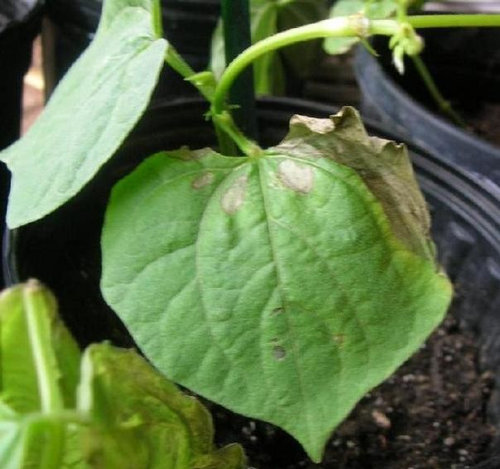
Hello. I am having a problem with a type of Peruvian bean which requires 120 days. I hope the picture I'm posting comes through.

In February, I started the seeds in my basement, with lights and a fan (this is the way I do tomatoes and I grow sturdy tomatoes). I started them in small peat pots, transferring them after about 6 weeks to 6" plastic pots, which I did sterilize. I left them in the peat pots, but slashed them some and ripped to make sure the roots didn't end up bound. They were fine for a while, then what appeared to be maybe wilt appeared on some; at the same time, some had started to vine(I had sticks in there for them), and most of them just dried off at the tops and came right off the sticks. Now I only have one that still is vining, and all have the malady, whatever it is. My plan was to put them in the garden two weeks from now, but because of this issue I have barely begun hardening them off for fear that they will completely dry up.

I am hoping someone has suggestions because I really want to make this work. The plant is a legume commonly called ñuña and the botanical name is Phaseolus vulgaris. It is not probably anything most people would want to grow but I really want these to be successful. Thank you.

Image link:

Comments (12)

  • 17 years ago

    Environmental stress. Check potting mix. Too wet? Or did it dry out once?

    Or is the peat pot restricting root growth?

    If you have a number of seedlings, it would be worth removing at least one from the container to take a look at the roots, also the peat pot. It's a good bet the later is dry.

    Whatever happened, a tip for next time -- either remove the peat pots entirely or make certain they are soaking wet before you plant into the next larger size pot.

  • 17 years ago

    Thank you. I think I will check it out. I was worried enough about the roots being bound that I did score the peat pots, and ripped them in some areas, but I think your idea about stress is valid.

  • 17 years ago

    I don't think it's likely that you have it in IN since it seems to be confined (so far) to warm states like FL but there is a blight that looks similar to your picture. I don't know much about it so I'll include a link to info & photos with this post.

    I suggest you take a plant (pot and all) to your local extension office to see if somebody there can accurately identify it. If not, they should be able to send it to your state university for identification. I know that won't help save your current crop but it may help you prevent it in the future, providing it actually is a blight and not cultural as jean001 suggests.

    These long distance diagnostic attempts are difficult at best. Hands-on, microscopic investigation is the only way to be sure of what's going on. (Saw your post over on the Master Gardener forum.)

    Sandy

    Here is a link that might be useful: Choanephora blight

  • 17 years ago

    After a bit of research on the particular type of bean, I see it's from the tropics. So if it turns out to be choanephora blight, it's possible it is carried in the seeds. This is not something your local extension may have seen before so you might want to mention the "possibility" if you take a sample to them.

    Of course, it still might be cultural. No way of knowing at this distance. Have you unpotted one of them yet? If so, what did you find?

    Sandy

  • 17 years ago

    Please look at the OP's image. It's *not* choanephora blight.

  • 17 years ago

    Hi jean. I'm sorry if I implied that I "knew" it was cb. It was just a suggestion for the OP to consider. As I'm sure you know, without examination of the plant, diseases are hard to diagnose. And you're right that it may be cultural. But without the plant in hand and a detailed description of it's care, that diagnosis is difficult, also. My suggestion that the OP take the plant for an in-person examination still stands. That's the only way to be absolutely sure.

    Sandy

  • 17 years ago

    I am thinking it was environmental stress, although whatever was the offensive entity must be done offending now, because the new leaves seem healthy, although the plants are spindly. Thanks for the tips. If I see anything different, I'll post again. Also, if you think of anything, please post me (and other thoughts welcome). Thanks again.

  • 17 years ago

    Several questions.

    1. Have you sacrificed one of the struggling plants as yet to examine what has occurred with the roots and the peat pot? (I bet that's where the problem is, at least in part.)

    2. What conditions are the plants in now?
    Are they still in the basement?
    If so, what is the light?
    a. Kind of light; if fluorescent, how many tubes, and how long are they?
    b. The lighting strategy: how high above the plants, and how long do you run the lights each day?

    3. If the plants are still in the basement & under lights, can you start hardening them off to move them outdoors?

  • 17 years ago

    Jean001 - thank you for your responses! I am sorry I am so late getting back to you. I am still going to post answers in case you can shed some additional wisdom. I am pretty sure you were right about the environmental stress, though, since they are now outside and doing fine (albeit growing VERY slowly).

    I did eventually open one up, and I had ripped/scored the peat pots sufficiently enough that the roots were able to extend beyond the peat (at least at that point). By the time you posted, I had begun hardening them off by bringing them up from the basement . . . for a few hours outside and the rest of the day by a doorwall (western exposure).

    The lights are florescent and about 4 feet long (two tubes). I had them maybe an inch above the tallest plant, and ran them for about 14-16 hours a day, on a timer. I think that part of it was done correctly, since that's how I do my tomatoes and have success with them.

    We live in a REALLY windy area, so I put the fan on them fairly hard and forgot about it one day, so they were blowing for over half a day. I am thinking that was the stress, either that or the initial repotting. Not sure, since I didn't keep records. :( I just looked up one day after not going down there for two days, and they looked pretty bad.

    I am hoping they will give me beans. I inadvertently transposed the numbers in my first post --- they need 210 days (NOT 120!), and we are in northern Indiana. If not, I will give it another go next year, and learn from my mistakes.

    Again, any wisdom you can share would be most welcome, since I intend to do this again. I am done with school now, so should be keeping up with my mail now!

    Thank you, and thanks to all who shared.

  • 17 years ago

    You wrote "they need 210 days (NOT 120!), and we are in northern Indiana."

    Oops. In order to get beans, you may need to start new plants very early indoors. Or build a greenhouse for them!

    Have fun with your experiments.

  • 17 years ago

    I thought you might be interested in what happened to these. As I mentioned, Jean was correct. My plants thrived and grew. And grew.

    I am feeling like they might reach the top of the garage, since they are already way past the supports my husband built. They are 9-10 feet tall. That's great, but . . .

    . . . no beans. No blossoms. Nothing. Zip. Nada.

    So I did some hunting. The 210 days is actually not a problem, because the original issue was that they were started in my basement in February. HOWEVER, I found out that they will not flower if there is more than 12.5 hours of daylight. SO, I would have to build them a greenhouse AND cover it for a few hours each day.

    Maybe they still have time to get those beans out before first frost. :::sigh:::

  • 17 years ago

    Another problem may be that your area may lacks sufficient heat. In my area that would certainly be true because the nights are dramatically cooler than the days.

    Thanks for the update. It helps us all learn.