Software
Houzz Logo Print
santoury

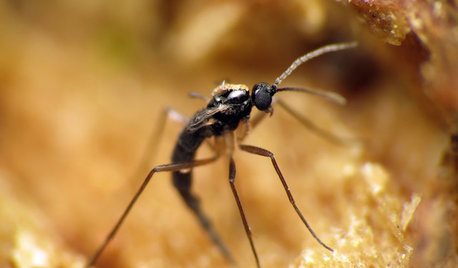
fungus gnats!!!!!

18 years ago

I'm sure there are millions of people who have posted about these, but I don't feel like going through 300 pages :)

Of course I have Fungus Gnats. Who doesn't? I do NOT use any chemicals - no sprays, no soaps, etc. I don't want the hassle of mixing this and that. Moreover, with thousands of plants, specialized watering is not practical.

I guess the yellow sticky traps are my best bet for population reduction? I would love to trade for a supply of these - I have plants to offer.

Comments (18)

  • 18 years ago

    If you dont want to spray anything or change watering habits, you would be better off looking into "Hypoaspis(sp?)miles...a predatory mite (are your plants in a greenhouse or outdoors???). If you have a lot of plants indoors, you would accomplish more with these good mites than sticky traps (which are best used to "indicate" you have a problem vs solving a problem).

  • 18 years ago

    sticky traps are a diagnostic tools to determine what kind of bugs your plants have ....

    they are not a cure ....

    the eggs are in the soil ... and even if you trap every single adult.. the kids will emerge sooner or later ... and the cycle will continue ....

    i avoid such problems by sterilizing the soil in potted plants and medium .. before i bring them in the house in fall .... medium can be sterilized in the oven or in the microwave .... potted plants need chemical or biological control or need be repotted in clean medium ....

    i never heard of the mite cure before.. but would be hesitant to introduce another bug into the house.. to get rid of the first bug .... but i would do the research ...

    no chemicals.. no change of the watering schedule which has caused the problem .. and no interest in researching the forum for previous posts .... good luck Don Quixote ....

    ken

  • 18 years ago

    The Yellow Sticky traps will capture the adults that fly about, they are attracted to them, and if you capture the adults you reduce the number of eggs that will be layed in the soil so in addition to being a method of diagnosing a problem they can be part of an effective control measure. The egss hatch in moist soil so the most common, and simplest, method of Fungus Gnat control is to allow the soil to dry between watering. Most house plants are overwatered and the largest problem we see with house plants at the Extension Office is from overwatering.
    To see if a potted plant needs water insert your index finger to the first knuckle from your hand into the soil and if the soil is dry water, if not don't.

  • 18 years ago

    If you have thousands of plants, and a bad infestation of fungus gnats, then I strongly suggest that you avail yourself of some Gnatrol. Gnatrol is a biological control of the fungus gnat larvae, and is applied during your normal watering schedule. Yes, it DOES have to mixed according to directions, but I'll bet that you won't find that too challenging, lol! It can be applied via your fertigation or injection system, drip irrigation, siphon system, or in a plain ol' watering can. Truly, you'll have to do nothing special other thana read and follow the directions.

    The use of Gnatrol PLUS some sticky cards would be quite helpful in the control of this pest. In the future, though, you might want to re-evaluate your potting mix. Oftentimes, over-watering is not the cause at all, but the consistency of the potting medium. A very coarse, rapidly draining mix will not support fungus gnat larvae. And such a medium is pretty impossible to over water, too!

  • 18 years ago

    "i never heard of the mite cure before"

    Ken A.

    Hypoaspis miles is a predatory mite and has been used for decades+ in commercial greenhouses. For the average homeowner and their houseplants, not even worth thinking about (I would not release them in my home)....but worth looking into if "thousands of plants" are involved

  • 18 years ago

    Could be, but with populations of beneficials it's sometimes difficult to keep them contained to a g'house environment. I have used gnatrol since it has been on the market when I needed gnat control. Nothing could be simpler than running a little BT israeliensis through an irrigation system. It has zero potential for phytotoxicity, and is safe no matter what stage your plants are in and safe for mammals in general.

    As an aside, I don't think I have had any type of gnat problem of much consequence in the seventeen years I've run my own business. They have been a problem maybe four or five times if extraordinarily dark/dank stretches of weather in winter when constant soil moisture was a problem and I can almost tell you for sure it was when somebody who was not as experienced was doing the watering.

    I've used a variety of commercial soil mixes, some one certainly could call soft and dense. I've used the sharp draining coir mixes as well but can also tell you there are certain crops in which that medium does not produce a good product. I've also used private formulae mixes produced on site when I was a head grower at another concern.

    It doesn't make a doodly what you start out with there is always a potential for acquiring a good infection of fungus gnats, just like there is always a potential for fruit flies or cabinet moths in your kitchen. Round, round, round, round, ..........they get around. (Thank you beach Boys)

    It does all boil down to soil moisture and how you water and being a consistently inviting environment for them to multiply. Just fluffing the soil up and drying out a crop is sometimes sufficient if you haven't let the numbers get out of hand. If they are past that point.......then BT I is your best friend.

  • 18 years ago

    They are not going to leave just like that. You are going to put up with a "fight" and act. I am almost done with my fungus gnats problems, and I read and tried everything I could find on this site. I still have sometimes one or two flying on my computer monitor, but I keep on fighting them. Mosquito dunks did the trick for me, and I have to watch that some plants are not overwatered.
    If you love your plants, you'll have to get out of your way to help them. That's just the way it is.

  • 18 years ago

    I have thousands of plants, many times over in my busy season.........and you can take it to the bank, they do get watered differently depending on their needs, the weather and the soil types. Proper watering is one of the most important functions of your job in raising plants. And, unfortunately it's the one most delegated to those who are new or inexperienced in this industry. The right culture is the key to not resorting on chemicals for a quick fix. I use chemicals when all else fails, but find that the extra time with culture is in the end cost effective.

  • 18 years ago

    Calliope,

    Its great that Bt has worked well for you on FG's, because you have used it from the very begining helps a lot. BUT....in the big world of FG control (and beyond), this form of Bt (Gnatrol) is only effective on the first couple of enstars of the larvae,afterwords if is very limited on its control (mainly because most do not stay on a "constant" application program)

    Schmoo

  • 18 years ago

    "only effective on the first couple of enstars"

    Strike that.....it is "most effective" on the first instar,much less effective on later instars.

  • 18 years ago

    I can count the number of FG infestations I've had in my own greenhouses in 17 years on one hand and that's a big claim because I grow winter crops. I've only had to run a Gnatrol like product a few times. OTOH, a greenhouse I worked for years ago had a continual problem with them to the point they were a major factor in losses in winter crops. It's mostly in the culture.....not the chemicals and not the soil. A chain can be broken at any link. So pick one and go for it. After a good drench of gnatrol there's nothing stopping you from hitting the crop with a good soap spray for the adult population. If you still see a heavy population a few weeks later, then reapply the gnatrol according to label directions.

    I did not imply that I'd use it as a prophylactic so I don't understand what you mean I use it from the very beginning. I did mean, like with any other pest, you scout.........scout.....and scout some more. This is where your sticky traps come in handy. FG adults head for the g'house skins and are usually evident shortly after you get them if you bother to pay attention. Then you deal with the issue immediately before it becomes a problem. I much would prefer to use this product than a less specific poison on adults. You can argue about any treatment you choose to use. They ALL have their advantages and drawbacks. It's a pity to pick out a safer and very effective treatment like BTI and pick it apart.

  • 18 years ago

    "It's a pity to pick out a safer and very effective treatment like BTI and pick it apart"

    Calliope,

    Maybe I came across as "picking it apart", but that was not my intention. My point was to at least bring up this is not the "silver bullet" (yes, I agree this product does work)...use this stuff and all of the problems(FG) will go away....that is not normally the case. As you mention, all means of control have good points and bad points....if you mention the good points, shouldn't someone be informed of the bad points also??
    If the optimum enviroment is created for FG's,other insects,disease etc.etc......you can spray/drench all of the Bti or chemicals you want and still end up losing

  • 18 years ago

    I beat fungus gnats in my house with beneficial nematodes.

    I tried Gnatrol with no luck at all.

    I used the yellow sticky traps which caught many adults, but it never would eliminate them all.

    I tried drying out the potting media (til my plants wilted), but they would just switch to other plants.

    I have about 40 plants and DO NOT over-water.

    The nematodes I bought were the live ones on a sponge although I know you can buy the ones in "suspended animation" which probably work just as well, and are easier to apply. The cost was about $15 plus $20 in shipping for next day delivery of the live ones. They were the ones for soil pests, but I forget the exact Latin name. Kind of expensive, but I'm free of those buggers cruising around my head! I spent $$$ on traps and Gnatrol. Nearly killed some of my plants by drying them out too much. I wish someone told me how well the nematodes work from the get-go!
    -Jim

  • 18 years ago

    BT israeliensis works and I've also had success with 1 tablespoon of lime added to a gallon of water and drenching with that. No idea what instars are affected, but it works.

    tj

  • 18 years ago

    Many people start a "pest control" program with the most potent product they can find and then find that it does not work, evidenced by many of the posts here. Most all house plant problems that we have seen around here, and others from around the state involved in the Master Gardener program tell me it is the same where they are, is overwatering, but also placing the plant too near a heat source so the air is too dry, the plants roots are too wet and the plant is too dry. Very careful watering, but misting the plant frequently, will solve most house plant pest problems, fungus gnats and spider mites.
    There is seldom a real need to spend much money on products to control these, or very many other insect pests for that matter.

  • 18 years ago

    Thank you everyone - sounds like I'll just stick to trying to find the yellow sticky traps. I do not let my plants dry out - for obvious reasons, and THIS even, does not get rid of them all (Have tried it)
    So yeah, "a few gnats leftover" is better than using chemicals or investing in another control system, since I hand-water all the thousands of plants, since they all dry out at different times, and can you imagine measuring just the right amount when you hand-water approx 50 - 100 gallons of water every few days?
    Thanks all

  • 18 years ago

    I was recently told cinnamon works on the dratted gnats so I'm currently sprinkling my houseplants with it. I have not treated all the pots but I can tell I do not have as many (not as many flying in front of my computer screen!).

    Peggy

  • 18 years ago

    This stuff from gardens alive works really well. But what I'd do if I was you, since you are hand watering all those plants on a different schedule, mix it up and water each plant with it on it's on schedule, so that might mean using it each time you water for about a month or so.
    A pint of this product ought to be enough for you to do that. After they've all been watered with this stuff a couple of times, the gnats should really thin out. And eventually go away if you keep using this solution for a while. It's the same stuff as the Gnatrol, but a smaller jug so you don't have to spend so much money at once and get a commercial supply. I hope this helps because I've had fungus gnats in the greenhouse before and the Gnatrol and this stuff was the only things that worked that I tried.

    Here is a link that might be useful: gardens alive website

Sponsored
Custom Home Works
Average rating: 4.6 out of 5 stars10 Reviews
Franklin County's Award-Winning Design, Build and Remodeling Expert