Software
Houzz Logo Print
gtippitt

Tomato Early Blight, aphid damage, or heat damage? HELP !

19 years ago

Is this what Early Blight looks like, and is it always early?

http://bellsouthpwp.net/g/t/gtippitt/tomato_leaf_top.jpg

http://bellsouthpwp.net/g/t/gtippitt/tomato_leaf_bottom.jpg

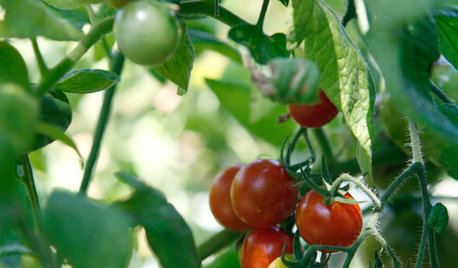
I have two tomato plants that I am growing in 10 gallon buckets. I have a large hole drilled in the bottom of the buckets and grow these two indeterminate plants hanging upside down in the manner of the "Topsy Turvy Upside-Down Tomato Planter". This has worked well for me the past 2 years. I try to grown them organically. Because of the temps near 100 each day and no rain in months, I water them both daily with compost tea to fertilize them, and they have grown well. They are potted in a mixture of half commercial potting soil mix and half compost. The compost was made from last fall's bagged lawn clippings from a herbicide free lawn. The clippings were about half grass and chopped leaves from poplar and maple that were picked up by the lawn mower. The mixture heated up well and aged all winter. As the soil settled and its organic matter decomposed, I have topped the containers off with more compost to mulch the plants roots that have grown to the top of their containers. One of my plants is a cherry tomato and is not having any problems. This cherry tomato plant is nearly 6 feet long and hangs heavy with clusters of tomatoes like grapes.

My other plant is a German Johnson (non-potato leaf) heirloom variety. I have only gotten one tomato from this heirloom, but it was large, meaty, and one of the best tasting tomatoes I have every eaten. All spring this plant was infested with aphids and red-spider mites, and only a single bloom set to form fruit. The aphids and mites, ate around the neck of each bloom until it dropped off the plant. Each day for 2 weeks, I tried hosing the plants down with a water hose to wash the bugs off, but this was only slightly effective. The single fruit I have gotten from the plant formed after I began these "fire hose" treatments.

I kept trying to decide why the cherry tomato on one side of the house had lots of lady beetles and other predatory bugs, but no aphids or mites that I could see, while the German Johnson on the other side was being eaten up by pests. I noticed that the cherry tomato plants was near a porch light that comes on dusk to dawn, and thought that this might be attracting beneficial insects. I gave up on the "fire hose" treatments and then tried putting a spotlight on the pest infested heirloom at night, and after a week, every single aphid and mite was gone. I don't think I have ever seen or heard of using a light at night as a method of attracting beneficial insects. Has anyone heard of this, or was it a coincidence?

After I got rid of the aphids and mites, I did not expect much fruit to set until there was some break in the temperatures. I am cherishing my cherry tomatoes and hope to keep the indeterminate heirloom plant healthy for a good fall crop once the temps dropped a bit. The plant has now started dropping its leaves. All of the leaves are now gone from the oldest half of the plant, which would be the lower half of the plant if it were not hanging upside down. The newer growth is now starting to turn yellow and die as well. The leaves look somewhat like what I can find of "Early blight". From what I can read about the German Johnson variety, it is supposed to be very disease resistant.

The new growth is lush, green, and has lots of blooms, but it is not setting fruit. More and more of the older growth is dying each day. The leaves first begin to look like the one in the picture below, then turn turn yellow, then brown. Once one of the leaves on a stem begins to look like this, the entire stem will be dead 3 days later. Did the pests weaken this plant beyond saving, or it is simply dropping the damaged leaves? I cannot judge for certain, but I think that most of the foliage that is left, may be new growth since I got rid of the aphids and mites. The plant is also on the southwest corner of my home and gets hot sun all day. Like most of the nation, it has been near 100 much of the summer, but unlike most of the nation, we have only had about an inch of rain per month, so I water the plants every morning. Is the plant doing all it can to survive the heat in afternoon sun?

Can anyone look at my leaf pictures at the links below and tell me what is wrong? What I might do to save it? I prefer not to use anything toxic, because my dogs play on the patio beneath the plant, and I hope to eat the fruit from the plant.

http://bellsouthpwp.net/g/t/gtippitt/tomato_leaf_top.jpg

http://bellsouthpwp.net/g/t/gtippitt/tomato_leaf_bottom.jpg

Thank you,

Greg Tippitt

Knoxville, TN - USDA Zone 6B

Image link:

Comments (2)

  • 19 years ago
    last modified: 11 years ago

    I don't think ALL the aphids and mites are gone Greg. I still see some in the photos and the rolled edges are classic signs of their damage. How often and what are you feeding? Remember that aphids and mites are both real partial to excess nitrogen.

    I also see some early magnesium deficiency in the leaves and veins. Have you ever tried epsom salts on your tomatoes? If not, try giving the plants (1) 2 T of ES dissolved in 1 gallon of water as a root drench, or (2) mix up the above and put it in a spray bottle to mist the plant leaves with (early AM and not in the direct sun).

    Hope this helps.

    Dave

  • 19 years ago
    last modified: 11 years ago

    I've been feeding them with compost tea when I water twice each day. Like most tap water, mine has a a fairly high pH, so minerals may not be as available to the plants as they should be. I try to avoid all toxic stuff, but I do use non-organic fertilizers when my compost for tea is either used up or washed out. I mainly compost maple tree leaves and grass clippings that I bag with the mower each fall.

    I gave the plants dose of Epson salts and bought a small package of Miracid fertilizer with trace elements. I'm going to try adding a small bit of this each day with their water to lower the pH and supplement their feed now that I am running out of compost that is not already washed out.

    The rate of leaves dying has slowed down a bit, so it looks like the plant might survive to give me a fall crop after the weather cools down a bit. I am not sure if the improvement is because our temp for the past week has finally dropped from over 100 to the high 80s. It may also be that the sick leaves are the left over ones from before I got rid of the last few aphids and mites. I cannot find a single aphid or mite anymore. It cannot tell for sure which growth on the plant as emerged since the final bugs were beaten. I did take some of the leaves and hold them up to a flash light last night to see if there were any pin-holes. The leaves that have any yellow all seem to have some tiny holes that light would shine through, but the newer mature leaves do not have any holes or yellow.

    Thank you for the suggestion regarding the magnesium. Between the Epson Salts, more balanced pH, lower temp, and beneficial bugs, I hope somethings works. If I can get this problem with leave drop fixed, I think I can get a good fall crop. The plant's basic stems and roots seem to still be very healthy and there is enough new growth with leaves to still produce a good crop once our night temps drop back below 70 so my blooms will set fruit.

    Knoxville is near the mountains, but down in river valley, so our cool fall temps are moderated. Last year, I was able to cover my plants with a sheet at night for the first 3 or 4 frosts, and then we got a warm spell without more frost until mid November. After I gave up and picked the green fruit before our first really cold night, I had ripe tomatoes until nearly Christmas.

    Between tress and my 4 dogs which love to dig, I had a hard time finding a good place to grow a couple of tomato plants, so I've grown 2 or 3 in pots for the past few years. I read about the Topsy-Turvey tomato planters that a local man had invented, so I decided to try the idea 2 years ago. For anyone that wants to grow tomatoes next year in a container, I recommend the idea highly. I don't have to stake them and the plants are clean and dry up off the ground.

    I'm disabled and living on social security, so I try to make do with things I can scavenge whenever possible. For my planters, I use a 5 or 10 gallon bucket. I tied a strong nylon rope around the top of the buckets, because I did not trust the handles to be strong enough to support both the bucket's contents and the plant's growth. I drilled a 2 inch hole in the center of the bottom of the buckets. When I transplant my seedlings, I sit the bucket right-side-up on the edge of a table with part hanging over the edge so I can get to the hole in the bottom. I slide the plant's roots up from the bottom through the hole in the bucket and then wedged soft sponge-like foam around the plant's stem to keep it from falling out and keep the dirt from running out when I add it next. After the tomato plant is in the hole with its foam collar, I reach in the top of the bucket and pull the plant's roots and stem up into the bucket until only the top stems and leaves of the plant are hanging out of the bottom of the bucket. I then add enough dirt to hold the plant in position. Pause before adding so much dirt that the bucket gets too heavy to lift up to hang. Warning, this thing will get heavy, so a simple cup hook screwed into the overhang will not be enough to hold it once you get it full of dirt, watered, with several feet of foliage. While it is somewhat clumsy to put together, if you have a place to hang it that gets lots of sun, it works great. I was lucky in that someone in the past had already put up a mounting for a swing on the porch. The porch is so sunny, it lends itself better for container gardening than it does for a porch swing, so I use the heavy hooks intended for a porch swing with two adults, to instead support large hanging tomato plants. After I have the pots hanging, I then finish filling the buckets with a mixture of compost and potting mix. I use fresh potting mix each year and wash the buckets with bleach each spring to avoid soil borne diseases and pests from the prior year. In full sun and heat, I water the plants each morning and afternoon.

    As the stems grow, they will tend to curve back upward in graceful "swooping" arcs that almost hide the bucket they are growing in. Once the plants are heavy with full-sized fruit they will hang more straight, so try to put the pot as high as you can, and still be able to reach up to water it from the top.

    Cherry tomatoes plants make a very beautiful hanging plant when grown this way. The graceful arcs of lush green leaves are accented so well by the clusters of ripe fruit, you would be tempted to leave then on the plant for decoration, if they weren't so tasty. They are so good, that many of them never even make it inside the house, because I cannot resist picking a few to eat fresh from the vine, every time I go outside and walk past them. While they don't produce bragging sized fruit, I always plant a cherry tomato plant because they are so predictably productive. For me, they always seem to be the most disease and pest resistant and best at continuing to set fruit during the hot summer.

    Greg

Sponsored
More Discussions