Software
Houzz Logo Print
piratezeke

Seed Savers Exchange

16 years ago

I'm confused and hoping for a little help. And while it's not totally tomato related, it's mainly tomatoes I would be interested in ordering.

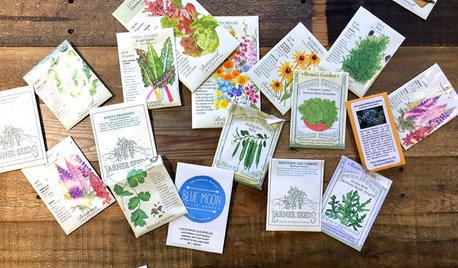
I just had this year's Seed Savers Exchange catalog delivered. They have quite a few tomatoes. However, it says under all the headings (using tomatoes as an example) "Members Offer 4,639 Varieties"... Does that mean if I join as a member there are over 4600 types of seeds I can order? Or does that mean if I join I am put in touch with other members to trade seeds? I've only started growing last year and I really don't have much to trade (nothing unique anyway)...

I am assuming a lot of people here use them as a seed source... How were your results compared to seeds you got from other places?

Thanks

Comments (11)

  • 16 years ago

    What you're looking at is the PUBLIC SSE catalog where anyone can order seeds, tubers, etc.

    And yes, if you become an SSE member you do have access to seeds for several thousands of tomato vareieties.

    But this is not a trading situation at all. There is an SSE suggested request price for each pack of seeds. Some members do ask for less. Contact information for the persons listings the seeds is in the front of the paper Yearbook, and there are several pages of instructions also in the front.

    Your membership money also includes other SSE publications as well as the annual Yearbook.

    I'll link to the main SSE site below where you can read more about membership and if you have any questions please just ask here in your thread b/c either I or another SSE member here would be glad to answer. I've been a long time, Life Time member of SSE for 21 years now.

    If you want to talk about seed purity in regard to what one might buy from the SSE Public catlog as opposed to seed listed in the Yearbook by regular SSE listed members that's possible as well.

    I would encourage anyone interested in preservation of OP varieties to consider membership whether they become listed members or not. And yes, ALL SSE members can request seeds from the listings but the requested price is different for listed and unlisted members as well as for different categories of seeds, tubers, scions, etc.

    Carolyn

    Here is a link that might be useful: Seed Savers

  • 16 years ago

    Carolyn,

    This is a little off topic, but I have another SSE question. What kind of production does it take to be a listed member? I was thinking of maybe adopting a variety that is not being grown right now, but I don't know what all that entails. I think I could do well with tomatoes, but how many plants, fruits, seeds, will be necessary to produce?

    Do you have a variety in mind that might be good for a newbie to start saving?

  • 16 years ago

    Hi Milehighgirl,

    They have a couple different ways of listing your offerings, depending on how much seed you have to offer. Many, many people will offer the same varietes as each other, and that's great, because there are always going to be regional / climactic differences, even though the genetics are the same. I try to pick an offerer that is in my same geographic / climactic area.

    I am a listed member, and for two of my offereings, I am the only one in the 2010 Yearbook that is offering them. I hope there are others in the country growing them, just not offering. To have that kind of responsibility is truly daunting!

    See if you can get hold of a copy of the yearbook, it has all the instructions for offering. Unfortunately, they don't have the instructions on their website, and you can't order these seeds from the website, only view the offerings.

    Steve

  • 16 years ago

    Steve,

    Thanks! I did get the book and that's what made me realize how important saving genetics is. I was AMAZED to see how many people there are just doing their little part. I wouldn't know where to begin with which variety to choose. I was sent a few seeds of Idaho Hillbilly by a member. I did not notice that this was listed in the SSE book. How do you choose which variety you will save?

    I'll spend some more time reading up on the requirements.

  • 16 years ago

    Bull! Why pay just to be able to pay again for seeds?

    Gardening is turning into a rich mans game and I ain't buying into it.

    They should make it easier not harder to purchase these seeds.

    I'd rather place my order and be on my merry way but thats me.

    Not flaming, just stating my point of view. Maybe someone can explain it better to me?

  • 16 years ago

    Wwwwhoa.... there early,

    If I am not mistaken there are many dedicated people up there in Iowa, and many more past and present that have devoted their careers and passion for what they love to do, in order to create one of the worlds leading seed lineage collections.

    I am sure even with the volunteers, that it costs a boatload to operate.

    Tom

  • 16 years ago

    How do you choose which variety you will save?

    Why not pick a couple of varieties that only a few folks are offering? If 50 folks list variety A but only 2 list variety B - pick B as it needs more "saving". ;)

    Dave

  • 16 years ago

    Thanks for the information. I'm probably going to join over the weekend.

  • 16 years ago

    For milehigh and erlyberd

    mile high, you mention Idaho Hillbilly and I'd ask if this is the same as Hillbilly itself for starters or something else entirely. There are varieties where a name has been attached to a variety, that's true with many of the Mortgage Lifters and Brandywines,which just indicates who grew it at one time.

    As to how many seeds you'd need to be able to list a variety,that really depends on whether you're the ONLY one listing it and it appeals to others or whether you're listing varieties that already have several folks listing them.

    I'd have on hand probably around 500 seeds for a variety that's brand new and less for one already listed. I can't tell you the number of plants you'd need b'c it depends on what the variety is, how seedy it is and that determines the number of fruits you'd use off how many plants to get enough seeds to process by fermentation or whatever.

    A couple of more comments.

    I see the YEarbook as a place to obtain the more rare tomato varieties and have suggested that it might be a good idea for folks to have some tomato growing experience with the more well known varieties first. And that pertains to knowing how to rogue out plants that are not true to the variety. No commercial seed company has a perfect record when it comes to offering OP seed that's always true seed, and that's also true of Listed SSE members. Some bag blossoms others don't. And how important that is in terms of possible cross pollination depends on a lot of factors as to where a person gardens, what the pollinators are in the area, when they're active and on and on.

    Second, there's no need to list at all although if you have something unique you might want to consider it. If you look in the front of your SSE YEarbook you'll see that about 90% of the SSE members are NOT listed members, and many of those members become members b'c they want to support the mission of SSE in terms of preservation of OP varieties.

    Erlyberd, I think what I just wrote speaks to your comment as to why pay for a membership just to pay for seeds from others. First, the membership monies are an important source of income to SSE in terms of staff, growouts, isolation stuff, maintaining the permanent collection and so much more. Second, there is no obligation at all to requests seeds or tubers or scions or anything else from the listings in the Yearbook. Third, as I said above, there are those who want to join just b'c they have strong feelings about preservation of OP varieties and the Yearbook, to me, is the core of those preservation acitivities.

    A good number of companies that specialize in OP tomato varieties are owned by SSE members and we wouldn't have the many seed companies we have today if it weren't for SSE b'c that's where most of those seed companies got their initial starts for their companies.

    Carolyn

  • 16 years ago

    Thank you, Carolyn, for all your advice! I have tried to figure out if Idaho Hillbilly has another name, but haven't found any evidence. There is an "Idaho Moscow" listed that seems like it may be similar. The description LarryW put up for Idaho Hillbilly was this:

    "Idaho Hillbilly: This one puts Opalka to shame!!!
    It is a red long pointed banana pepper shaped fruit on an indeterminate vine. Fruits (~1.5x4") actually have a bright full flavor, are very meaty without being dry, and are born in profusion. The vines are strong and regular leaf and seem to hang in there through the worst of blights though looking pretty awful at times. Many fruits, of course, will not achieve the full size noted above. Once again a trade from years ago, this one from Rosaline McArthur, in Idaho."

    I think I will try to work with it this year and just see how it goes. If I'm able to collect enough seeds then I'll look toward listing in the future. I only have about 10 seeds now, so it will be quite a while before I'd have enough. At least I know now that 500 seeds is something to shoot for.

  • 16 years ago

    To me Seed Savers Exchange is far more than just some place to pay 35 buck for the priveledge of paying another 2 bucks for tomato seed. Way more.

    The Yearbook is a fantastic source for tomato seeds though. More than that, it's a great place for me to share new-found or newly stabilized, open pollinated and heritage varieties that otherwise will likely never be available anywhere else ... because maybe it just fell out of favor for a few years and was replaced by a newer, less tasty or hybrid variety. That old stuff has some virtues that need to be preserved and reintroduced for home gardeners to enjoy.

    Yes, the idea is to preserve valuable old germplasm. And it was rewarding to open the 2010 Yearbook and find someone offering Mozark tomato, for example, which I was able to retrieve from University of Missouri and offer in 2007. Since then, I've not regrown enough to re-offer, but a fellow in the PNW is offering it for others to enjoy and share.

    That right there was worth 2007's $35 donation to SSE.

    And that example can be multipied by over four thousand other tomato varieties and many many other vegetable and fruit seeds and roots.

    I mean if you want to overpay or pay a surcharge for tomato seeds, go buy them from a commercial seed vendor who charges 4.95 for a pack of 10 seeds and then wants another 6.95 for shipping and handling.

    If you want to share in the preservation of thousands of valuable heritage varieties, join SSE and list in the Yearbook.

    IN JE B2

Sponsored
Peabody Landscape Group
Average rating: 3.5 out of 5 stars8 Reviews
Franklin County's Reliable Landscape Design & Contracting