Software
Houzz Logo Print
snappybob

Tomato Seedlings yellowing

18 years ago

My tomato seedling which have been growing since I planted in Mid January are looking a little yellowish. They have been potted up into 16 oz cups and are getting pretty big. I think it might be time for a little feeding. I am planning on giving them some diluted fish emulsion to tide them over until I can get them into the ground in a few weeks. I normaly dilute my fish emulsion by 1 table spoon to 1 gal of water. I was thinking about diluting it for my seedlings to 1/2 table spoon to 1 gal water. Does this sound about right?

Comments (11)

  • 18 years ago

    Yeah, Poor dave (Digdirt) must be so tired answering that question. I asked that same question awhile back. Sure enough Daves suggestion worked like a charm. My Seedling are Super happy now. Now, my obstacle to tackle is i planted to early (Started seeds on Jan 6 seedlings emerged Jan 11th 08 I'm Zone 5), and not sure how I am going to get around that. I hope keeping them indoors wont hurt to much. Keeping Fingers crossed.

    Sumilea

  • 18 years ago

    I really don't think it is too mauch water. I let them dry out then give them a good soaking then let them dry out again before watering. I'll wait until they need watering and them give them a little food with their water.

  • 18 years ago

    Bob,

    It's hard to tell without pictures exactly the nature of the "yellowing" as that general description could be symptomatic of several causes.

    If you do not have a saturated root condition, and the seedlings are advanced with regard to true leaf development, then the most likely causes are low photosynthesis due to insufficient light or lack of sufficient nitrogen.

    If the cotyledons have yellowed, then the seedlings have drawn all the available nitrogen from those seed petals, since nitrogen is mobile, and it's time to dose them with a light feeding. If the cotyledons are withered and spent, then for sure it's time to feed the seedlings a light dose of balanced plant food, since the cotyledons are the natural source of nutrients for the inititial development of the seedling.

    With regard to advice you've received both here and at another forum where you ask the same question, it's my exprience that 1/4 the recommended dose of Miracle Grow tomato or rose formula (say a teaspoon per gallon of hand warm water) plus a teaspoon of Epsom salts will brighten up the seedlings at the stage where there are two to three sets of true leaves. It usually takes a couple of days to see the greening up, but if after five days, you feel the green isn't dark enough, hit the plants with a second dose and add a teaspoon of Ironite to the gallon of nutrient amended water.

    Again, it's hard to diagnose the cause of "yellowing" without pictures. But if the cotyledons and first true leaves are yellowing EVENLY (not blotchy or in an interveinal pattern), then the most likely cause is nitrogen deficiency.

    Bill

  • 18 years ago

    Bob - Bill raises several good points and all of them need to be checked thoroughly to ID your problem's source. I too often assume that most growers already know that cotyledons normally turn yellow and that seedlings need feeding to prosper. Not always valid assumptions on my part, sorry.

    What you choose to feed them is, as I said, your choice. I personally prefer to avoid the MG products and use one of the many organic products available. But MG works fine according to many.

    That said, please do not rule out the possibility of over-watering. Not only is it the most common cause of yellowing leaves but it is something those new to growing seedlings are very prone to do. There are ample posts here to prove it. ;)

    Surface drying, if that is what you are referring to when you say "let them dry out" isn't a valid indicator of the need for water. As Bill said, if you do not have a saturated root condition and that is what you need to monitor - moisture levels deeper in the container.

    Tomato seedlings are quite tolerant of too little water but they simply will NOT tolerate excessive watering nor will they tolerate poorly draining potting mix. You don't mention what your growing medium is but different mixes drain...differently. Too much water retention in the mix results in yellowing true leaves and suffocated, stunted root development leading to root rot. If that happens then it makes little difference what you feed them as the roots can't absorb it.

    Just some additional points to consider. ;)

    Good luck with your seedlings.

    Dave

  • 18 years ago

    Dave,

    At another site, Bob indicated his preference for fish emulsion, so he, like you, apparently prefers the organic approach to my Miracle Grow use. That's fine, since the fish emulsion will provide sufficient nitrogen if mixed to an appropriate dose.

    I just like the MG tomato or rose formula to get the P and K nutrients sufficient for other structural concerns. However, Bob's primary issue seemed to me to be N-related, if a saturated root ball isn't an issue.

    "Organic" isn't a bad word in my house as I also grow a few tomato seedlings that way for friends who prefer that approach. For what little nitrogen we're talking about to get them greened up and ready to harden off surely can be found in a bottle of fish emulsion if MG-type stuff is not desired.

    Bill

  • 18 years ago

    Hi,

    I'm also in zone 8 and started my seeds about the same time as snappybob. We've have fairly nice weather for a while so I've been bringing my seedlings out to harden off for several hours each day for the past week or two. As we're going through a bit of a cold spell, I brought them in today after just a few hours and decided I might as well put them in larger containers as there wasn't too much I wanted to do in the yard. I replanted them to the level of the first true leaves and they're about 3-4 inches above the top of 18 oz Solo Cups. I transplanted 44 seedlings of 20 different varieties. What I just noticed today was that my 2 Kellogg's Breakfast seedlings had lower leaves that were very yellow and also with some brown at the tips of these leaves - as if they'd been burned. The plants were all outside randomly and the KB's weren't near each other and no other varieties were affected. When I repotted the plants, the KB roots didn't look much different from the others. So, I'm puzzled - any idea of what might be going on? All the seedlings have been treated the same.

    Anne

  • 18 years ago

    I'll try to take some pics this evening when I get home. Things seem to be getting worse. I'm seeing some wilting in the leaves as well. they will be needing some watering by this afternoon so I will take them outside for some sunshine, water and food. As far as what kind of food I'm not really that particular in this stage of production. I have MG and I also have FE. I normally judge watering need by weight. Potting mix is pretty light so if they feel like it's just a cup of dry potting mix I water. Thanks for all of your responses.

  • 18 years ago

    I came home a little early today and fed the plants 1/4 dose MG and Epsom Salt. I don't think it was a soggy root problem. The thing that tells me that is some of the cups that they were potted up in somehow did not get drain holes put in prior to potting. They were the ones that looked the best. I added drain holes to those and added more drain holes to all.

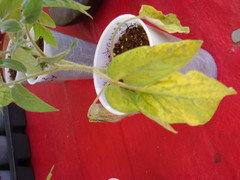
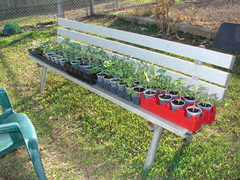
    Here is a pic of one of the yellow ones this is the most severe.

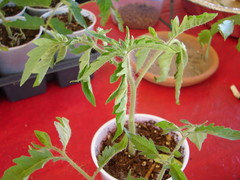
    Here is a wilted one.

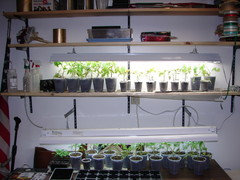
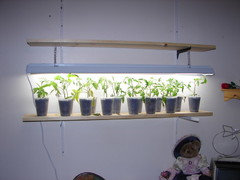
    Here is a few pics of my lighting setup

    Here they are outside enjoying a beautiful day.

    Well I hope that they are going to be OK now. I may lose a few but I have 56 plants so there is a lot of surplus. I can only plant 22 max in the room that I have and I probably wont plant that many. The rest will be given away or sold.

  • 18 years ago

    Okay ... I'm gonna take a wild stab here.

    I think your seedlings look great. Snip of the yellowed lower leaves. I don't see anything that looks like disease or over-watering ... under-watered if anything. I think the wilty looking foliage on the regular leaf plant is stress from dryness. Maybe the atmosphere in the room is a bit dry in conjunction with dry potting mix. Also, in and outside, especially on a breezy day, and if the mix is dry, may be stressing them just a bit, but that's all part of hardening off.

    Can you put the Dixie cups in a shallow plastic or metal tray and bottom water? Like pour in an inch or so of hand warm water and let the moisture wick up from the bottom. Looks to me like you have well developed roots visible through the opaque plastic cups. I think the roots are healthy enough to uptake some water and the foliage is advanced enough to transpire more water than you may think. And you'll be able to see the water wicking upward thru the opaque plastic and be able to prevent over-watering by watching closely.

    All in all, everything looks healthy to me. But a bit of fertilizer won't hurt, IMO. Many of those seedlings are well advanced and I can't imagine they can remain verdant without some balanced tomato food at this point. Again, JMO. But I'd definitely snip of those well yellowed leaves ... they're useless. Your plants are putting out plenty of new, healthy foliage at the apical meristems.

    Great start!!!

    Bill

  • 17 years ago

    I transplanted my tomato seedlings when they got their first true leaves, and now the first leaves which is the bottom leaves are turning yellow. Is this just shock? it was about a week and a half before I noticed the yellowing. When I transplanted them I took dirt and all from the small pot and put into a larger pot, hoping that they would not notice. Of course my seedlings where a bit leggy and I had to plant them deep. I planted them about 3 inches deep, the larger pots are about a 4 inch pot. I am trying not to over water them, but I am not sure if they are still damp at the roots since I did plant them deep, I used jiffy seed starte!! We are suppose to get alot of rain this week I am planning to catch some of the rain water and use it, hoping that they will improve from that. If they don't will it be ok to use a little Epsom salt? about a half teaspoon in a gallon of water? and how often can I do this? can I use it every watering?

    Thank you