Software
Houzz Logo Print
dew101

Tomatoe Fertilizer.....which one?

14 years ago

Dear Garden Folk

1st year growing toamoes. Chosing between 2 organic fertilizers.

Burpee, Organic Tomato Fertilizer W/ Aragonite

Organic blend achieves optimum tomato production and plant health.

Our organic blend contains aragonite or coral calcium specifically made to help tomatoes grow and avoid 'blossom end rot'

or

Espoma Tomato-tone Organic Gardening Plant Food

Thanks!

Dale

Comments (49)

  • 14 years ago
    last modified: 11 years ago

    If those are the only two choices then the Espoma. Espoma products consistently get good mention here.

    All the stuff in the Burpee one about "avoiding BER with coral calcium" is just marketing hype for those uninformed about what really causes BER.

    But there are many other brands available too. The search here will pull all kinds of fertilizer discussions.

    Dave

  • 14 years ago
    last modified: 11 years ago

    Espoma is the best. Hands down.

    Totally agree with Dave re. coral calcium hype.

  • 14 years ago
    last modified: 11 years ago

    Thanks, you guys are the best!

  • 14 years ago
    last modified: 11 years ago

    I would never recommend a fertilizer unless you have had your soil tested to see what it needs!

    Tomato Tone 3-4-6? (NPK) This would not work for me.

    My garden soil tests have always shown it has surplus P, and an almost toxic level of K. All my Ag. extension agent tells me to add is N, and occasionally some sulfur to reduce the PH.

    He has suggested some crops I could grow to reduce the K, but that would require not growing my desired garden crops for a year, or trying to grow a crop of something over the winter, which is totally impractical here in zone 5.

  • 14 years ago
    last modified: 11 years ago

    dcrosby - I've had good results with Espoma, but my suggestion would be to get whichever you can buy locally (in my case that would be the Espoma).

    tdscpa - ooh, you've peaked my curiosity. What crops did your extension office suggest to help deplete K?

    Best,
    T

  • 14 years ago
    last modified: 11 years ago

    I hope I don't seem naive, but standard 10-10-10 garden fert works fine for me. I use it cautiously about 3 weeks after planting in the garden and don't allow it to get on the plant itself. My soil is pretty neutral.

    Dave - What really causes BER and what is the remedy?
    John A

  • 14 years ago
    last modified: 11 years ago

    I would go for Espoma tomatone as well. It has micronutrients that chemical ferts dont. If you need good N, why not go heavy composted manure if you can get it?

  • 14 years ago
    last modified: 11 years ago

    Is the Espoma 3-4-6 better than the 10-10-10? There are so many fertilizer options. I'm going to go with the Espoma as is recommended and readily available to me but I always wonder why wouldn�t a straight cocktail of equal amounts (such as 10-10-10) make sense. I understand that different soils have different needs but when you don't know the composition of the soil perhaps you are better off going with the even amounts

  • 14 years ago
    last modified: 11 years ago

    I have used 10-10-10, espoma tomato tone, espoma gardentone, and worm castings mixed with crushed egg shells. I have had good results with all. I no longer use 'chemical' fertilizers, mostly due to not wanting a salt build up in my soil.

    http://agrowingcuriousity.blogspot.com/

  • 14 years ago
    last modified: 11 years ago

    but I always wonder why wouldn't a straight cocktail of equal amounts (such as 10-10-10) make sense.

    Not an easy question to answer without pages of detail on the history of synthetic fertilizers and the associated issues as well as a basic understanding of how fertilizers work and don't work.

    But the simple answer is that in addition to the salt build-up ncdirtdigger mentioned, most soils don't need 10-10-10 or similar mixes. And all that extra runs off into the ground water and adjacent lakes and rivers and is causing all sorts of contamination problems. That is why we so often encourage getting a pro soil test done and is one reason for the new federal guidelines calling for the fert companies to market 10-0-10 instead and at a cheaper cost.

    AG studies have established that phosphorous deficient soil is very rare in the US. Phosphorus-gutted soil is much more common. Potassium is used in such small amounts by plants that even minimal amending can usually provide more than enough. Nitrogen, because it is so volatile, is the only prime nutrient of concern to home gardeners especially if they practice even the minimal good soil care/amending techniques during the off season. Micro-nutrients and soil PH are the 2 vital concerns for the home gardener and synthetic fertilizers don't address either of those concerns.

    So for decades gardeners have piled on the 13-13-13 and the 10-10-10 based on the theory that if a little is good then more is even better. And do it without ever checking their soil pH to see if the plants can even use it or if it is even needed. It is the "quick fix" approach and sometimes it is needed with badly depleted or abused soil. But more often it isn't needed.

    In organics the philosophy is "less is more" especially if the less is all that is needed. Thus the lower nutrient ratings for the organic ferts. But the drawback to organics is they are slower acting and their efficiency is dependent on an active soil micro-herd to convert the organics to plant-usable form. That takes time and work to develop.

    Over-simplified but gives you a basic idea of what to research. :)

    Dave

    PS: Dave - What really causes BER and what is the remedy?
    John A

    John there is a FAQ and many discussions here about this that the search will pull up but basically BER is caused by a poor distribution of Ca throughout the fruit. There is plenty of Ca there it is just unevenly distributed and that is a plant circulatory issue caused by the young age of the growing plant and inconsistent soil moisture levels.

    Despite all the claims to the contrary there is no cure for BER - the AG industry has been trying to find one for many decades - because in early spring when it is a primary factor spring weather is a prime contributing factor. All we can do is make every effort through various gardening techniques to stabilize soil moisture levels and be patient. Assuming proper growing conditions are provided, the plant matures, the weather stabilizes, and it always goes away all on its own.

  • 14 years ago
    last modified: 11 years ago

    John - just to add on to Dave's comment on BER - I have found that the later I wait to put out my tomatoes (that is to say, after May 1st when erratic spring rains are generally over) the fewer problems I have with BER.

    Additionally, what a lot of people fail to consider is that if you are putting your plants into a structurally unsound medium (unamended with something substantial like a pine bark mulch) the soil will eventually collapse, limiting the amount of water the plant is actually able to take in. So even if you are watering you plant regularly, collapsed soil will prohibit the plant from taking in water and thus nutrients.

    Good soil / media mix, consistent (deep) watering patterns and consistent supplemental fertilizing have basically eliminated BER in my tomato growing.

  • 14 years ago
    last modified: 11 years ago

    the0ry:

    I think he listed 2 or 3, but I can't easily locate his paperwork and my memory is not that good any more. One was a specific type of vetch, and I think he also listed a grain crop. Barley? Oats? Sorry, I can't remember.

    I'm just assuming you have a county Ag. extension agent. You might stop in and chat, and he/she should be willing to tell you what you could grow in your area that would sop up some surplus nutrients.

  • 14 years ago
    last modified: 11 years ago

    "But the drawback to organics is they are slower acting and their efficiency is dependent on an active soil micro-herd to convert the organics to plant-usable form."

    what does that mean...acitve soil micro-herd to convert the organics How do i know if i have that micro-herd

  • 14 years ago
    last modified: 11 years ago

    Thanks, Dave & Cakefarm, for your good advise.
    John A

  • 14 years ago
    last modified: 11 years ago

    what does that mean...acitve soil micro-herd to convert the organics How do i know if i have that micro-herd

    First, you can learn much more about this over on the Soil forum here as well as on the Organic Gardening forum as that is their focus and I have linked the FAQ on it below. But briefly - are you growing in containers? If so then no soil bacteria, no micro-herd, exists because soil-less potting mixes that need to be used in containers are sterile. You can add it to the mix in the form of beneficial fungi and bacteria and many organic suppliers sell such mixes or, if you use your containers over several years and they winter-over outside bacteria will eventually develop in the mix. However just like nutrients they will leach out of the container when it is watered and need to be replaced. Some of the better container potting mixes are now adding beneficial bacteria and fungi to their mixes just for this reason.

    If you are growing in ground in the dirt then you can develop an active soil micro-herd through the use of compost and other organic matter added to the soil. With time and regular amending of the soil you can develop a a garden where only organic supplements are needed.

    Dave

    Here is a link that might be useful: MIcroherd FAQ

  • 14 years ago
    last modified: 11 years ago

    dear dave
    thank you for the millionth time!
    I appreciate your explanations as I find it hard to follow the soil and organic threads
    i'm not growing in pots so i will be sure to amend my soil with lots of compost to create a micro-herd and will use Espoma
    call me stupid but really simply speaking, will that do the trick

  • 14 years ago
    last modified: 11 years ago

    Thank you everyone for your help!

    Dale

  • 14 years ago
    last modified: 11 years ago

    simply speaking, will that do the trick

    In time, yes. It can take 2-3 years to build up good organic gardening soil, longer depending on how hard you work at it. In the meantime you often have to provide some non-organic supplements or organic liquid supplements that are more readily usable.

    I find it hard to follow the soil and organic threads

    Because it is new to you. But that is also why so many successful gardeners adopt a combo approach to gardening - organic and inorganic - where you can get the best of both worlds. :)

    Dave

  • 14 years ago
    last modified: 11 years ago

    What non-organic supplements do you mean? Miracle Grow? Is MG better than the organic Neptunes Harvest? Where does Espoma fit into the mix?

  • 14 years ago
    last modified: 11 years ago

    I find fish emulsion and kelp pretty readily available, even as a foliar spray or to seedlings in pots.

  • 14 years ago
    last modified: 11 years ago

    What non-organic supplements do you mean? Miracle Grow? Is MG better than the organic Neptunes Harvest? Where does Espoma fit into the mix?

    That is getting into the very basics of fertilizers, how they work, how they differ, and how they are classified. So it's way off topic for this forum and info that is readily available elsewhere. Just Google 'what is fertilizer' or 'how does fertilizer work' for starters.

    So I'll just say it isn't a question of "better". Organic and non-organic fertilizers are all clearly labeled as to which they are, where they fit in. And they work very differently in the garden. They each have advantages and disadvantages. But they can't be compared to each other. That would be like comparing apples to oranges.

    So each gardener has to research the different approaches and then decide which way they wish to go - organic, non-organic (synthetic), or a mix of both.

    Dave

  • 14 years ago
    last modified: 11 years ago

    I rarely use fertilizer in my soil garden. I have nutrient poor sandy soil, but amend it with a lot of compost made mostly from grass and leaves from my property. I occasionally add epsom salts for magnesium and sulphur for pH reduction but that's about it. Once my new beds mature after a couple of years and the worms move in, I just mulch deeply with chipped branches, grass and leaves and it breaks down quickly. I rarely have to add anything after that.

  • 14 years ago
    last modified: 11 years ago

    thanks Capoman!
    I'm all for the worms. what do you think of composted cow manure or how about the lobster compost?
    dale

  • 11 years ago
  • 11 years ago
    last modified: 11 years ago

    On the topic : ""

    Tomato Fertilizer.....which one?"

    This is a vintage thread but the topic is always interesting.

    This year , due to fruit sets problem with my tomato plants, I have explored the subject to some extent.

    WHY SOME FERTILIZERS ARE TARGETED AS "Tomato Fertilizer" ? What are so especial about them ? What are commonality amongst them ?

    I think I have found some clues. No sure that I have made a big discovery.

    1) Some or most of them include Calcium. It is often BER is blamed on Calcium deficiency. So by adding that into their product , the manufacturers have covered their back side. hehe.

    2) All such fertilizers are LOW in N (nitrogen), in proportion to P and K

    3) All such fertilizers are HIGH in K (potassium) , in proportion to P and N

    4) Phosphorus takes the middle ground.

    ALL PURPOSE FERTILIZERS :

    in the past granular fertilizers with 1-1-1 NPK formulation were called " All Purpose". But then it changed. MG came up with 3-1-2 NPK ratio (like 24-8-16) and called it All Purpose Plant Food. Some experts argued that 3-1-2 ratio is actually what most vegetables and plants use and need.

    But that "All Purpose" did not work quite well for tomato plants at least. Somehow, someone figured it out that for tomatoes you need something like 1-2-3 NPK ratio. That is quite some departure from 3-1-2. Hmmm.Believe it ?

    This ,of course, is applicable and more appropriate when tomato plant has passed its vegetative cycle and has entered into sexual/productive phase. In this phase we want to discourage foliage growth and instead we want to encourage flowering and fruit set. Sounds like a logical agenda to me .

    I HAVE SWITCHED :

    Not that I am 100% sure, but at least on experimental scale , I have switched from 3-1-2 NPK ratio to something close to 1 - 2 - 3 . So far seems to be working but it could've been just coincidental, as I am not doing anything near a scientific experiment.. My reason for switching is based on statistical co-relation, like trying a medicine just based on clinical experiment .

    Disclaimer : JMO, YMMV


    Sey


  • 11 years ago

    Wow that is quite a list Daniel, almost over-whelming in number. And it is only the ones available from peaceful Valley so many aren't on the list.

    But I do see that many of them are not OMRI approved and even less have both OMRI and CDFA approval so that would cut the list in about half (assuming those certifications are important to the reader).

    Of the ones with both certification the only ones I have any personal experience with are Alfalfa meal, Azomite, Bone meal, Kelp Meal and the Earth Juice products (which are not certified).

    As to which one is best for tomatoes? I don't think there is one BEST but there are many GOOD ones, some on that list, many not on that list. Personally I prefer the liquids over the granular ones as it gives me better control over amounts and timing of application. Especially so for any container plants.

    Of the many liquids I find the blends of fish and kelp products give me the best results. But that is in MY soil. Any of the many on your list could be bad for someone's soil if they have no idea what they have to begin with in their soil and if they lack even the basic info about how fertilizers work and are used by plants.

    Dave

  • 11 years ago
    last modified: 11 years ago

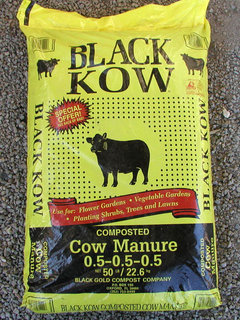
    I have used Black Kow and Espoma products (i.e. Garden Tone or various similar formulations depending on the time of use) and I can't say I have any complaints. They are cheap and effective in my soil, well balanced, and widely available.

    I use Miracle Gro potting soil for seed starting and don't have to fertilize at all, and at the end of the season I may give my plants a little nudge with some MG.

    I have a giant pile of compost going for next year.

  • 11 years ago

    One of the reasons I did NOT want to use Black Kow:

    > If you spread Black Kow over your plot and stand back,
    you will get a wonderful crop of hay. The hay seeds passed through the cow,
    survived the compost process, and now are happily sprouting in your garden. [ Black Kow's Dirty Little Secret ]


  • 11 years ago

    Can't say I have seen any hay. YMMV.

  • 11 years ago

    The power of opinions...

  • 11 years ago

    Umm, that's not an opinion - I am sharing my experience. Of course, others may have a different experience, as I said. FWIW, BK does claim that any weed seeds are killed by composting.

  • 11 years ago

    To begin with, I'm fortunate to have gathered, for free, a large supply of both Farm Co-op pellitized ferts of a few different formulas and a bunch of MG.


    I have a farm up the street. I have a compost pile, and 'compost' my mulch right in the bed. I add leaves and grass clippings at the appropriate times, and I pee an endless supply of nitrogen and micronutes... Buying ferts? Nope, not for a while yet.

  • 11 years ago
    last modified: 11 years ago

    Peter, I was referring to that Website's opinion, and its influence on me.

  • 11 years ago

    I'm not quite sure what you mean.....

    I have no idea whether hay seeds can survive the hot composting process of BK. It would be interested to hear from some better experts on it. I would be more concerned with herbicides surviving the composting, which is another concern. But there are concerns with everything..... unless you do it yourself, which is what I am doing for next year.

  • 11 years ago
    last modified: 11 years ago

    What I mean is, that after reading that comment about hay, in that Website, I decided NOT to buy Black Kow. So, that opinion influenced me to NOT buy the product. That's what I mean by "the power of an opinion." Sorry, for not being too clear.

    I think I read somewhere that manures - in general - can spread blight(s.) Not sure about that.

  • 11 years ago

    Lets talk fertilizers.

    Of course cow manure is also a fertilizers. The reason for hay seeds is that a lot of hay is mixed with the manure and the seeds somehow survives the composting.

    But Cow Manure is high in N . In a quick Google search it showed that CM has a 3-2-1 NPK ratio. That is the opposite of roughly 1 - 2- 3 ratio that is favored for tomatoes in flowering/fruiting stage.

    THE POWER OF "^K"

    Sey

  • 11 years ago

    Black Kow: 0.5 - 0.5 - 0.5


  • 11 years ago

    Black Kow is basically compost

  • 11 years ago

    Agree with Peter. Most manures are MOSTLY compost. I mix them in early in the season as soil amendment not as source of plant food.

    Sey

  • 11 years ago
    last modified: 11 years ago

    Black Kow is bit better than most bagged composted cow manures imho. I've seen BK produce crabgrass and tomato volunteers, but those are easily disposed of in a garden bed... I've had decent luck with stuff labeled as "dehydrated manure" in the semi-recent past. Their brand names escape me atm, but the two brands i purchased a couple of years ago were most excellent .... and pure.

    As for Texas Tomato Food, i'm finally giving it a workout this year in different sized containers, 19, 9 and 5 gallon .... 8 containers total. One thing i've noticed is the high amount of blossoms, the least productive container plant still has trusses of up to 9 blossoms. I've only spotted two fruit with BER so far, one Pink Heart and a Brandy Boy.

    Steve

  • 11 years ago

    You can use it as supplement , maybe once in a , if indeed your soil is lacking P.

    I similarly use 23-0-0 now and then on the greens early in the season. But N depletes fast , where as P sticks around for much longer. I also have Bone Meal (Pure P) and have sprinkled about less than a spoonful around each plant , ONCE. .

    I have this advice : Whenever in doubt , use the old fashion 1-1-1 ratio fertilizer. But they all come in granular form . I don't like that part.


    Sey

  • 11 years ago

    Just dissolve 1 part 10-10-10 granular in 10 parts water and you have you 1-1-1 liquid (if that is what you want.

    Dave

  • 11 years ago

    Thanks, Dave.

    I taught that they are not readily water soluble.

    I have some 16-16-16. I'll do as you have mentioned. I'll use one part 16-16-16 and 16 parts water. Then how do you use it ? One cup per gallon ?

    Sey


  • 11 years ago

    If 1-1-1 is what you want you'd just use it straight. No further dilution. If you want to dilute it further then use a stronger ratio of fert to water instead.

    One old gardener I know doesn't even worry about the ratio. He just fills a 5 gal. bucket with water, dump in 2-3 cups of the 10-10-10 granular stuff, lets it sit for a day or two to dissolve, stirs it up now and then, lets it settle out and then feeds each plant with a cup or two of it as needed. I'd prefer to be a bit more accurate myself. :)

    Dave

  • 11 years ago

    Anybody tried Dyna-GroFoliage - Pro ?

    I see many VERY happy customers in Amazon.

  • 11 years ago

    daniel_nyc(7a)

    Anybody tried Dyna-GroFoliage - Pro ?

    ^^^^^^^^^^^^^^^^^^^^^^^^^^^^^^^^^^^^^^^^^^^^^

    I have not used it but looking at its analysis ( 9 -3- 6) it has 3-1-2 ratio, same as MG All Purpose Liquid ( 12- 4 -8 ). That is what I have been using mostly. But in flowering and fruiting stage , I think it has too much nitrogen, as the name ( ...GroFoliage..) suggests. So I am supplements Alaska 0-10-10 (NO nitrogen).

    Sey