Software
Houzz Logo Print
vernonia_gw

worm experiment in 2 liter bottle

21 years ago

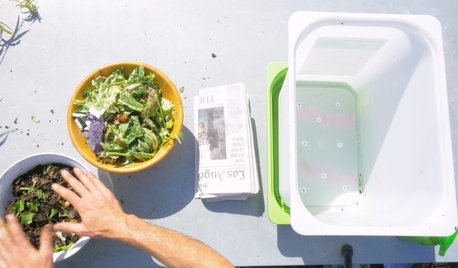
Ok, I decided I am very keen on vermicomposting, but I wanted to conduct an experiment first to see how I felt about having them in the house, and handling them and such. And also to study the native species from my yard in action. because I am highly unlikely to pay for worms :) So while I was weeding the pea patch, I scooped up several worms of varying sizes and varieties, but all in the uppermost layer of the soil. I think there were about 2 dozen. I then used an old 2 liter bottle and poked air holes with a push pin, and drainage holes in the bottom. It is sitting in a butter tub to catch any fluid. I used newspaper bedding, moistened. I added a little soil, so they would not miss home too terribly :) And I have only fed them coffee grounds and cornmeal. They are stored in a seldom used cupboard so they are not disturbed, and are kept dark. It has been 2 weeks. I have no escapees (the holes are too small) and so far I do not think there have been any deaths, and my only complication seems to be that the newspaper has balled up a bit from my turning the bottle to look inside the first week :) I only checked them 2 times during the second week :)

Now come the questions:

How long till they reproduce? what is the gestation period for eggs? will they even attempt it in such a small environment? anything I can do to make their life better?

I would like to keep this going until I see offspring, but if they are shy, then I can let em go sooner :)

I wanted to feel out the whole thing with a small scale project before making any commitment. So far it is cool, the kids like the clear plastic portion so they can see inside.

questions? comments? criticism? suggestions? Thanks in advance.

*wearing an "I love Kelly S." shirt :)

Comments (5)

  • 21 years ago

    On a scale that small it will take a while to see results. Common earthworms seem to take a bit longer to acclimate and arent quite as forgiving about being disturbed. As with most other species you should see populations double in 90-120 days (redworms closer to 90 days other species longer).

    Most worms collected in your garden prefer a lower temp. Which is part of the reason vermicomposters normally use a species like E. Fetida, L. Rubellus, or E. Hortensis. Although this is not to say that the species you collected is not one of those listed above.

    If worms want to escape your container they will. Providing more (and larger) air holes may help in case and smells pop up.

    Worms are pretty good at controlling their numbers. If there are too many worms for the food source worms will either die off or shrink in size. If there is alot of food they will grow larger and produce more offspring.

    Coffeee grounds take a while to break down. One of my tricks is to pour old soda on them before adding them to my bins, the coffee grounds will absorb some of the sugars helping the microbial activity to break it down faster.

    Bryan

  • 21 years ago

    Once a week add some kitchen scraps and you will see results but it will be in many months time since you only have 2 dozen and not all may be mature yet. The worms that aren't suitable for the environment will die so by now there may be less than 2 dozen.

  • 21 years ago

    Well, first allow me to compliment you on your keen sense of fashion... ::grin::

    Know, first, that just because you dug these worms from the topsoil of your garden does not guarantee that they are all surface dwelling species. Many deep soil worms will surface to feed and find a date. As such, and because there is no way to know what worm species in general might be common to your area, reliable information on reproductive and growth rates cannot be provided. I wish the kind of data you seek were available but, alas, that remains a wish!

    Adding some compost from a backyard pile to that container is likely to increase the level of available nutrition and better optimize conditions. Know, too, that coffee grounds and corn mean are no more or less attractive to them than are a few rotting leaves and a fruit or veggie rind or two. In fact, the fruit and veggie rinds may be advantageous due to the higher sugar and moisture content, which often/usually amplifies microbiological activity on which the worms rely. Consider including some of this kind of stuff as feedstock as opposed to the processed corn meal.

    My only other comment is that very small systems like this are far and away the most difficult to manage. Your set-up may require less resource but is not going to necessarily be an accurate indication of how a larger system will be managed. Larger bins are more stable and tend to have a better biological diversity that aids in heading troubles off at the pass. As you see your experiment through just keep in mind that your next bin, which I am confident you will ultimately set up, will be easier to handle!

    Let us know if you have more questions, and keep us posted on the system progress!

    Kelly S

  • 21 years ago

    Thank you all so much for the input. I figured this would be a potentially more difficult project because in a smaller control group there is a smaller margin for error. I appreciate the helpful comments. 90 days is a long time, and I am concerned that this might be a rather long time to keep these guys cooped up. I am noting that there is plenty of food in there for them, andthe moisture level seem sufficient. I did think about adding some compost, and some pulled dandelions, but I did not think of it till after *rubbing that painful bruise from kicking myself* I do have one other query.... can I kill em with too much food? If I add decaying greens for the little lovelies, in addition to what is already there, can they be harmed? *realizing this might be a no brainer question*
    But I think these little ones will be in their bottle for a little longer :) I like them :)

    WHAT?! no reliable reproductive information on worms?! What are all the scientists doing? tryin to cure cancer? :)

  • 21 years ago

    Yes its very easy to overfeed a bin, especially so in a small system. Chances are you wont get an overheat, but may get a smelly slimy mess. Fresh greens are going to add water content, too much non-oxygenated water is a death trap for worms. I would probably leave any fresh greens on the counter for a few days til they get good and wilted.

    Bryan

Sponsored
Kuhns Contracting, Inc.
Average rating: 5 out of 5 stars26 Reviews
Central Ohio's Trusted Home Remodeler Specializing in Kitchens & Baths