Software
Houzz Logo Print
zetterberg_gw

Please help identify possible problem with leaves

17 years ago

Hi,

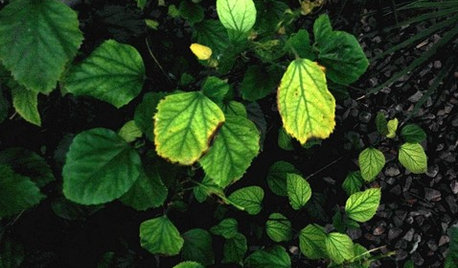
I've got an otherwise healthy kellogs breakfast that has some strange markings on lower leaves.

It is in a SWC and is setting fruit and seems to be pretty happy.

As you can see in the pictures, it is only affecting the lower leaves.

Is there any reason to be concerned? Anything I should be doing differently?

thanks in advance!


Comments (9)

  • 17 years ago

    Z, Looks like powdery mildew - but you be the judge. Link below.

    Here is a link that might be useful: Tomato Problem solver

  • 17 years ago

    Tomato plants always seem to develop yellowing of the lower leaves as the plant matures. It can sometimes be a sign of too much watering. The plant in your picture looks dandy to me, however, and I would just remove the yellowed leaves as I see them from day to day. Other symptoms like spots on the leaves might indicate disease, and that is common too as the season wears on, but I don't see anything unusual in your picture.

  • 17 years ago

    Growing the same way (SWC) and have exactly the same deal with lower leaves. Some plants have it quite severe (Black Krim, Knin). Much worse than yours. Others show minimal signs (Cherokee Purple, Stupice)

    I thought it was mg deficiency caused probably by high PH rather than lack of mg. However, I've been foliar feeding with epsom salts and it hasn't changed much.

    Interestingly, my container plants in regular containers (MG mix, but not self watering) do not show these signs.

    Next year I'm going to try two things. Introduce some epsom salts into the planting mix, and two, use some gypsum instead of agricultural lime to try to minimize the PH spiking up. I guess I could keep a special PH adjusted tank of water for tomato feeding, but that seems too much trouble.

    Curious to hear what others have to say. BTW, there is at least one other thread with the same symptoms in SWC.

  • 17 years ago

    You have interveinal chlorosis -- meaning that the leaves are yellow between the veins, while the veins themselves are still green.

    As raisemybeds said, it's normal for the lower leaves to yellow as the plant gets older.

    The yellowing can also indicate stress and/or a nutrient deficiency. It can result from too much rain, but since you're somewhere in California, I assume it hasn't been raining a lot. I don't grow tomatoes in containers, but as I understand it, container tomatoes need to be fertilized more often because nutrients wash out through the container's drain holes.

    Some of the leaves are a bit curled: another general sign of stress, but no big deal.

  • 17 years ago

    I'm experiencing the same dilemma with a couple of Pineapple variety plants that I have in self-watering containers. Some of my Brandywine's that are planted in the ground exhibited similar symptoms but only on a very slight yellowing of a leaf or two. It's really only affecting the plants in my SWC. During planting, I used MG Organic Choice Potting Mix and side dressed with about 1 cup of organic fertilizer. (The transplants were healthy and robust)

    As a remedy, I'm trying epsom salt mixtures when watering and fish fertilizer applications but so far no improvements. I'm curious as to what exactly is going on and posted a previous link with a picture of a plant showing the exact same thing. One thing that I've noticed is that both our plants are large variety tomatoes (Kellogg's and Pineapple). Could it be that the plants are rootbound and therefore roots are sitting in the water in the bottom? I'm not sure what it is but I used plenty of fert and a good potting mixture so my guess is it's a watering / weather symptom but not sure. Could it be that the PH has spiked as one poster alluded too? One thing I did not do is add lime. I'm new at this and never heard of that before I started reading posts on GardenWeb this year. (I have grown cherry tomatoe varieties successful in years' past without using lime in the SWC)

    One other part of my strategy is letting the soil dry out a little more before adding water to the reservoir. If it was too much water then hopefully this will correct the problem but hopefully not at the expense of BER or cracked fruit.

    I'm not necessarily suggesting that anyone do what I'm doing but I thought I'd share and if I see any improvement I'll post what I think helped.

    Here is a link that might be useful: Helpful link

  • 17 years ago

    Hi zetterberg,
    The curling upward & chlorosis on older leaves looks like magnesium (Mg) deficiency symptoms. It is not fatal.
    I am guessing that you have been using a good deal of calcium (Ca) in your fertilizer, since we are always paranoid about BER. Also, when a container medium is "limed" to adjust pH, this technique can introduce several Ca variables. (Not subject of this post.)
    There is a problem associated with Ca, which is usually a booster of mineral uptake - but not Mg.
    Mg uptake is less with excessive Ca present (one reason why symptoms take time to show up = it takes time for Ca to build up). Since Ca is not a fast moving element it is possible that in a SWC it is accumulating in the root zone, from wicking into the growing medium.
    This Ca can the alter the root's membrane surface & bind to reactive sites in a way that affects permeation of Mg. (But the same Ca behavioral properties encourages many other ions, like crucial potassium or K, uptake.)
    So, please review your level of Ca use, to see if you are using too much of a good thing. In a SWC the fertilization technique (ie: wicks up depending on growing medium used) may be hard to alter, but the fertilizer ingredients can be adjusted. Flushing of the growing medium would be possible to do; but quite inconvenient an extreme if leaf Mg deficiency symptoms are not becoming rampant.
    An effort to foliar feed Mg may or may not be effective, opinions on the technique vary. Foliar feeding excessive Mg that is allowed to drip down into the growing medium may or may not (TDS problems) be desirable.
    Poster named structure indicates his top watered container tomatoes do not have these symptoms, but tomatoes in his SWC do. To me this indicates his top watering precludes the Ca from accumulating in the tomato root zone & so no Ca antagonistic affect occurred with Mg; unlike symptoms seen in his SWC tomatoes.
    Dirt growers have an open eco-system so tomato crops are less prone to this Ca/Mg inter-action problem. For those with high Ca content in their irrigation well water &/or calcerous (many island land is upthrust coral) soils the symptoms of Mg deficiency are possible.

  • 17 years ago

    Thanks for posting the info, Gringojay. I'm experiencing the same issues as zetterbeg and overuse of Calcium seems to be likely in my situation. I think you really hit it on the head as I forgot about the handful of bonemeal that I added to the planting hole for all of my plants as that was what I read in Territorial's catalog. (Recommended for those who have acid soil). I'm sure I added it to the SWC as well. And as you pointed out, the plants I have in the ground who received essentially the same fertilizer application are not showing these symptoms.

    Did any of you other guys go a little heavy with calcium-rich fertilizers?

    I think I will try to water the plants from the top through the soil as opposed to watering directly in the reservoir for a couple of weeks and see if I can't get some of that CA in the bonemeal to move around. (Of course, I'll let the reservoir dry up first)

    Once again, thanks for the info. The knowledge and expertise that is shared on this website is remarkable.

  • 17 years ago

    That was helpful gringojay. I'll trying a SWC with much less lime lime, one with recommended, and one with gypsum instead. I guess the secret is getting the right balance between Ca and Mg. Too little Ca, BER. Too much, Mg deficiency.

  • 17 years ago

    In many varieties this is normal. It looks to me like you have a nice thing going on. As far as I know (and experienced) leaf curl does not negatively affect production. Make sure your plants are not being beseiged by aphids or spider mites. If so spray with water or an complst tea or a commercial insencticide poweer, etc. Otherwise just live with it.

    Tom