

Sungold's Wild 'Splitting' Gene???
Okay ... I'm going to bounce this one off the wall, folks.
We've all seen post after post about how Sungold splits open when ripe. Complaints abound.
It must not be total fantasy since seed companies often compare other sweet gold cherries to Sungold then say, "but doesn't split as badly," or "is crack resistant," blah, blah, blah.
It seems some other cherries with the wild tomato characteristic of "ladder trusses" also split open when ripe.
Is there a consensus on that? Does anyone have extensive experience with wild type tomatoes and can tell us if splitting is typical?
I'm not talking about the radial cracks or concentric cracks you see in larger domesticated tomato varieties. Those seem confined to the upper areas of the tomato around the calyx. I'm talking about tomatoes that split wide open from stem to stern ... (the yellow ones in back are Chello to show not all the cherries cracked under identical conditions).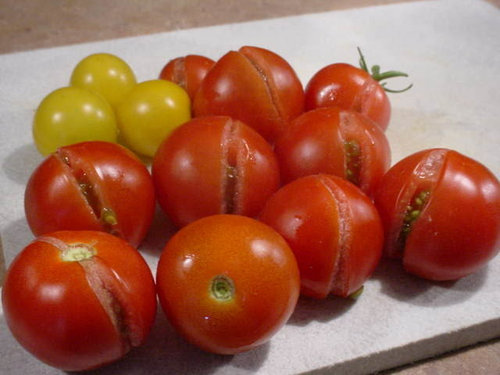
That's a handful of Indian Stripe x Sungold. I never had a Indian Stripe split open like that regardless of rain. Yeah ... they might have a few radial cracks like a Cherokee Purple will do. Or even an occasional random skin split ... but not anything radical. However, the Sungold I grew and used for this cross only split like this when dead ripe and hit with a heavy rain.
So, I'm assuming the radical bursting tendency exhibited by this Indian Stripe x Sungold comes from the Sungold parent. Is that fair to assume?
Now, look at the location of the splits ...
Every tomato split right in the seed locule, which of course would be the logical place to burst as it is the weakest point in the structure. But isn't that curious how it happens ... only one of the three locules bursts. Yeah, that releaves the pressure and allows the other two locules to remain intact. But isn't that curious from a natural point of view?
What I'm getting at is I think Nature works to burst one of the three seed locules to open the fruit to feeders who will carry seed away from the grow site (distribution to other potential sites) while spoiling the fruit by accelerating rapid decomposition (via fermentation, infestation, etc.) so that the remaining two seed cells rot and drop seed to the ground at the grow site (perpetuation at a known/suitable site).
With larger, domesticated tomatoes, this natural (and unappealing) tendency has been bred out. The wild structure of two or three relatively large and seedy locules have been modified by manmade selection to interior structures that withstand the natural tendency to split or burst like the more simply structured wild tomato.
But Nature prevails, it seems, when one crosses a domesticated "beefsteak" type (Indian Stripe) with a more "wild" structure (Sungold) and the bursting tendency dominates. Is that a fair assumption?
Bill
Comments (21)
 19 years agolast modified: 11 years ago
Bill, I have no idea! LOL
But I've grown SunGold many years. And later in the season they split like your pics every year. None have split so far this year and I've picked maybe 40 ripe ones so far. They split for me from mid season on to the end when the lawn is heavy with dew each morning. I wonder if the fact that they never split early for me but always split mid to late can be explained?
I cut back on this problem by always picking anything near ripe before a rain is due and drying them quickly after a washing off in the sink. If I don't dry them immediately and simply place them on a table or plate still a little wet I can come back an hour later and see half of them cracked just from me washing them!
last year Black Cherry followed this pattern of none splitting early but splitting later but they split far less often than SunGold.
But I won't stop growing SunGold because of the splitting. Too many of us here love them too much!
- 19 years agolast modified: 11 years ago
Bill, are you a Colts fan? I am. I followed them when they were in Baltimore. Last year was MAGIC!
Related Professionals
Brooklyn Landscape Architects & Landscape Designers · Manhattan Landscape Architects & Landscape Designers · Harrisburg Landscape Architects & Landscape Designers · College Station Landscape Contractors · Parkersburg Landscape Contractors · Newport Landscape Contractors · Flagstaff Landscape Contractors · Riverside Landscape Contractors · Atlanta General Contractors · Vincennes General Contractors · Natchitoches General Contractors · Poplar Bluff General Contractors · Portsmouth General Contractors · Laredo General Contractors · Vancouver General ContractorsHoosierCheroKee
Original Author19 years agolast modified: 11 years agoBig Daddy,
Isn't everyone in Indiana a Colts fan?!? If they're not, they's best not advertise the fact. Have you ever been to a home game in Indianapolis? That has to be the loudest stadium in the league!
Sungold is like the Colts ... loyal fans :::smile:::
Bill
- 19 years agolast modified: 11 years ago
No Bill I haven't been to Indianapolis ever but I watch as many Colts games as I can. I am a huge Peyton fan and I am happy that he finally shot down his critics. He is the best QB I have ever seen and finally now some of my friends here in Delaware are starting to agree with me. And that is a very rare experience! LOL
And Tony D is a great coach and a great gentleman. Patriots got even better with Stallworth and Moss. But I think the Colts can repeat. That would be great...:)
 19 years agolast modified: 11 years ago
Sungold tomatoes are not all things to all people; they have a wonderfully complex & balanced flavor, but tend to become monster sized plants, and they do split when over ripe or allowed to sit on the vine too long. As a result, they are not a good choice for folks with limited space or for those who are not diligent about harvesting. If you want a longstanding cherry tomato -- look elsewhere.
Pick a tomato, any tomato and you will be able to identify an upside and a downside. For many folks, the sungold flavor far out weighs the negatives. The tomatoes in the pictures above appear to be over ripe and therefore with splits, they simply need to be picked sooner. Consider making multiple searches through the sungold patch each day.
HoosierCheroKee
Original Author19 years agolast modified: 11 years agoThe other planters' experiences with Sungold and their opinions are all very interesting. Thanks for the replies. Like I said ... I was just bouncing some far fetched ideas off the wall ... an old man's musings. Hahahahaha.
Bill
- 19 years agolast modified: 11 years ago
Those seem to have a deep red color and not orange. I'd try picking sooner. Some of mine split also, even the very small fruits. Those that split seem to taste sweeter, too.
-Ed
HoosierCheroKee
Original Author19 years agolast modified: 11 years agoEd,
The tomatoes in the picture aren't Sungold F1 ... they're F1 fruit from an Indian Stripe x Sungold cross.
Yes, I can pick them half ripe and they are deep orange with the green gel still barely visible through the opaque skin and flesh ... but when they are fully ripe, they are indeed bright crimson. And yes, when I pick them half ripe and looking deep orange, they don't split. But none of that has anything to do with the questions and theories I have about the genes that might control fruit splitting or the reasons why Nature wants tomato fruit to split.
Bill
- 19 years agolast modified: 11 years ago
It seems some other cherries with the wild tomato characteristic of "ladder trusses" also split open when ripe.
****
The source of the gene(s) that determine the flat truss trait that are bred into modern day hybrid cherries is from currant tomatoes, S. pimpinellifolium.
I've grown several different currant varieties as well as Sara's Galapagos which is a stable interspecies cross between a currant and ???? and none of them have split. When saving seeds I have to individually pop open each wee fruit with my hands when setting up fermentations. LOL
(Is there a consensus on that? Does anyone have extensive experience with wild type tomatoes and can tell us if splitting is typical?)
Just answered above and no consensus as far as I'm concerned. Oh, and I've grown S. cheesmanii as well, and no splitting.
(I never had a Indian Stripe split open like that regardless of rain)
Bill since I introduced that variety, seeds from Donna Nelson, as you know, I've no doubt grown it more than others. And like most other tomato varieties it has split for me when there's been rain deluges.
So I don't think Sungold is necessarily the splitter in the cross with Indian Stripe.
I never did do X sections of split cherries so I do find it interesting that all the splits are asociated with locule locations.
Carolyn
- 19 years agolast modified: 11 years ago
in my climate..the only way i could ever keep sungolds from splitting was to pick them early in the morning while the fruit itself was still cool.
if we ever picked them in the hot summer afternoons and then brought them into the air conditioned house...they'd all split!
i never noticed a difference in months and we rarely, if ever have rain during the summer...
HoosierCheroKee
Original Author19 years agolast modified: 11 years agoCarolyn,
Thanks for the input. That's what I was looking for ... someone who has grown several different "wild" tomatoes
or tomatoes with a "wild" parent to tell me if the tendency for radical splitting pictured in the
original post is typical to those types of tomatoes.Let me clarify what I meant when I said, "I never had a Indian Stripe split open like that regardless of rain."
As you know, I only grew Indian Stripe one year ... 2006 ... but that was a very hot summer with a week or so
of torrential rain coinciding with the Indian Stripe getting ripe in July.Yes, as I said above, the 2006 Indian Stripe had "an occasional random skin split ... but not anything
radical." What I meant is, yes, the Indian Stripe would exhibit a skin split in a random pattern sometimes
vertically, but usually horizontal around the belt of the fruit with some irregularity in the direction ... NOT a
radical, vertical chasm from the calyx to the blossom end and bleeding seeds as shown in the pictures above.Also, as I said in the original post, "the Sungold I grew and used for this cross only split like this when dead ripe
and hit with a heavy rain" meaning the Sungold would split from stem to stern in a big ugly chasm just like what is shown
in the pictures above.That's why I thought just maybe the tendency to split open from stem to stern, vertically, as shown in the pictures
in the original post, might be a characteristic carried into the cross by the Sungold parent and specifically associated
with the interior structure of the fruit ... two or three proportionally large seed cells as opposed to Indian Stripe
structure which looks like this: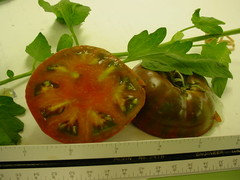
Oh my gosh ... look at that ... there is a skin split right there on the left hand half-tomato right at 3:00 (90* azimuth) ...
but notice the skin split doesn't open through the interior wall, bursting the fruit and spilling the seeds and gel.So, I may be imagining things here, I admit, because just about any thin skinned tomato I've grown will split its skin
in a heavy rain following a dry spell, right? But again ... I'm talking about the degree of splitting shown
in the pictures in the original post. Maybe I should characterize it as "bursting" rather than "splitting."
Then I might say I don't remember seeing tomatoes burst open, stem to stern, when they had an interior structure like say this.
And none of these heavy walled tomatoes burst open or even split in 2006 and were grown right next to the Indian Stripe
and in the same row as some Sugar Lumps which did burst open exactly like the Sungold and the F1 shown in the original post. Here's an example of a very heavy walled fruit that didn't split in that garden.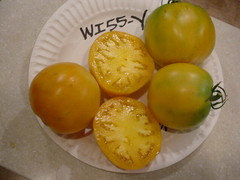
But, again, thanks for the input as it is what I was asking for. Since there are several "wild" tomatoes or tomatoes
with one "wild" parent that you point out don't tend to burst as shown, I need to look further into the particular structure
of the walls and locules to see if there is something there that indicates this weakness.Bill
- 19 years agolast modified: 11 years ago
A few more comments.....
I've grown many cherry varieties including Texas Wild Cherry, Mexico Midget, Sungold, Black Cherry, Ghost Cherry,
Sweet 100 amoung many, many others and I have never had to deal with split fruit on any cherry varieties with exception to Texas Wild Cherry. Texas Wild Cherry was the only one and the split fruit was very limited when compared to the overall number of fruit harvested.I know this year we had had record amounts of rain, but I have yet to observe any split fruit on any of the cherry varieties I've grown this year including Sungold. Unfortunately, I can't provide firm reasons why and I have read the reports of split fruit with Sungold from others over the past few years.
I have to admit, I was completely confident that I was going to get split fruit on all varieties due to the never ending rainfall we received but looking back over the course of the spring season, I only had a handful of fruit that split.
Jay
- 19 years agolast modified: 11 years ago
What you are describing is called "bursting". It is controlled by two genes. Some of the literature calls it "harvest cracking".
As mentioned in TL - I have seen and grown several different accessions of cheesmanii and some have burst.
RCA Dome?
I DONT think so. I've heard asthmatic old ladies screaming louder for ice cream at a KC nursing home than Colts fans!
;) HoosierCheroKee
Original Author19 years agolast modified: 11 years agoWhat Hortist is referring to is at another garden forum he suggested I get a copy of "The Tomato Crop: A Scientifc Basis for Improvement (1986)" via interlibrary loan and see what is in there ... and that the book has been or is being revised, so a more up to date version should be out soon.
Thanks, Hortist, I know you also have grown many many "wild" type tomatoes, and I value your input. You too, BVG ... and I sure hope your 2 straight months of monsoons are over!!!
Bill
- 19 years agolast modified: 11 years ago
brazosvalleygardener,
I wish I knew why your SunGold's never split. man would I love to grow a SunGold that doesn't split. I've tried the SunGold imposters like Sun Sugar and they didn't split as badly as SunGold but some still split and the taste didn't measure up to that one and only SunGold taste.
- 19 years agolast modified: 11 years ago
Below are a couple of photos of Sungold I harvested. A bit blurred as I was trying to master the macro mode on the camera and was not very successful.
Jay
{{gwi:1369669}}
{{gwi:1369672}}
- 19 years agolast modified: 11 years ago
I've posted this else-where ...
But have I read somewhere that breeding peruvian wild tomatoes into other lines can improve splitting / cracking genes ?~ Tom
- 19 years agolast modified: 11 years ago
brazosvalleygardener,
Yes, that's how mine look now. So far no cracks/splits. In another week or two they will start splitting again as they do every season without fail. I have been growing SunGold since about when they first became available to home gardeners and I think that was in the mid to late 90's.
HoosierCheroKee
Original Author19 years agolast modified: 11 years agoBVG,
Yes, when I harvest the Indian Stripe x Sungold at the stage of ripeness as you show those Sungold, they don't burst either. Note, you can still see the green gel through the somewhat transluscent skin and flesh. Same with the slightly underripe Indian Stripe x Sungold ... I picked some at the same degree of ripeness as you show those Sungold and they haven't bursted as they've sat on the counter inside for three days now.
But when they are truly ripe, the transluscence disappears, you cannot see the green gel any longer, the fruit appears crimson, and they burst. I noticed the same thing with Sungold last year ... when they get truly ripe, they are much deeper orange, not transluscent, and burst. So ... what Mr.Clint said above applies.
Tom, interesting about the Peruvian tomatoes ... I hope you can find that document to share with us.
Bill
- 19 years agolast modified: 11 years ago
Hey folks,
For me, it does not matter when I harvest. Early, mid-season or let them go overripe on the vine - still no splitting. I almost pulled my Sungold plant this weekend but what I'm going to do is hold off and I will purposely let the remaining fruit go way over ripe on the vine and take some photos along the way to demonstrate this. I've got some bagged and unbagged. The bagging is to prevent stinkbug damage as is reflected in some of the fruit above.
It may be about Thursday or Friday before I have any that will be overripe. Not many fruit left on the plant but should be enough to take photos of what I am experiancing.....maybe another 50 to 75 fruit for sure, probably more.Jay





brazosvalleygardener