Software
Houzz Logo Print
hemnancy

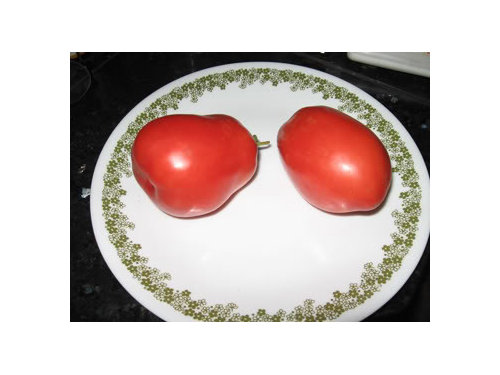
ID these tomatoes?

17 years ago
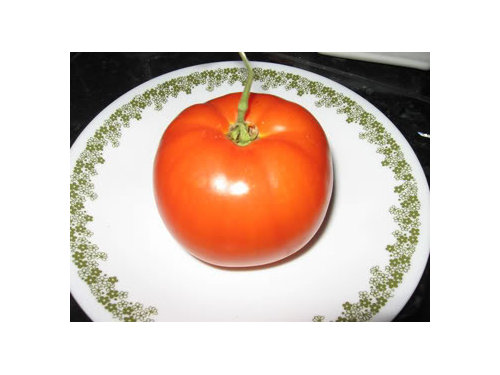
Even though I try to keep seedlings labeled, make maps when I plant out, etc, I'm having a lot of trouble making my map fit the plants I see in the bed.

Here is a tomato that I found broken off in a cluster of 3 and was on the ground, potential ID's from my map include Nepal, Sioux, Jetsetter, Soldacki, and Carol Chyko. It weighs 12 oz., completely blemish free.

When I picked these they looked very pink, the photo not as much. They weigh 5 oz. Some choices are Plum Giant, Sochulak, and Garvey's Special? Paste.

Thanks, I am planning to save seeds on them anyway.

Comments (9)

  • 17 years ago

    For some reason I don't understand, Vent Marin's Passion Tomate database fixates on odd data like the number of sepals. That might help you eliminate some of the possibilities.

    In the first group, Sioux, Jetsetter, and Carol Chyko are all supposed to have 7 sepals; Soldacki has 6. No sepal count for Nepal.

    The pic of Soldacki was very ribbed on the top, but I don't know if that's always the case.

    Nepal has a truss size of 6-7, and apparently 5 locules. Sioux has a truss of 4-5; Jetsetter 3-4; and Carol Chyko 4-5. No truss size given for Soldacki.

    No helpful info for any of the pastes.

    If you read French, it's here: http://ventmarin.free.fr/passion_tomates/passion_tomate.htm

    An online dictionary I have found helpful in figuring out some of the tomato terms that we definitely didn't cover in class all those zillions of years ago:

    http://www.wordreference.com/

  • 17 years ago

    Soldacki it isn't! Soldacki is a large pink.

    Here's Nepal the last time I grew it... maybe cut yours open to see the locule arrangement.

    {{gwi:1384310}}

  • 17 years ago

    For some reason I don't understand, Vent Marin's Passion Tomate database fixates on odd data like the number of sepals.

    lol, that's a funny way of putting it...I've thought that is an interesting database (and hard to understand without knowing French). I'm not sure if I understand the sepal count either, because I see varieties with highly variable numbers of sepals so I can't see how sepal number would help much to ID a variety that could put out one fruit with 5 sepals and another with 8 on the same plant.

  • 17 years ago

    catman, I assume they only cite a sepal number if the number is consistent for that variety. And I'm hoping they're fairly accurate. But who knows?

    They also seem to fixate on the type of blossom scar and the stem depression. But I'm not interested enough to look up all the vocabulary that seems to go with that -- not being myself fixated on those traits!

    Maybe it's a French thing?

    I suppose the blossom scars and stem depressions might be of interest to market gardeners (wanting "pretty" fruit with few blemishes).

    The best reason I can come up with for the sepal count is maybe to ID the variety. Or it might have something to do with the variety's ancestry?

  • 17 years ago

    I was finally able to locate a label in the ground for the paste tomato, it was Sochulak.

    I cut the round tomato open, it looks somewhat like the Nepal photos but the loci are smaller and the middle part larger. When another similar tomato developes maybe I can tell. The problem with my labels is the moles come up in my planting holes and a lot of labels get covered with dirt or washed down the holes. I think next year I will try to put the stakes in when I plant and put the labels up on the stakes so I won't have that problem again, as it is driving me crazy. The other problem is that maybe I'm missing one planting sheet since I think I can count 36 rows on one side but my map only goes up to 32.:-( With the difficulty in finding labels and not knowing exactly what some of these tomatoes look like... But they taste good anyways.

  • 17 years ago

    I always draw up the yarden on the computer in MS Paint. I do a couple basic sketches, then add things and save the images after each group addition. Then next year, just erase the names and change to the new varieties. You can get as crazy as you like, spending little or lots of time on it. I pretty much have it mapped out to 2". I even include the irrigation system so I know where it is. Make a backup copy in case of a computer crash. You don't have to worry about losing sheets of paper.

    I even switched to an old large format (11x17") color laser; now I don't have to worry about the printout getting wet in the yard and the colors running like inkjets do.

    Very lo-res, lo-quality sample in reduced size at the link below...

    Hope this helps.

    Here is a link that might be useful: {{gwi:30992}}

  • 17 years ago

    I've used Paint also, but only for landscaping, the orchard, and the interior of the house. If you're going to use Paint, here are some tips:

    View -- Zoom lets you see things close-up. View -- Zoom -- Show Grid (usable only after you've already Zoomed to a closer view) allows you to place pixels precisely.

    It's helpful to make yourself graph paper and save that as a generic document (I have different sizes: 10x10 pixels, 20x20, etc.). I also have lined paper of different sizes.

    Image -- Attributes lets you specify the size of your picture in pixels.

    ====

    For simple row-garden areas, I use the Word's Table function. A few tips for that:

    Create the table you want by using Table -- Insert -- Table, then specifying how many rows and columns you want (you can add and delete later).

    You can change the thickness, color, or style of the cell lines by using the Tables and Borders toolbar (View -- Toolbars; I keep my Tables and Borders toolbar below the document as part of my basic Word layout).

    Keep in mind that anything you want to do to the table must be done from the Table function -- and you can't do anything unless your cursor is within the table itself.

    Play with it; use Edit -- Undo as needed (okay, that's the regular Edit -- Undo, not found under the Table function).

    Some people would tell you to use Excel instead of Word. I've done complex things in Excel, but not often enough to remember how I did them....

    ===

    So far the worst thing that's happened to my tomato labels is faded ink (sun? rain?) before I had all the bed on paper. Luckily the only 3 I couldn't guess at were a cherry, a PL, and a RL (the PL and RL have different fruit colors too).

    I used a ton of plastic labels in a large shade flower bed, but it seems like the only labels that didn't fade were pulled up by squirrels....

  • 17 years ago

    I use Excel for maps. I guess if I were organized and made the map first then planted the plants according to the map I could do better but it would take more time, and there are sometimes mishaps like a tomato stem breaking while planting. I'll have to consider that for next year, plus maybe some short plant stakes to attach the labels to that couldn't wash down the mole holes. They would have to fit under my tunnels which are 18" tall. At least the voles don't nip off the tomato stems at the ground like they do the pole beans, leaving the vine to wilt and die. My latest mole retaliation is to put rotten meat in the top of the hole so they won't think it's so nice to re-dig the hole.:-P

  • 17 years ago

    Last year, when I was planting many more veggies, and was much more organized, I made a grid the shape of my veggie garden, put it on a clipboard (still covered by its vaccuum-plastic wrapping -- conventient for a muddy garden!), and took it with me as I planted. Then at the end of the day I would enter what I'd planted, and print out the new version.

    One good thing about our years of drought is a major drop in the mole population. I'm building raised beds (very slowly), and so far haven't seen any sign of moles there.

    Something chopped my borage plants at the soil line and carried them off for a snack (they were in a seedling tray on the sunny edge of the carport, being hardened off -- definitely no cutworms). And a squirrel (or something four-legged -- definitely not a hornworm) ate the younger part of the lower branch of my Pink Berkeley Tie-Dye. Maybe, when the garden fence is finished, I should electrify it....