Software
Houzz Logo Print
maydl

Need help to start researching this dish

17 years ago
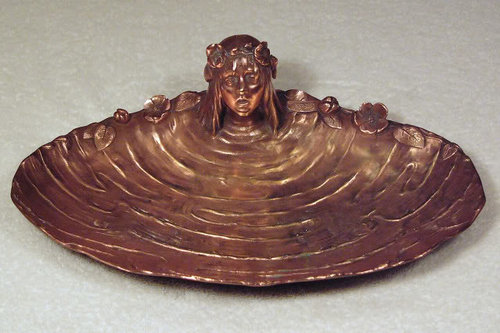
Newbie here, over from the Kitchens Forum.

Can anyone give me a clue as to the age and purpose of this dish, which is 11" wide x 4" high and weighs 4.3 pounds. I think it may be cast copper, but I'm not sure. It has no maker's marks that I can discern. It belonged to my late aunt, who probably purchased it from an antiques dealer. Thank you!

Comments (28)

  • 17 years ago

    The style says it's Art Nouveau, probably c. 1900-1910, although it could have been cast at any time since. Beautiful piece - not as 'flowing w/tendrils' as many art nouveau pieces (that's why I think it may have been made later but that's a guess) but certainly not lacking in detail. Definitely a keeper!

  • 17 years ago

    I am thinking later as well, like perhaps late 20's...early 30's.
    It's a "tray"...to put your mail on, calling cards or just because it's pretty.
    Was it polished when you got it? Does it have a protective coating...like laquer?
    I am amazed at the lack of tarnish but at the fact that it doesn't look "new penny bright".
    It's very nice.
    Linda C

  • 17 years ago

    Are there any marks on the bottom. It's too bad it's been polished.

  • 17 years ago

    Thanks so much for your responses and clues, and I freely admit that I am the one who polished this piece. I don't want to offend anyone, but I am not of the school of thought that antiques must never be polished in order to have or maintain value.

    I think that this piece was shiny and beautiful when it was created, and it is difficult for me to believe that the artisan who made it would want it to turn a dull shade of brown. When polished, the piece has depth of color and contrasts between reflection and shadow that highlight its sculptural features.

    To my way of thinking, there is true patina (for instance, the lovely glow of well-used sterling silver), and then there is oxidation/tarnish. I have seen many priceless collections of fine metalwork in museums around the world, and not one of the pieces was shown in a tarnished condition.

    Thanks for your help and for your patience with my "rant".

  • 17 years ago

    there's tarnish and then there's patina....
    I am sorry you removed the patina that I feel was prpbably originally applied by the maker, with the grunge and grime.
    Soap and water and a good rubbing with a soft cloth are often preferable to an attack with brasso and simichrome.
    But it's yours...do what you like....and no matter what it's lovely.
    Linda C

  • 17 years ago

    I can see where someone could think that it was intended to be polished, but they would be wrong. Victorians and later were enthralled by bronzes finished in different patinas. Reason being: an artist would apply a patina as he saw fit, and it was permanent, it was his vision for the piece. Polished goods OTOH always exist in a state between polished and tarnished. The surface starts to oxidize very soon after polishing. It cannot be maintained forever, because each polishing removes metal, and eventually the detail of a fine casting is worn away.
    Whenever I see a highly polished bronze _objet_ I reflexively think of baby shoes!
    The unhappy lady in the water looks like she needs rescuing.
    Casey

  • 17 years ago

    Sorry I didn't mean to offend you, but she's not meant to be polished. Having said that, she's yours & you can have her the way that she pleases you the most. :) If you brought her into my shop to sell her, I would have to offer you about 75% less than I would if she had 80 years of bronze patina. Collectors will pay for patina, not for cleanliness! :)

    Still wondering if you can take a photo of any marks on the underside. I would still love to tell you who's she's made by, I have a good hunch, but would love to see a mark.
    Thanks, mfrog

  • 17 years ago

    mfrog, here are pictures of the bottom of the dish, taken from two different directions. I truly cannot discern any mark other than scratches.

    {{gwi:1378243}}

  • 17 years ago

    You're right, there's no marks there. I will take a look in a couple of my books & see if I can find it for you. It's the kind of thing that I sold lots of in my shop.
    Hope I can help you out.
    Cheers, mfrog!

  • 17 years ago

    Wow, is the base what she looked like before you "cleaned her up"? It's gorgeous (tone, finish etc). She's beautiful, and yes likely art nouveau given it's style. Is she very heavy? You know bronze is made primarily of copper so often people confuse them when a bronze is cleaned in appropriately (all of the artists finish removed).

    She could have been quite valuable...she certainly is appealing in a retail fashion. I'd sell her in my store in a heart beat, but only in original form. I know you don't feel you're in the school of "leave it unpolished" but in all honestly, it's not a "school of thought" but instead a basic fact. Removing the patina, especially an artists patina on a bronze piece, literally ruins the value of the piece. I suppose if you're never going to sell her and no one in your future ever family never wants to let her go, than it does not matter, but frankly when I look at her in her current state, I feel it's akin to seeing a beautiful eastlake dresser with all of it's finish removed, and a horrible and VERY Shiny thick gloss varnish has been applied. Fortunately for the eastlake, it can be dipped and removed....but patina can never be returned to a piece which is really quite sad :(

    I hope anyone who reads this thread can see the damage done and understand why it shouldn't be, even if you do like the look of shinny copper. If you've ever seen a Remington bronze and then think of it all shiny copper colored...that's the nightmare of any art collector! You'd litteraly be taking the piece from museum to garage sale in quality in on swipe of that awful brasso filled rag :o(

  • 17 years ago

    What a great piece, and as long as maydl loves it as it is ~~ good for her. I guess "what it's worth", which by the way the OP did not ask, is whether the worth is measured in dollars (as in an investment) or a lovely little treasure and keepsake from a family member.

  • 17 years ago

    I can appreciate it whether it has original patina or polished - the casting & finishing are beautiful either way & the size is impressive. It may no longer be considered museum quality (if it ever was) but it certainly is a long way from garage sale status.

    Originally, the artist probably washed it with a chemical solution that caused oxidation, giving more depth to the details by darkening. You can have this redone or you can leave it outside for awhile to darken naturally if you decide you don't want to polish anymore. Admire & enjoy it!

  • 17 years ago

    Justlinda, one of the fun things about an old house forum and an antiques forum is that people can learn just by reading the forum. It's interesting and fun, but it's also valuable information. It isn't uncommon when you ask "what is this" that you get much more information than you thought was available, which again is fun but also great information for any one else who spots something similar one day.

    Part of the value is learning how to take care of a beautiful treasure or a beautiful old home (just a bigger treasure) so when someone in the old house forum asks "do you like vinyl windows and laminated cabinets" when discussing their 1600 Cape Cod...they get answers akin to mine..."You're kidding right?" "Do you know how much that will devalue the property" etc. This is no different.

    Of course she should love the piece, but it's also good information to know how to love it correctly. If someone posted a Picasso and said they were going to hang it at marker level in their 5 year old's art room to inspire him, unprotected, and maybe in a nice shiny metal frame, you'd see similar remarks "You're kidding right" "Gad don't do that" etc. While the poster might not have known it was a picasso and receives good info there, if they came back and added they still thought the art room was a good idea you'd see literall gasps of horror from any art lover.

    Antiques are treasures and if not treated right, we lose a little bit of treasure every time that patina gets scrubbed off by someone who didn't know about the artists finish.

    And FYI...Originally the artist chose a spicific type of finish for the piece. Leaving it outside to darken is NOT the same process and will not produce the same results. It might be better, but it's not the same. My starter DH did lost wax casting. All of the finishes are very specific and have been for many many many years (far earlier than this piece).

    I do hope the OP loves it, but information is good for everyone :)

  • 17 years ago

    With all due respect, and in defense of the original poster, I think the message to be learned here....is FIND OUT WHAT YOU HAVE BEFORE YOU DO ANYTHING.
    I am sure the OP thought she had a copper dish, in which case polishing it would have been just fine, but it's a piece of cast bronze sculpture.

    All people who are "into antiques" have seen all manner of horrors, like set of beautiful ornate flatware inherited from Grandma which was dip polished, and the old Sarouk whuch had the end cut off so it would fit into the room, the faux graining which was removed to espose the old wood.
    And we have all bought things like the 18th century sampler in a box of doileys, or the Navajo pot which was in the shed with the flowerpots.

    If this forum serves no other purpose than to iterate the fact that you need to find out what you have before you sell it or do any more agressive cleaning than dusting, it has fulfilled it's purpose.

    If you doubt how you changed the artist's work, try to imagine Rodin's "The Thinker" in shiny brass.

    However, it can be repatinated, and luckily you didn't polish the bottom, so you have an idea of the artist's intention.
    Linda C

    Here is a link that might be useful: patina on Bronze

  • 17 years ago

    LOL Lindac, we're buying a house with faux graining. The previous owners painted over one side of the door to the library to hide the "Fake painted wood". They chose a lovely "blah" white to hide that delicious work...and should be smacked with a graining paddle for doing so. We're bringing in a faux artist to redo it as it was intended to be. They did the same on all of the wood in the upper floors, which were a lower grade wood than the main floors. All that glorious work is now white or burgundy :(

  • 17 years ago

    I admit my error in polishing the piece, and I thank you all for the education you have provided to me within this thread. Thanks as well for the civility you have displayed during a "conversation" that must have been hair-pullingly frustrating for you. And to mfrog, thank you for help present and future.

  • 17 years ago

    maydl;
    I have looked in all my art nouveau books & shown her to a colleague, he agrees she is very familiar but we can't give her a name!
    It's one of those pieces I would put on the shelf in my office til I found her, but I suspect she was mass produced in during the art nouveau period to satisfy the masses for the "new art"
    She's lovely, enjoy her, she's not worth a great deal of $, if I had her, she would be in my bedroom for putting jewelery in or in a guest bathroom with fancy soaps in.
    Cheers, mfrog

  • 17 years ago

    mfrog....do you really think she was "mass produced"?
    From what I know of bronze casting, it's a painstaking process which doesn't lend itself to mass production.
    not to say there weren't several....just as there are "several" Rodin's The Thinker and at least 2 of Da Vinci's horse.
    I am not saying it was unique, but certainly not mass produced the way poured porcelain is reproduced.
    I would guess that in unpolished condition she would bring between $300 and $400.
    Linda c

  • 17 years ago

    Hi,
    It doesn't look mass produced to me. There is a level of detail and 3-dimensionality that you couldn't get outside a lost-wax casting technique. Unless it's a new repro made in china.
    Casey

  • 17 years ago

    Yes, I do think it's mass produced, even pieces from WMF, Liberty, Dixon & Son, Mappin & Webb etc, were mass produced. It doesn't mean they were cheaply produced, people bought nice things at nice shops for their homes in the teens. Not everything was either cheap or handmade, there was lots of middle class people wanting new things to buy. (sound familiar?)
    I don't know why everyone thinks there can't be good pieces made in a factory. It is not an artist produced piece & it certainly is not a new repro. See how nicely finished the bottom is, you would not find that on a new piece.

  • 17 years ago

    But lost wax casting is difficult to reproduce with great detail. And I'd agree with Casey that this does look like a lost wax casting. It's hard to get that level of detail otherwise. As to not being signed....my ExDH didn't sign his pieces either....that does not mean they're not wonderful....just not signed. It would be interesting to know what a gallery that specializes in lost wax castings would say about the piece.

    And I think it would be lovely for jewelry :) I was just searching for something the other day and dang she'd have fit the bill LOL I didn't see her anywhere, in original patina or not!

    Part of the reason I'm passionate about her is her beauty. If this was some cheap knock off from China, I could care less what happens to her...but she's wonderful, honestly beautiful :) I hope I didn't give a different impression to the OP.

  • 17 years ago

    Thanks, again, everyone.

    Mfrog, you're a mind reader: She has been holding potpourri in a guest bathroom. Thanks for all your efforts to identify her.

    She's definitely not new. I remember her sitting on a shelf in my Aunt Alice's etagere since I was a youngster, and I'm now 62. When my aunt died, each of her surviving relatives was allowed to choose two items from her belongings as mementos of her. The bronze lady was one of the items I chose.

  • 17 years ago

    Oh, she's interesting, I like her!

    At first glance I thought she was meant to represent some kind of water fairy or nymph. Her face sames to float above a pond with ripples. The flower buds resemble water lily buds, but the leaves are not typical water lily. Water lily leaves are typically circular and larger than the flower itself. But those are more heart shaped, like a trailing vine of some type. But, there are many water plants that trail, so perhaps it's meant to be one of that variety?

  • 17 years ago

    Maybe's she's Ophelia. Is there really no mark anywhere?

  • 17 years ago

    Thanks for your interest, moonshadow and ideefixe. I absolutely cannot find a mark anywhere. The bottom is totally bare and smooth except for a few scratches. And I couldn't find anything that would qualify as a mark on the top side, unless it's something that's worked seamlessly into the design, like Hirshfield's name in his cartoons.

  • 17 years ago

    So, is the general consensus Art Nouveau? It looks it to me and those nymph and lady bronzes were pretty popular then. 1890s-1910 would be my guess.

    Ophelia crossed my mind too, as did the Lady of the Lake. It may not be any particular entity either. At one time I had a site bookmarked dedicated to this sort of item. Can't find it now, but they had dishes fairly similar. Not a one identical to your's however. The value on them were around $50.00 through this collector.

    It's a lovely little dish and I would suspect it wasn't a one of a kind..but that doesn't make it undesirable.

  • 17 years ago

    Isn't this a portrayal of Ophelia? And how can you tell it's bronze and not copper?

    Christopher

  • 17 years ago

    I'm not sure it is, or isn't bronze, just assuming.....but know that those types of art objects were popular in bronze in that era. I've never seen old bronze so shiny, but I've never seen one shined up, either.

Sponsored
Franklin County's Heavy Timber Specialists | Best of Houzz 2020!
More Discussions