Software
Houzz Logo Print
jnh896_gw

What is a 'normal' moisture level for a shower?

15 years ago

We are having a moisture problem in our guest bathroom. Our house is only six months old and still under warranty, but the "people at the corporate office" of the builder are not convinced that there is a problem. We already had our inspector come back and take pictures and write a report, but I am wondering who else we could/should call in for an outside expert opinion?

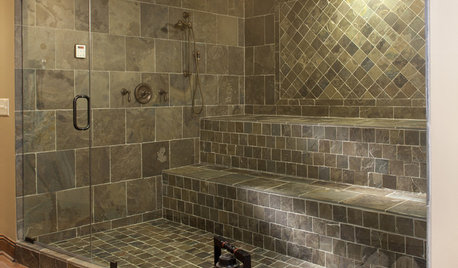
The bath in question is a walk-in shower with a tile pan and bench. It has probably only been used 30 times total in the six months we have lived here. The shower hasn't even been turned on since the first of November. In October, when we had guests, they noticed a crack in the grout where the pan meets the wall and the crack goes up the wall of the bench. It is not just a hairline crack - it is large enough for water to get in. There is also discoloration on other (noncracked) grout lines.

The builder's warranty representative came out and measured the moisture levels with a moisture meter. The reading was sky high in the pan and up two tiles high on the wall. He called in their environmental company who ran a dehumidifier and air mover for two weeks. Although it purged a great deal of water, the moisture level in the pan did not change. The plumber does not think there is a leak after visual inspection from the basement and no sign of water leakage/damage anywhere else in the house.

I do not expect a bathroom to be completely "dry"; however, I think the moisture levels should be consistent throughout the shower. Especially in a shower that hasn't even been turned on in two months and had a dehumidifier pulling water out for two weeks. What could be causing a shower pan to hold so much water and not dry out?

The bottom line is that I think the tiles should be pulled off to inspect what's underneath. An added problem is that the tile has been discontinued, so we can't just patch - it will have to be completely redone. The tile company is resisting since it will be on their dime - they just want to regrout the cracks. What can we do to get this resolved?

Thanks for your feedback.

Comments (9)

  • 15 years ago

    Are you informed enough to say what methods were used to install the membrane? What operation was performed before the membrane was installed? Can you describe any parts of the process? What is under the shower floor tiles, as far as you know? What were you told, what did you see happening, and what did the itemized bill or proposal say?

    I suspect big problems just as you have said it.

  • 15 years ago

    Thanks for your reply, davidro1. This is a house built by a production builder (Ashton Woods), not a custom home, so I don't know a lot about the material used. I do know that the plumber installed a type of membrane that was painted up the wall to cover the height of the bench. (so he says) The pan material was folded so that there were not cuts anywhere that could cause leakage. But I do not know the name of the material, but could ask. Then it was filled with water to be checked by the county inspector that is was waterproof. Then, it is my understanding that the pan was formed and the tiles were laid on top of it. I think that the tile company did both of these steps. I have more faith in the plumber's work than the tile company.

    There has been speculation that the pan may be too flat so that the water cannot drain to the middle correctly. Or, that the act of sealing the tile may be holding water. (Although the builder recommended that we do this.) Or, that it could be a bad batch of tile that is aborbing water abnormally. However, it seems that we have exhausted all testing that is not invasive and destructive.

    The original plan suggested to us by the builder was to get the tile dried out, regrout it and reseal it, and then run water and measure moisture levels again. But, the tile never dried out - which to me indicates an even bigger problem than just cracked grout. But, I don't know what other questions to ask, problems to look for, etc.

    Thanks again for any feedback!

  • 15 years ago

    Search using these words in these combinations and in other combinations
    shower membrane liner pvc
    shower membrane liner cpe
    shower membrane liner
    shower membrane


    and post again to say if these products look like the ones that were used.

    here are examples of what you will find and read :
    http://www.acehardwareoutlet.com/ProductDetails.aspx?SKU=4007480

    http://www.buzzle.com/articles/shower-pan-liner-installation.html "....For plywood sub floor, it is a requisite to build a sloping mortar bed prior to installation of the shower pan liner. You can consider creating a slope of about 1/4 inch per foot ...."

    http://www.ehow.com/way_5832455_shower-pan-membrane-liner-installation.html "....The liner must be installed on a slope mud bed so that the water is directed toward the shower drain or weep hole...."

    http://www.installingceramictile.net/shower-pan-liner-membrane.html "Shower pan liner membranes in the past were copper, galvanized steel, iron, lead and even tar. In time, all tend to fail for one reason or another. Currently most shower pan liners are a plastic sheet which seems like it will last a very long time. Time will tell. The actual shower liner is either a chlorinated polyethylene (CPE) or polyvinyl chloride (PVC) sheet. Either works. The CPE is more flexible and seems to stiffen slower. ...."

    http://www.diybanter.com/uk-diy/127252-ugent-pvc-shower-pan-liner-punctured-screws-potential-leaks-please-advise.html

    AFter you get really comfortable with all this, prepare yourself for a conversation with the plumber. You will be fishing for the right information, and he might be uncomfortable confirming anything to you, so get ready for this step very slowly and methodically. Post again when you are ready to say you understand a whole lot more. There is more I can tell you already, but I'll wait until you make some more progress on your own. Others can help you in this forum too...

  • 15 years ago

    Eternally wet shower floors are usually the result of the membrane being placed flat on the subfloor, then a sloped layer of mud is placed on the flat membrane, then the tile going over the sloped mud.

    A flat membrane is bad practice and a code violation.

    Code requires that the membrane itself be sloped. This usually means a sloped layer of deck mud on the subfloor, then the membrane goes over the sloped mud, then another layer of mud goes on top of the sloped membrane.

    When the two-part clamping drain is installed, there are secondary weep holes along the throat of the drain. The intent is that any moisture that gets under the grout/tile and into the mud bed beneath the tile will hit the sloped membrane, then travel down the slope (code min 1/4" per foot, code max 1/2" per foot, with 1/4" per foot being standard) to the drain. The moisture will go through the secondary weep holes and down the drain.

    Normal practice is that when placing the second layer of deck mud (the layer that goes on top of the sloped membrane) the installer will first place a bit of small stone or tile spacers near the weep holes, then pack the deck mud around the stone/spacers. If not done, deck mud that is packed right up over the weep holes can clog the weep holes, and slow or prevent moisture water from escaping.

    As to the cracked grout lines at the changes of plane, that's why changes of plane (wall-wall intersections, etc) are usually caulked instead of grouted in lightweight shower construction.

    Here's a good reference on how to do a sloped membrane on a shower floor:

    Harry at Ontario Tile

    Sealing tile is sort of superfluous. In general, unless it's handmade or some sort of artisan tile, porcelain tile itself is pretty much waterproof.

    I'm not a fan of sealing grout, but that's my personal preference. If grout is sealed, a vapor permeable sealer should be used.

    Lastly, and going backwards a bit, cracked grout around a bench can sometimes indicate poor waterproofing. Thin hairline cracks can indicate movement cracks, but if the cracks are wide, it can sometimes indicate wet and swollen wood underneath the tile. The swelling of the wood is causing excessive movement, and thus, larger than typical cracks.

    Again, supposition on my part, but based on the nasties I've seen over the years...I'm simply putting them out there for your consideration.

  • 15 years ago

    Thanks again for the replies, davidro1 and mongoct. I will do further research this weekend.

    The builder tells me that the plan is to remove some of the floor tiles around the drain to check that it is clear. He says that if it is not clear, then a puddle will form around it. If they don't find a blockage in the drain, they will proceed with removing the entire shower floor and and the "light weight concrete pan" (his exact words in quotes), get the moisture out and redo the floor.

    Of course, this doesn't address looking at the walls or the upper area of the bench so this sounds like just a partial fix.

    What's the worst case scenario if we don't look behind the wall tiles? Thanks again!

  • 15 years ago

    the bottom row of wall tiles has to come out, anyway, when you pull the floor tiles off. So you will get a chance to see If There Is Indeed a Membrane under The Wall Tiles. Some installers just put membrane in the wall corners, and they figure the cement board will dry out if H2O gets through the wall grout.

    A Slope. Slope First. On top of a Slope a "topical" membrane can be applied. It can bond to the membrane on the wall.

    stand by for others' comments. over and out.

  • 5 years ago

    Husband had bath planet come in and remove the tub and put in a walking shower....🥴🥴🥴🥴🥴🥴 moister level is 9.0 on the floor. It leaks I've sealed as much as i can that company won't do anything. It was a train wreck to start. Was supposed to be a roll in not step, he's in a bloody wheelchair, and over 300 lbs, i am 93 lbs, i can't lift his rollin shower in to the shower so the fun really begins getting him in and out. Sorry for rambling it just bends me. I know what I need to do, it's a wet room for him. But more worried of the moisture under the floor.

  • 2 years ago
    last modified: 2 years ago

    Hi! i know its been 12 years, but do you recall what the root of the problem was? Having what sounds like a very sinilar problem in my new bathroom. We’ve ruled out several of the more common possibilities.

  • 2 years ago
    last modified: 2 years ago

    HU-659037316, Moisture in a shower is to be expected and a moisture meter is not a really useful here. if you are looking for help it is best to start your own post, include pictures and as much info about the materials and methods used for your shower's construction. Their issues I can pretty much guarantee was a poor or complete lack of proper waterproofing. All changes of plane are to be silicone, never grout.