Software
Houzz Logo Print
mfiligenzi

Restored vintage ranges

18 years ago

Hi everyone -

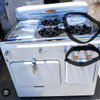
We've been looking at buying a Lacanche for some time now, and were down to picking a color when my wife found a place nearby that restores Wedgewood and O'keefe ranges from the '40's and '50's. This guy does a great job with the cosmetics, anyway. Some of them still have working clocks, the enamel looks good, no rust, etc. Our house was built in '31, so one of these would fit nicely into it. My wife's now thinking seriously of switching out of beautiful-French-range mode and into cool-classic-range mode.

We're pretty dedicated home cooks and need a range that's powerful and reliable. We're looking to buy one that will last us many years, if not the rest of our lives. Does anyone here have ideas on the pluses and minuses of going with a restored Wedgewood vs. a new Lacanche?

(I tried searching for more info but didn't find much. My apologies if this has been discussed to death in the past.)

Comments (14)

  • 18 years ago

    I thought about doing this myself in my renovated 1914 kitchen -- esp since I had access to an O&M in mint condition. The main reason I hesitated was that I couldn't find anyone local who specialized in restoring these great ranges. The second reason I hesitated was that I wanted as many btus as possible on my top burners & I was just plain chicken about altering the gas flow on old range.

    I know someone who had an O&M in his last home & absolutely loved it. Said it was a reliable tank & he hated to leave it behind.

    I think I would make an appointment for a serious chat with your local guy and come loaded with questions -- then get a referral to someone like yourself who loves to cook and has one of his refurbished ranges. My neighbors have a gas Hotpoint from the 30's (I think) that they adore -- the range and the house have been in the family for years. They would classify themselves as "busy cooks" as opposed to "fancy cooks" so they may be asking for less from their range than you would ask from yours.

    In the end I went with a BlueStar (available in any color you can dream) for the 22K btu star burners and it is the only modern note in my renovated bungalow kitchen. I love it but I would love it more if it were a fabulous refurbished O&M -- or Chambers (my personal fave). I use the convection oven frequently but could live without it. The biggest thing I would hate to give up for a grand old range is my modern charbroiler. I use it almost daily & now find it indispensable. A small detail that I do love is the automatic start -- I assume a refurbished range needs a nearby box of matches like my grandmothers' ranges.

    Lacanche makes a glorious range, well outside of my dreaming range, but if you can swing it you are privileged to have a difficult choice ahead!!! You may well be able to rebuild a vintage range to your specifications. Back when I was dreaming vintage, I was especially woozy over a Chambers range.....

    Please post about your decision-making as others will be as interested as I am. Few folks go on to incorporate a vintage range so I'm over hear hoping that you really do take the plunge and report back with photos one day. The subject was addressed a couple years ago (during my own kitchen ordeal) but I only remember one person actually succeeding. Wish I could give you a better lead, it might have been an O&M, not sure.

    Good luck!

  • 18 years ago

    The biggest disadvantage of a (properly) restored vintage range is the lack of BTU's of the burners when compared to what's out there today, especially considering the steep price a properly restored range will command. If you aren't that serious about high heat cooking, or don't want to fit in a full sized baking sheet, then a restored vintage could be a potential possibility for you. Obviously, the steep price isn't a drawback if you're considering a Lacanche. :~) However, do make sure that you really are getting your money's worth. Some of the things to look for in a properly restored range are removal of the old insulation and replacement with new, adding an pizeo ignition system, redoing all of the internal gas lines and replacement of any regulators, replacement of all internal wiring, reporcelainizing of any worn trim parts (not painting, reenameling, which requires a LOT more work and firing at high heat to set the enamel) rechroming of any of the shiny parts, application of a high heat rust converter and inhibitor to any internal parts that are bare metal, and the creation by hand of any parts that cannot be sourced from new old stock. Owning a properly restored vintage range is like owning a vintage 40's automobile. It's retro cool and beautiful, has some unique features, and if you appreciate it for what it is, it can work for you. But, it's no modern day Ferrari, or Corvette, or even Impala. If you're not into real performance or modern convenience, you'll be happy.

  • 18 years ago

    There was a poster back some time ago who had planned an entire kitchen around a vintage Chambers, if I recall correctly. The cabinets were very pricey and it was a fitted kitchen.

    When the building inspector came they disallowed the range because it had continuous pilot lights which are considered oepn flames nowadays -- evidently against fire codes. The hood had been built for the old range and there were problems with a sub in because of the uptick in BTUs.

    So, before you go vintage be sure you are able to from that end of things. Also, be sure you are willing to pay the gas bills when those start to rise.

    The other drawback I'd see is the repair issue -- parts could be problemmatic or extremely expensive, as could finding someone with the knowhow to do repairs.

    Personally, while I love a vintage look, I'd be looking at something very different today or consider Heartland.

    The great part about a Lacanche is, well of course first the charm of it, but also the power and the lack of electronics. Very solid and old-fashioned in its way. I know it doesn't bother most Lacanchers but the lack of oven lights is a drawback for me. I also understand that the brass knobs get quite hot. However, everyone I know with a Lacanche adores it.

    Every range will have osme type of drawback, no doubt. There is no perfect pick. I think it's all a question of what really speaks to you for cooking on a day to day basis.

  • 18 years ago

    The look is cool, like a vintage car, which is great for Sunday morning drives, but it is not a substitute for a modern car for everyday use.

    Unless you get a spark-ignition system installed, you will waste 90% of the gas you purchase, because of the pilot lights. Pilot lights are not overly wasteful in restaurants, where the stove may be used 12+ hours per day, but in a home setting, as much as 90% of the gas you buy is wasted, and even creates heat you have to get rid of if you run an AC. At today's prices for gas, this can add up quickly.

  • 18 years ago

    Thanks so much for the help! This is the kind of info I was looking for. It's much appreciated.

  • 18 years ago

    I may not be correct in my recall, so do check this out out with Lacanche. I think someone mentioned in a previous Lacanche discussion that only the electric oven ranges had a broiler. The gas ovens did not, which would be a disadvantage for us. I remember it really took me aback to read that, but then other things intervened and I never went any further into the Lacanche research.

    Beautiful ranges, though, and I love being able to configure the burners.

  • 18 years ago

    Two houses ago, I had a restored O'Keefe and Merit. I adored that range and seriously considered taking it with me when we moved. I cook more today than I did back then, but it sure suited my needs at the time. Now I have a Bertazzoni because it reminds me of the O&M, but with the higher BTUs and larger oven.

  • 18 years ago

    If you want a vintage stove look, I would check out the Hartland as well. Beautiful ranges, etc. Here is a link.

    Here is a link that might be useful: Hartland appliance homepage

  • 18 years ago

    I think the older ranges are far more attractive than anything new, including Lacanches. If I had a large kitchen, I'd pick up a shiny old Wedgewood with a fold-down top and store my potatoes and onions in it and use an unobtrusive induction cooktop for real cooking.

    Yes, I'd have a fake stove. They're that purty.

  • 18 years ago

    On the gas issue: I love my 1980 out-of-code Garland but I've been having heart failure this year as I watch the monthly bills rise. The 3.00 a month in recent memory is now 45.00 a month, even with one of the ovens turned off.

  • 18 years ago

    elizabeth10029

    Your Garland is not 'out-of-code'. It met code when it was sold and is thus automatically grandfathered in to code today. Authorities cannot make people change equipment out if it met code when it was sold-if they could, everyone would have to buy all-new appliances about every three years!

    There is something you can do about your pilot light situation. Have the gas company (or other licensed pro) install a solenoid valve on your range then disable the pilot lights. A solenoid is an electrically-operated valve that will only allow gas to pass when on. Now, if you install this valve, it MUST be tied to a hood.

    What happens is this: Under normal circumstances, the hood and range are off, and no gas is being used. When you want to cook, you first turn on the hood. Since the solenoid is tied to the hood, this will turn on the gas to the range. You will have to use a long-reach lighter to ignite the burners, but you will have safely eliminated the need for pilot lights. By the way, with the hood on, it is UNLIKELY (but theoretically still possible) that dangerous levels of gas will build up, if a valve is left open but not ignited.

    If you decide to do this, consider getting a bypass valve installed as well. The bypass valve will allow operation without the hood being on in the event of a power failure, but you will have to be very alert to gas escaping from a defective valve or burner accidentally left turned on in this situation.

  • 18 years ago

    Glad you started this thread! I'm the proud owner of a 1930s Magic Chef which came with the house we bought in October. We're in the planning stages of a kitchen remodel, and Question #1 is whether or not I'm keeping the range. On the one hand, it has everything I want: six burners, two ovens, a warming drawer and it looks really kewl. On the other hand, I know it needs to be overhauled, as it's not well-insulated, the oven temps are wacky and I'm getting a bit too much yellow in the gas flames.

    I'm having a bear of a time finding someone in my area - even within 100 miles of me! - to give it the overhaul it needs and am not sure if the hundreds I'll pay for it to be serviced way out of state will result in the performance I want. I don't need a high-BTU burner but I need basic reliability in my oven temps and I need to know it will last another 10 years; I'll need to make sure the repair place can give me some confidence in that before I invest the time and money.

    It's nice to know I'm not the only one wrestling with this dilemna.

  • 18 years ago

    When I was looking around for a range I was very close to getting a high end 36" pro range with a grill but had some concerns about a modern looking range in my older home and the all modern range reliability issues highlighted on this Board.

    A local appliance repair company owner acquaintance suggested that I look at a Chambers - advanced features, very reliable because the components are so heavy duty, and readily available parts.

    Ultimately I got the Chambers. The reliability was the clincher. I just don't have the patience or the time for service calls. I also have childlocks, nicely configured and performing burners, a griddle and broiler on the top of the range, retained heat cooking, and a really beautiful piece of equipment that is definitely not run of the mill and that fits with my home.

    As far as what I thought were potential negatives...

    I do only have 9,000 BTU burners. I was pleasantly surprised by their output and control. Hadn't really believed all the folks raving about them until I tried them myself.

    Pilot lights. I do have them and they do consume some gas. On the other side of the coin I don't have the ignitor woes that folks mention on this board. I have also found that the moderate amounts of gas that the pilot lights consume are more than balanced by what I save with the Chambers' retained heat cooking in both the regular oven and the smaller Thermobaker. Basically, the Chambers oven is super insulated. I can cook a chicken by turning the gas on for 20 minutes and then turning it off and cooking on retained heat until it is done (the results are just superior compared to traditional ovens). I also have the smaller thermobaker mini oven. I can very efficiently cook individual meals or baked goods in it. It dawned on me after I got the Chambers that using the thermobaker is significantly more efficient than running the oven on a 36" range to make one cherry pie. And I guess there is the case for not expending energy on making a new range.

    I didn't get my grill. This has not been the big deal I thought it would be. I use my stove top broiler.

    My conclusion after the tortuous range decision process is that there is no perfect range, just what is the best choice for your individual needs. I am extremely happy with my Chambers. Hope this input helps!

  • 18 years ago

    Thanks again for all of the help and suggestions, everyone! I think we'll still probably go the modern route, but it's been a tough decision.