Software
Houzz Logo Print
caflowerluver

I really hate my AG Wolf range!

17 years ago

I have tried to work with it since my kitchen remodel 2.5 years ago and I am still unhappy. Unfortunately I can't afford to replace it with something else. I am so frustrated with roasting and baking in the oven. The burners are great and I have no complaints with them, it is the oven that drives me nuts.

I am so frustrated with roasting and baking in the oven. The temperature has been checked a dozen times and it has been calibrated twice. And I am talking hours of checking the temperature every 15 minutes. It supposedly is accurate. But meat takes much longer, at least an hour or so more, to cook then it should.

If I use the convection setting then it burns on the outside but is still uncooked on the inside. So that doesn't seem to help. I have tried covering in foil so it doesn't burn, but it still takes longer to cook even with the convection fan on. It really is hit and miss with baked goods. A cheesecake took more then one and half hours longer then it's cooking time to be done.

And service is a joke. The "official" service company here does not insipire confidence. They keep sending out 19 YO kids. What experience do they have? I know they have to learn, but I want someone who already KNOWS what they are doing. I have written the company with my complaints about the local service representative, but got nowhere with the company. We are way out in the sticks and that is the only ones they have.

I wish I had never bought it and this is a warning to all those of you who are thinking of getting one. Think twice, then buy something else. They really aren't worth the price tag.

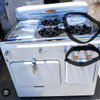
What I really wish I had bought is a 1950's O'Keefe Merritt or other vintage stove that had been restored.

Clare

Comments (19)

  • 17 years ago

    This is a strange situation. In general, oven performance is awfully simple. It is a function of temperature -- is it correct, is it evenly distributed through the oven, is the oscillation between max and min temps within acceptable range. Secondarily, air circulation plays a role, with convection obviously being the most common way of addressing this.

    I have a hard time understanding how your oven cooks so incredibly slowly (an hour and a half extra for a cheesecake??!!). It's not totally clear from your post if this is because your oven won't stay at the desired temperature, or if the temps are, as you imply, correct when measured. My reading of your post is that your oven does indeed maintain the correct temperature but somehow your foods are still cooking too slowly.

    The convection problem is at least partially understandable. Convection should bake faster, and many recipes and oven instructions suggest reducing baking temp by 25 degrees or so to compensate. I find it again hard to understand though how you can burn the outside of a roast using convection but still not cook the interior.

    If you oven temps consistently read correctly, within a reasonable range over time, then I can't really think of any way to blame the oven for your roasting problem. If your temps indeed measure correctly, then what is it that you think your oven is doing wrong?

  • 17 years ago

    joe and I posted simultaneously, but we both independently come to the same conclusion--if the temps are right, then it's not the oven's fault.

  • 17 years ago

    Yeah, this whole thing sounds strange to me - an oven is just a heated box - you can have somewhat uneven heating given the construction of the oven but something taking an extra 1 1/2 hours seems strange. Dumb question, but when you cook a roast, it is defrosted beforehand, right? If not, you could burn it on the outside and have it raw in the middle, but other than that the situation seems strange. Convection will help brown a roast on the outside while keeping it moist and juicy on the inside. As the others have said, I would double check that your oven gets up to temperature properly. Someone a while back had a problem with their Bluestar oven never reaching temperature and it turned out, I think, that half of the oven burner wasn't working properly. Good luck.

  • 17 years ago

    Yes, I have confirmed the temperature with 3 different thermometers. One is from the IC lab where my husband works. It is one that has to be 100% accurate. It's how we found out it was 25 deg. off when we first got it. That was after the 19 YO service rep, who had a $3 Safeway thermometer, tested it for 15 minutes and declared it fine.

    I let it preheat at least 30 minutes before I bake anything. This oven has the longest preheat I have ever had in my 47 years of cooking. I always defrost either by taking the meat out of the freezer the day before or on the defrost cycle in microwave before roasting.

    I should mention, which I forgot to do in my first post, that it is LP and is specifically designed for just LP. We are way out in the country and can only get propane.

    One thing I noticed is that it seems to be constantly cycling with the gas coming on. I don't know if it cools way down, then the gas has to come on to bring it up to temperature or what is going on. I just hear it coming on a lot.

    It also makes a loud bang noise. It use to do it when preheating. Now it does it when cooling down. I think I got a lemon and Wolf won't admit it. Something is wrong but don't know what it is. So I hate the D@*N thing!

    And what is this thing about Wolf having a recall of AG ranges? I read it when I did a search on Appliances Forum on Wolf ranges. I went to their website but found no information.

    I have read the manual so many times I have it memorized. I could recite it backwards.
    Clare

  • 17 years ago

    The loud banging is the floor pan warping and un-warping from the heat up and cool down. Very common, and you won't get Wolf to do anything about it.

    Since you have access to lab thermometers, you could plot the heating over a couple of hours to determine if there are some wild swings. I doubt there are any, though.

    Apologies in advance, but I'm still not entirely convinced there is no operator error here...

  • 17 years ago

    Here are two Wolf recall notices but I don't think either applies to your range:

    http://www.cpsc.gov/cpscpub/prerel/prhtml02/02022.html

    http://www.cpsc.gov/cpscpub/prerel/prhtml08/08391.html

  • 17 years ago

    joe_blowe - I will admit I am not above making mistakes occasionally but not ALL the time. And it always takes longer to cook then it should. It has even happened to my DH, the engineer, when he was cooking and he is OCD about being precise. Thanks for letting me know where the banging noise came from. I have been wondering about it for the last 2.5 years.

    weissman - Thanks for the links.
    Clare

  • 17 years ago

    I have no practical experiences to offer but I would look to applying some basic physics to this.

    Your oven problem sounds like it needs some scientific experiments to solve the mystery or mysteries involved. You haven't mentioned your geographic location which may be important if higher altitudes are in play.

    The fact that a particular temperature can be attained is only half the equation. The other factor is how fast the temperature is first reached and how fast it recovers to it after some cold object is placed in the oven to be roasted.
    It is comparable to water pressure and water flow to a bathroom tap.

    I would try to establish several parameters in the operation of the oven because I am suspicious that it is not capable of producing the amount of heat energy required for quick recovery, or the oven has a defect which allows heat to escape, or there is something interfering with the gas volumes needed.

    I would try to work around a common temp setting like 350°f and use something like a large open roaster containing a gallon of 40°f ice water, a cheap remote lcd temperature probe in the ice water and another one hanging in the oven. I would want to know how long the water would take to reach a set of given temps up to 200°f on the water probe and what the usual oven probe (gas on high)/(gas off low) temp range was during this time and was it stable. Samples of gas on vs gas off times should be recorded too.I would repeat the whole test once or twice again if possible during the session to stress the oven and hope to see worse and worse performance.

    I would also have a chat with your LP provider to pick their brain about your problems. They may have some tips to help track down your problem. Or perhaps they can point you to someone. It sounds like your oven just isn't getting enough fuel most of the time and then once went to the other extreme and scorched your roast.

    Here's hoping someone reads your story and has the real world answer!

  • 17 years ago

    laat2 - Thank you for the detailed information. I will propose the experiment to my DH. And never thought about the LP being a problem but will check into that. Maybe it is fuel regulation problem.

    I am in CA, ocean level, so don't know if altitude factors in or not. This is my first gas oven here. I had electric for 20 years before that so never had a problem.
    Clare

  • 17 years ago

    You do have a 3/4" dedicated gas line for the range, correct? My suspicion would be that the installer just T'd off a supply line for another gas appliance, and that isn't enough supply for both an oven and the other appliance. When the other appliance kicks in, your oven is starved for fuel, thus you have "cold spells" occurring.

  • 17 years ago

    Aptosca, your statements:

    "I should mention, which I forgot to do in my first post, that it is LP and is specifically designed for just LP. We are way out in the country and can only get propane".

    "One thing I noticed is that it seems to be constantly cycling with the gas coming on. I don't know if it cools way down, then the gas has to come on to bring it up to temperature or what is going on. I just hear it coming on a lot".

    Here are two things that should be checked in hope of identifying the underlying cause of your oven performance problem. Both of them are easy to observe.

    Your oven thermostat has a sensing bulb--capillary tube that is fastened to the oven liner on metal clip-like standoff's. This keeps the bulbs sensing surface clear of the oven liner by about one half inch. If any part of the sensing bulb touches the oven liner, it can cause the rapid cycling and temperature control problems you are experiencing. If the bulb is out of place, secure it in the clips and gently adjust the bulb & capillary away from the oven liner. Be careful not to bang or disturb this during use or oven cleaning!

    Another thing that you can check is the size of the oven burner flame. The flame should spread out about 1 1/2" on each side of the burner up the flame spreader. Wolf should be able to tell you and the tech what their flame size specs are for your model LP range. If the flame is not right, it will require adjustment by the Wolf service tech or your LP gas supplier.

    If the flame is too small, which it sounds like it is; you'll experience temperature problems, that cannot be properly diagnosed by an oven thermometer or thermocouple test equipment.

    Hope this helps.

    Dixie

  • 17 years ago

    live_wire_oak - Thanks for the information. I will have to check that.

    Dixie - Thanks also. How can you see the flame? New ovens are now completely sealed with no burners showing. I think that is part of the problem with all new gas ovens. You use to get more heat because of an open flame before. I will look for that sensing bulb and see if it is in the correct position.

    Clare

  • 17 years ago

    Depending on the design of your oven, you should be able to lift out the floor pan (the thing that warps and bangs during heat-up and cool-down) to view the oven burner. Look for a finger hole or recessed metal handle.

    If not, the front louver can be detached for viewing of the burner.

  • 17 years ago

    Are you sure it is factory LP or did your dealer convert from natural to LP. You say the burners are okay, just the oven is the problem. Once in a while we run across ranges on lp where all the orifices are correct but the oven does not perform and we found by increasing the size of the orifice to let more volume in it solves the problem.

  • 17 years ago

    I've read about a similar case that turned out it was due to some loose insulation that got into the gas input line and ended up blocking the gas flow to the oven. In this case the situation was an extreme reduction in the ability for the oven to reach and maintain temp. First, does it take lots more than 30min to reach say 350F? Crank it up to 450F or 500F and see if it ever gets there. If it takes more than an hour to get up to your baking temp, then it's possible just the act of opening it up and and putting your food in is cooling it down enough that it takes another 30 min to get it back to your baking temp. Slow preheat can be caused by restricted gas flow. Here's a trick to try that I use to use. Preheat the oven and once it's at temp and holding for 10-15min, then open the oven door for a minute or so. Close the oven door and wait for the flame to come back on. Once the oven has just reached it's set temp but the flame has not gone out yet, open the door quickly and put your food in. Most oven's overshoot the set temp a bit to keep the it from going on and off and back on too quickly. This trick might help the oven hold it's temperature right after the food goes in.

    Another thing to try is take two oven thermometers and put one towards the front and one towards the back. Then bring the oven to 350F and see if there's a significant difference between the readings. You can move them around the oven to look for any pockets that might not be maintaining temp. Usually, this will be near to door or one of the heat vents.

    One silly question is when you do your baking, you don't open the oven to check on it do you? If you do, then the obvious answer is that the oven temp is cycling up and down. If you husband has an advanced digital temp probe, it should have an min/max record. To use it, put the probe in the oven (not touching any surfaces of course) and bring the temp to some set value like 300F or 350F. Then reset the recorded min/max temps but make sure it's at temperature before resetting. Let it go for 30-60min and check the min/max (and average if avail) values. They should not vary much.

    Good luck and let us know if any of the suggestions worked.

  • 17 years ago

    Thanks again everyone for all the information. I will have to print it out and try everything. If the oven would work like my 35 YO oven did before the remodel I would be happy.
    Clare

  • 17 years ago

    Are you just dealing with your local dealer or have you called Wolf?? I think their customer service department is so helpful. We had a problem with our dealer on our frig 18 years ago and they sent someone out from another town.

    good luck

  • 8 years ago

    I truly hate my custom order Wolf range. The broiler has never worked, the porcelain range covers “bubbled”(I am not a messy cook nor do I let spills remain on my stove top) the self-cleaning option does not clean and the oven temperature is inaccurate. I have paid incredible amounts to have Wolf “certified“ technicians come to my home to diagnose an issue, only to pay them a second time to “resolve“ the issue (not really) just to have a $12,000 USD boat anchor dispayed in my kitchen. I woold not recommend one purchase a Wolf brand cooking device.