Software
Houzz Logo Print
plllog

Induction and cast iron wok -- another why induction thread

16 years ago
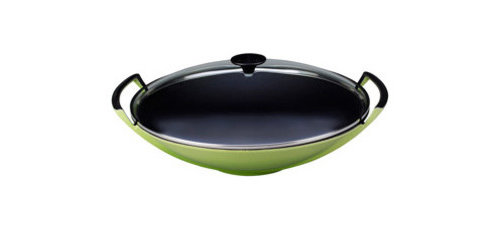
I don't wok. My Asian friends have tried to teach me to stir fry, but I'm a little hopeless with chopsticks for the stir part. And I don't even fry much. When I was at the Le Creuset clearance sale, however, a wok followed me home. I thought it would be good for frying, and it was cute. It cost less than a puppy. :)

This wok is cast iron, enamelled inside and out, with a flat base and a rounded inside (no flat spot at the bottom). There's plenty of mass at the base to develop heat.

I'm really low on groceries. Tonight I just had this idea that garbanzo fritters were a good idea, so I made them in the wok. It behaved just the way I expected, limiting splatter, and requiring only a small amount of oil. The fritters came out great.

Why induction? Because I swear to you I got hotter from the hologen lights in my hood than from the hot wok with oil. The air conditioning didn't come on. The kitchen didn't get hot. Fritters in high Summer? Not entirely crazy after all.

So I also tried stir frying a few snap peas that I had because I knew people would want to know. They came out fine, though I'm no expert.

I don't know that a cast iron wok is ever going to get you great wok hai because the temperature is very steady, and if I understand correctly, you want to be changing the temperature a lot. What I can say is that once the wok was good and hot (it did take some time to get there because of the relatively small contact area and the high sides), it held the frying oil temperature quite well. I was only frying a few at a time, as one does, but the temperature recovered very fast.

I don't remember how many KW my center element has, but the wok wouldn't make the outer ring active, so I think it's about 1.8. I had it set on 6.5 or 7. Boiling oil would have been no problem. I tried to get a temperature with my candy thermometer but it was too hard to have the sensor in the oil without touching the bottom. I do think it would be possible to develop and hold a high enough temperature for stir fry, however. I was taught that you don't actually want the pan blazing hot, and that the issue is returning to heat as you add ingredients, rather than having a too hot wok.

Comparing this to making stock, my new understanding of using induction (which may not be right, it just seems to be right so far) is that you don't need the MORE POWER people get caught up in for a wok, which traditionally is used to make small amounts at a time. From what I can tell, power is for volume. The full stockpot takes a a lot of juice to keep simmering. The wok took considerably less.

Unfortunately, none of my able wokking friends lives close enough to come try it and give you a better report. Just wanted to say if you're concerned about how a plain old flat induction will work for wokking, do give it a try before dismissing it.

Comments (10)

  • 16 years ago

    fyi - you don't need to use chopsticks to do the stir fry - they make wok spatulas for you to use - in fact, we've never used chopsticks for cooking in the many Chinese cooking classes I've taken and it would never occur to me to do so. On the other hand, if you don't use chopsticks to eat the food, it won't taste right :-)

  • 16 years ago

    LOL!!! You're right, but I never thought about it. I think it's the metal. Metal has a taste, and it doesn't go with the delicacy of stir fry. Neither do plastic or wood, for that matter. Polished or enamelled is best, don't you think?

    Obviously, there was some thought of trying to learn again behind my wok purchase. I'll try to find one of those Chinese classes with the spatula, rather than going the you're-too-dumb-to-handle-food home cooking get-out-of-my-way style, next time.

  • 16 years ago

    There are a few cases were chopsticks are used with wok cooking. Typically noodles (chow mein) and some deep frying is easies with chopsticks. In restaurant kitchens, many/most pow woks are actually used with a spoon rather than a spatula. The spoon is used to scoop the spices (salt, pepper, soysauce, etc) from tubs nearby. Flipping is done by flipping the wok. This requires quite a bit of arm strength however so most home cooks use spatula instead. I don't "flip" at home because there's usually not much space between the top of the wok and the hood. Also, smaller ingredients like peas or chucks of meat can sometimes fly out and it's just harder to clean that up at home.

    With regard to metal vs other materials. I'm not sure what you mean by "metal has a taste". All wok spatulas I've seen are stainless steal which does not usually leave any taste. Plus most woks are uncoated iron which will leave more of a taste than the spatula ever would. That's why you never leave a dish sitting in the wok after finishing. Always transfer to bowl or platter immediately or your dish *will* acquire a metallic taste.

    Cast iron woks are actually very common although not typically enamel coated. In mainland china where they still use wook or charcoal in many cases (like street side vendors and such), cast iron is extremely common. Cast iron can in fact get blazing hot. Typically, if you've got a powerful burner (> 18k BTU) then thinner hand hammered iron woks are the best IMHO. The transfer heat quickly and respond quickly when you turn the burner up or down. They are also light enough that makes lift and flip possible.

  • 16 years ago

    Good job Pillog! From what I have read, (and we haven't stir fryed either), it's that Stir fry is very good for you and "non fattie". Sooooooooo------maybe,-- if more of us "Woked" less of us would "Waddle"---Ya thinks?¿?¿?

    ***~~~~~ Runs & Hides

  • 16 years ago

    Thanks for the info, Amcook. I was "taught" by Asian (as in from Japan and Honk Kong) home cooks who use big chopsticks with their woks. I didn't mean to imply that there aren't other valid ways. Only that that was the only way I know, and I'm not fast or accurate enough to do it properly.

    The metal has a taste remark was to Weisman, who said one needed chopsticks to eat the food. I found myself thinking that they do make a difference in the taste, which, at least for me, comes down to metal or plastic, both of which I can taste when I use such forks, and the polished surface of good chopsticks, which I guess also has a taste, now that I think of it, but it's "right" with Asian food. Not saying I've never used a fork on leftover takeout. Just agreeing about the flavor. And yes, stainless steel has a taste, but it doesn't come off on stuff. It's the fork itself that has the taste.

    I think anyone who is a very good wok cook would be happier in moving to induction with a bowl shaped specialty burner, which works well with your hand hammered wok. I looked at the stainless specialty induction woks, like Demeyere, and the Gaggenau unit/wok, and they looked all wrong to me. The Le Creuset just said it wanted to live it my house with all my other Le Creuset. There are very few flat outside, round inside cast iron woks.

    This one seems to work pretty well on the induction. The only issue would be the power, because the diameter of the bottom isn't big enough to trigger the outer ring. It should work okay on my front 2.2KW ring (about 15k BTU), though, which should give it a faster recovery time. The important part is that it certainly gets hot enough for stir fry, even on the 1.8. The outer ring boosts to 4.4KW, which is more than 30,000 BTU, but there isn't a round bottomed wok which has a big enough contact radius to take advantage of the 20,000 BTU large element, or the 30,000 BTU boost, but for normal portions, it shouldn't be necessary.

    This is something for people to consider when they're looking at total power on a flat surfaced induction unit. To me, the shape of the interior of a wok is the whole point. Other people are happy making a stir fry in one of those wok/frying pan hybrids, or just a skillet, which would be big enough to take advantage of the maximum power.

    And it made very nice, American style fritters.

  • 16 years ago

    LOL!! Dodge indeed while you're running!

    When you put very cold into good and hot, not much oil gets into the food. The fritters weren't greasy. They didn't even leave grease spots on the paper towel I drained them on. Doesn't mean they weren't pretty rich. :) As to stir fry? It depends. I can make tasty food with fewer added calories.

  • 16 years ago

    When you put meat into a wok with 1/2 oz of hot oil for traditional Chinese stirfrying, you usually want the outside of the meat to be seared quickly, without overcooking the inside. Since the meat is cut into small pieces, overcooking happens quickly.

    If your burner isn't powerful enough, the wok cools significantly when the meat is added, and the meat boils in its own juices, getting soggy and gray, instead of seared and browned. If you carry on until the juice boils off and the meat is browned, it will be overcooked. Coating the meat w/ cornstarch helps a little.

    At home, I deal with this by cooking in very small batches, might take four batches to cook one dish's worth of food. That is irritating.

    Your cast iron wok might stay hot better than my thin steel wok, and maybe that is why street cooks in Asia (who aren't equipped with monster burners) might use cast iron woks. Just guessing, I've never interviewed one :-)

    If you watch a cook working over a big wok burner in a Chinese restaurant (like amcook has done, I think), he dumps the whole dish's worth of meat in the thin steel or hammered iron wok and it is cooked in less than 30 seconds, then he rinses out the wok and places it back on the burner, in seconds it is ready for the next order.

    When deep frying in the wok, the mass of the oil does much of the job of retaining the heat. Because the bottom is rounded, you can get enough oil depth, without having to use too much oil (just a few oz). A nice round bottom is great.

  • 16 years ago

    "A nice round bottom is great."
    I'll "2nd" that! johnliu

    Not bad on a Wok, either!

    *****~~~~~~Still running & hidin"

  • 16 years ago

    There is absolutely a place for chopsticks in wok stirfry. It's just hard to imagine how I could flip the contents fast enough with chopsticks alone using the 22k burner on a BS. :) In the end, it's whatever you're comfortable with. My roommates in college laughed at me for making chili spaghetti in a wok and ate it with chopsticks. Of course I was also watching knee replacement surgery on Discovery Channel at the time.

  • 16 years ago

    Well, John, that makes a lot of sense! Thanks for the explanation. My you're-hopeless-don't-try wok mentors advocated small portions at a time as well. I don't know if that's because of lack of power on a home stove, or making it easier for pathetic student.

    Other than the few snap peas I chase around with a little oil to say I tried, I was quasi-deep frying. More pan frying. I hate the mess and waste of doing it the traditional way, and as expected, the shape of the wok was far superior, used way less oil, and there was no mess.

    John, you've also confirmed my guess on the home-cooking issue. That is, if you're an occasional wok user, you can do fine with a wok like this on a flat induction unit, but for someone like you or Amcook, who want the real deal blast furnace, restaurant style, then a dedicated bowl shaped unit is a must, if you're going induction.