Software
Houzz Logo Print
tbipp

If You Are Building ICF . . .

19 years ago

Are you using grapplers? How many are you using with each window and where are you locating them?

Thanks in advance.

Teresa

Comments (19)

  • 19 years ago

    Grapplers are generally positioned so that you can easily mount heavy curtain rods. They go on top of the EPS, before the sheetrock is installed.

    That being said, we didn't use any on our home.

  • 19 years ago

    I have a follow up question. What system are you using to ensure your curtain rods do not fall off the wall since they are being held through styrofoam?

    Teresa

  • 19 years ago

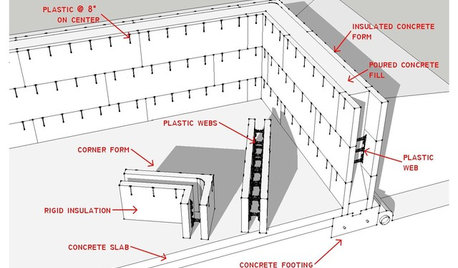
    Our ICF blocks have the plastic firring strips built into the block; we haven't moved in yet, but have heard that these act just like studs, to secure anything attached to them.

    Cheers!
    Heather W

  • 19 years ago

    Ours went into the window bucks that surround the window.

  • 19 years ago

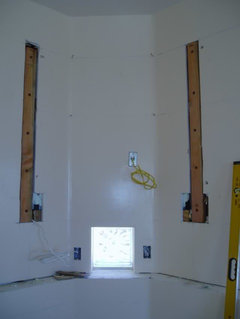
    My DH put metal plates up for the curtain rods and bath accessories, but I haven't put any up yet (just shades so far). He put them on the foam block before sheetrock, I believe with cement screws. We took pics and have the measurements written down so hopefully will find them when we need them.

    So far as the plastic strips, they are a little bit tricky to find and they may not be where you need them to be. Putting up sheetrock on the ICF was quite time consuming as the strips are much narrower than a 2x4 stud and spacing is different. Putting on the cement siding was also another challenge (finally have that almost done, yay).

    I love our home, it's quiet, strong and easy to heat and cool. Building ICF results in a solid structure, but definitely has some challenges over stick built. After having done this home, my DH (who is a contractor) doesn't know that he would do a whole home with ICF again, but feels they are the best for foundations. He thinks we could do nearly as well with 2x6 construction and blown in foam insulation.

    How does everyone else like their ICF homes?

    Jill

  • 19 years ago

    Wherever we planned to attach anything to the ICF walls, we hogged out the foam and attached solid wood directly to to the concrete with blue concrete screws before the drywall went up. That included toilet paper holders, handicap grab bars, towel bars, cabinets, large paintings and anything else we could think of. Our block (Nudura) also has the plastic ribs, but I don't trust them to support anything heavy for any length of time.

    As for how I like my ICF home - I love it!

    It is so solid and easy to keep warm or cool. Case in point - we recently fired up the radiant floor in one of the bathrooms just to test the system. The temp in the room was 77° when we turned off the heat... 24 hours later (first thing on a cool morning) it was still 76°!

    Lately the weather has been in the 80's and 90's and the A/C hardly runs at all - and that is with subs running in and out all day and leaving the front doors wide open. I think it must be in part to the mass of the walls along with the insulative qualities of the styrofoam.

    After experiencing the solidity of an ICF house, I truly don't think I would build a home any other way.

  • 19 years ago

    We didn't use any grapplers. We are just counting on the black webs. What did you all do for cabinets? We forgot about this and we just drywalled. Any solutions this late in the game?

    Jennifer

  • 19 years ago

    We had to add a couple of supports for our upper kitchen cabinets. We just cut right through the drywall, removed the foam and bolted a ledger to the concrete wall.

    The installed cabinets hid the majority of the subsequent drywall patch. A little drywall mud and paint took care of the rest.

  • 19 years ago

    The webs/strips in all ICF brands are always on specific centers and actually make it easier for sheetrock to go up. Being slightly narrower than a stud makes no difference at all for anybody doing the job correctly.

    If you don't rip out your drywall and foam to install ledgers, as the picture above shows, then I wouldn't want to be the one standing below your cabinets when the dishes get loaded in. Your contracter should have caught this earlier. You attach them with a hammer drill and tapcon screws.

    Plates in walls are not needed for towel bars and toilet paper holders unless you plna to hang sides of beef from them. Even in stick homes they are often just attached to drywall, not a stud.

    Finally, after the windows are in and before the drywall is up, measure the distance from the edge of the door/window frame to the center of the first ICF web/strip -- each side from each window and doorway -- and keep it in a notebook. Since the strips are always on 6in centers (some blocks do 8in) you will always know how to easily locate them.

  • 19 years ago

    Dallasbill,

    Just curious if you are an ICF builder or what your experience is with ICF?

    Jill

  • 19 years ago

    The strips will be predictably on 6" or 8" centers if your ICF crew stacks the blocks with the strips lined up like they are supposed to. Sometimes they will use odd bits around doors, windows and corners.

    I made sure to take plenty of pre (and post) drywall photos of every wall in every room (thank goodness for digital cameras!). I even marked some of the less obvious electrical wiring with spray paint so it would show up better in the photo. Nudura blocks have vertical lines every 2" and a diamond pattern where the plastic strip are. Those photos have come in handy on a number of occasions.

  • 19 years ago

    Odd bits around doors and windows? HUH?! You STILL have the same blocks stacked in complete walls everywhere. Any cut blocks still have the same strips on center in whatever piece of the block they use. If you put in a cut block, you ensure the strip is on center with that above and below. And if you don't, then it's rookie hack work, plain and simple!

    The fact that you state the above, and that you thought/were told that you needed to install wood ledgers everywhere for toliet paper and towel bars leads one to believe someone was not exactly forthcoming with you about what ICF stacking is all about.

    jillferd... we bulit with Amvic two years ago and I was at the build each day. Our installer is one the the premiere ICF installers in the south and was direclty involved in the R&D for the development of Quad-Lock and Amvic block.

  • 19 years ago

    DB,

    I don't know anything about your Amvic, but we built with LOGIX and I guess if your house plan worked out with dimensions divisible by 4 ft. you wouldn't have to cut blocks and the strips would all line up. But since seams must be staggered to avoid blow outs sometimes you end up with blocks not lining up if you are working with odd dimensions. With LOGIX the ends of the blocks lock together in addition to the "lego" style tops and bottoms. If you cut both ends of the blocks to have strips line up, you would lose that locking mechanism and increase the odds of blow outs.

    So far as attaching things, the LOGIX manual does state that "A screw driven into the LOGIX web does not have the same holding power as a screw driven into a 2x4 stud." They go on to say they recommend additional backing for items such as wall mounted fixtures, grab bars, hand rail, etc. They also say that plywood board can be attached to the LOGIX walls behind heavier cabinets in place of gypsum board (which is what we have done for the kitchen and fireplace cabinets.) So maybe the backing for towel bars is overkill, but no big deal, better overbuilt than underbuilt.

    So, good on you if your builder was able to do everything right and I am glad you are happy with your home.

    Jill

  • 19 years ago

    Dallasbill

    may I ask who you used for your AMVIC? We used it, and loved it, but then had a rep here in the south who was used by one of our log home clients that I would not give you 2 cents for.

  • 19 years ago

    Jill... being divisible by 4 feet has nothing to do with it. All ICF installs will need to be cut somewhere at a window or door, and that has nothing to do with maintaining proper web/tie alignment in an entire wall surface. You have missed the point. It has *nothing* to do with avoiding blowouts, either. Best wishes with your home.

    Amvic webs also use more raw material than other ICF blocks, which allows for a 198 lb pull out strength for drywall screws -- and makes the forms more rigid, too. Thus, no need for anything behind the drywall unless hanging cabinets, etc.

    Dixielogs... if you mean the Amvic distributer, we used Norman Williams in Cedar Hill, TX were very pleased. He dist. 3-4 different brands, but we were sold on Amvic after extensive research on my part, as well as recommendations from our installer.

  • 19 years ago

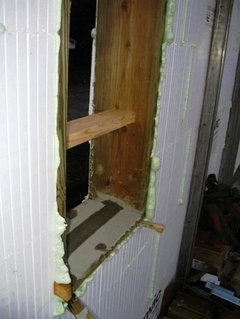
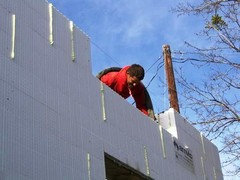
    As a follow-up, this will illustrate the previously stated falacy that an aligned ICF home will have "odd bits around doors and windows" which thus result in unaligned webs up and down the wall. It also has nothing to do with building walls that are neatly divisible by 4 foot sections (for sheetrock, etc.).

    As I previously stated, all blocks have web/ties at 6 or 8 in on center. All blocks have the "lego steps" on top/bottom and are grooved at each end. The grooves at one end, and in some occasions, both ends, are (obviously) going to be removed if a block needs to be cut for a door or a corner or a window buck (i.e. the frame blocked out in the pour, for future door/window placement).

    That does not preclude that one then compromises the entire web alignment system for that particular vertical section of the wall by mis-aligining the short-cut block(s). You always stack a wall one row at a time, from bottom to top, alternating the joints so the next row joint falls mid-way to the block below it. With 16in long blocks, and 6 or 8 in web centers clearly scribed into the EPS face on each side, it's child's play.

    So, when you come to where a buck is, you cut accordingly and align accordingly. Where you have cut a block off, you spritz Wind-Lock foam into the joint between it and the partner block, to prevent liquid leakage.

    Keep in mind that these cuts are not going to contribute to blowouts in a properly stacked wall, in any way, because:
    1) they are few and far between
    2) the wall's primary stability is via the horizontal, interlocked lego-steps and the rebar resting horizontally within the block
    3) the verticle bracing along the inner walls, for the pour.

    You can clearly see in these two pics the Wind-Lock joints where the cut block was correctly aligned around the bucks to maintain web vertical continuity for future interior sheetrock or hanging/attachment use. You can also see the block grooves for easy alignment -- every one inch. And, with Amvic, every six inches, there is the web groove - that is not clearly visible in these pics.

    On other brands it's a similar type of markings. After all, it's the way ICF blocks were designed, in order to ensure that you could find and hang things inside later on!

    Thus, if you are planning an ICF home, make sure your installer has lots of experience. Ask for references. Ask questions about alignment and "how do I know inside webs once the sheetrock is up?" See how they answer. Save my 'measurement from window/door edge' ideas I posted upthread. Take pictures and be there when it's being stacked. Then you will be just fine, and you will have a correctly aligned web system, and you will always know where to find any web section on your walls after finish-out inside.

  • 19 years ago

    In an ideal world, everything is done the way it is designed to be done. Unfortunately, in some areas of the country there is a dearth of qualified, experienced and/or conscientious ICF crews. It only takes one worker to mis-align a section of block and throw the whole pattern off. Or if there is an especially awkward series of angles and/or curves that do not conform to the inherent design perimeters of the block. As stated above, taking photos of the completed wall sections is still your best insurance of being able to find things afterwards.

    As for adding or not adding additional blocking - if there is more than one way of doing things, my personal preference has nearly always been to opt for the overkill. It may cost a little more, but I sleep better at night. ThatÂs one of the perks of building from the ground up. YMMV

  • 8 years ago

    I'm looking for a Insulated Concrete Form (ICF) contractor in Arizona. Does anyone have a recommendation??