Software
Houzz Logo Print
kbmas0n

selection500 - erv/hrv - confused!

18 years ago

I'll try posting this over here, as I didn't receive a single response on Building a House.

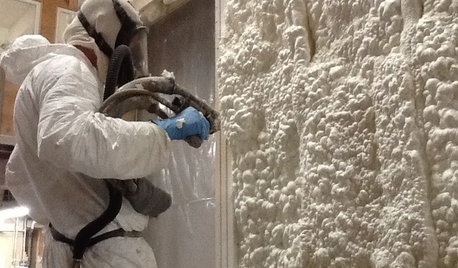
We are ready to accept a bid for Sealection 500 open-cell spray poly foam. Now doing research I find out it's necessary to install either an ERV or an HRV. I called my HVAC and it sounds like it's going to run me $2,000...which seems a smidgeon steep. A few questions:

1. What's the difference between an HRV and an ERV?

2. Is there a DIY alternative?

3. What MFG do you recomment?

4. Is it truly necessary?

Thanks, Keri

Comments (10)

  • 18 years ago

    Besides exchanging heat, the ERV allows moisture to transfer between the incoming and outgoing air. An HRV doesn't allow this to occur. (One uses a permeable membrane in the heat exchanger that passes water vapor, the other uses a solid material.)

    In extremely cold climates, an ERV can have trouble with the membrane freezing in the winter, so defrost controls are added.

    Re: "I find out it's necessary to install either an ERV or an HRV." - I would disagree; there's still another alternative. One economical approach to bringing outside ventilation air in is to supply outside air to the return of the HVAC system. Our home has such a setup with a motorized damper in the supply line and a simple Honeywell control to ensure proper ventilation rates. Cost was probably well under $500. Open the document linked below and scroll down to "Intermitent Supply with Inlet in Return Side of HVAC System".

    Here is a link that might be useful: Review of Residential Ventilation Technologies

  • 18 years ago

    Thanks, formula1. Did you HVAC guy install the morotized damper and control?

  • 18 years ago

    I'm sorry, just a few more things. I admit to being extremely ignorant about heating & air conditioning verbage and workings. I admit it.

    We are using geothermal in our new construction. Will that have any effect on using the method you described?

    And above should read, "did YOUR HVAC guy..., not you"

  • 18 years ago

    The outside air supply was a req't that was in the request for quote package we put out when bidding the job. So, yes, our HVAC company did the air supply as part of the installation. The line-item wording used in the RFQ was

    6" Outside makeup air scuttle with volume damper (terminology borrowed from a Building Science document).

    Thankfully, our contractor was savy enough to include the Honeywell controller making it a nice little setup. Now, I'd add wording to make sure this was included.

    It wouldn't be absolutely necessary for a contractor to install the makeup air system. The air supply comes from an outside screened grill (looks like a glorified dryer vent - Fantech or American Aldes sell them), then through a 6" pipe in the basement ceiling to the Honeywell motorized damper (operates off the 24 volt HVAC system), then runs into the return air plenum. The damper motor is wired to the Honeywell controller (mounted on the furnace plenum) and inside has simple settings for desired air flow, # of bedrooms, etc. It can only provide air if the HVAC blower is running, so do be aware of that. When the HVAC isn't running in the spring/fall, opening windows is our outside air supply. If you want model #'s of the Honeywell components, I can get them for you.

    We have geothermal as well (WaterFurnace using horizontally bored ground loops), but the type of HVAC system doesn't matter; the outside air supply is connected to the return air ductwork so it functions with any type of ducted HVAC system.

  • 18 years ago

    Thanks, formula1. I would love the Honeywell part #s when you get a chance. Then, I can print this thread off and show my HVAC guy.

    Thank you so much.
    Keri

  • 18 years ago

    This is the hardware setup used in our home for the outside air supply. This can be found on the web for under $200.

    Hope this helps.

    Here is a link that might be useful: Honewell Y8150/W8150 Ventilation

  • 18 years ago

    Thank you so much. I really appreciate it! I'm going to check the link out...and then I'm sure I"ll have more questions :)

    Keri

  • 18 years ago

    Hold the phone just a sec!!! What type of climate are you in? If you are in the Southeast, an HRV does you no good. An ERV will. Do not "just run duct into the return duct" and install dampers etc., etc., etc.-- you can create an elaborate arena for the mold olympics to take place. a professional should be the one to install this. Don't forget filtration!!
    To answer your question or concern, a sealed home DOES need fresh air. This is a must. However, the "attic or crawl", whichever is sealed up, is conditioned as well. Dehumidification is another "biggie" if you are in a hot, humid climiate.

  • 18 years ago

    You need to weigh the cost savings from not installing the ERV/HRV whatever you decide and the increased energy usage over the life of the system, if you bring in outside air without treating it you will add to the load requirements of your house, They didn't invent this stuff because there wasn't a need

  • 18 years ago

    We live in Illinois.