Software
Houzz Logo Print
emilynewhome

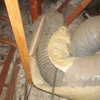
How much flexduct is permissable?

18 years ago

On our 'Trane' bid sheet, for attic model - heat pump system, it states "install R-6 flex ducts, sized for each room".

I know I'm showing my ignorance in regard to ducting, but is this usual practice? What would be considered the maximum run of flexible ducting? Should the flex duct be connected to rigid ducting? Thanks!

Comments (9)

  • 18 years ago

    I prefer an insulated metal trunkline with flex connectors for each diffuser/register. Flexible duct is not uncommon, especially to connect to the diffuser/register, and especially in attics. It has to be done right, not strewn all across the attic. It needs to be strapped and supported for best performance and airflow.

  • 18 years ago

    10 feet max but i seen up to 15 and work fine

  • 18 years ago

    By the way Emily, did you get the sizing ordeal figured out?

  • 18 years ago

    It can be run a long ways (residentially) as long as it is done right.

    When flexible duct is not installed fully stretched as per manufacturerÂs installation guidelines, friction loss increases significantly. Air quantity (CFM) and velocity (FPM) decrease, when compared to steel duct for a given size. Flexible duct size must be increased to overcome the detrimental effect of compression and the spiral walls that make up the duct itself.

    For example; a length of 6" flex duct measuring 10Â when fully stretched is installed between two duct connections 7Â apart would have a 30% compression

    10Â of 6" flex with 30% compression (7Â long) is equal to just less than 4" round x 10Â long steel duct pipe.

    10Â of 6" flex with 15% compression (8.5Â long) is equal to 4.5" round x 10Â long steel duct pipe

    10Âof 6" flex with 4% compression (9.6Â long) is equal to 5" round x 10Â long steel duct pipe

    So you see, when stretched to its near limit 6" flex duct performs like 5" pipe. That being said, if you need the 6" duct run to room (approx 110 CFM at .1" static pressure) you better use a well stretched 7" flex duct.

    To overcome the loss in efficiency, flexible duct must be increased in size to meet equivalent pressure loss requirements and achieve proper CFM & FPM air flow.

  • 18 years ago

    Thank you all so much!
    Yes Ryan, I finally got a 'j manual' heat load calculation, from the Trane guy;
    2975 sq ft living space,
    unvented, open cell foamed attic,
    closed cell foamed walls,
    aluminum low e-clad argon windows,
    north facing house

    = XL 16i seer, 4.8 ton air conditioner
    w/Fresh Efects,
    variable speed air handler,
    EWC Ultra Zone forced air controls,
    10 year warranty compressor, coil, parts and labor

    3 zone split w independant thermostats,
    sheet metal plenum w/ damper controls,
    sheet metal returns,
    install refrigerant and drain pans,
    emergency float switch,
    all parts, labor, taxes and permits

    Total = $15,359.

    I notice that the bid did not include the ERV I requested. Would it be the same as 'Fresh Effects'?

    The builder wants his guy to do the installation and we want the Trane guy, whom we sought out on our own.

  • 18 years ago

    It's rounded up to 5 ton

  • 18 years ago

    Not to throw a wrench, but just for comparison's sake:

    Our house (ATL, GA) is ~2,300 sq ft, w/ ~800 sq ft @ 9'6" ceiling and the rest at 8'3". We added on- the old portion of the house has zero insulation in the walls and air-leaky c. 1949 windows. The addition has 2x4 walls w/ insulation and new windows/doors w/ good weatherseals. Attic insulation is pretty good to R-38 w/ fiberglass in most of the house. Besides the old windows/doors the air sealing is pretty good- did a lot of detailing during construction.

    Getting to the point- we have a 3.5-ton heat pump. I realize that the point of the calcs is to customize for your home. Unless you're a lot further south or have zero trees, a 5-ton unit with all that foam insulation and an ERV seems oversized for not a lot more square footage.

    Hopefully, one of the pros will chime in. Take that observation at the price you paid for it.

    And on your original topic- minimizing flex duct makes for a more efficient system just b/c it takes a lot of care to get the best flex installation that minimizes the friction losses. Sure it's easy for the installer, but then you have to pay for it forever.

    The guidance I've seen and we tried to do when we put in our new system was to use hard ducts except for the last 5 ft to connect up to a register boot. And that .05 cfm/sq ft (~150 cfm for your 2,975 sq ft) confirmed via duct blaster test was good for new construction.

  • 18 years ago

    Thanks 'thull', we have 12 and 10 ft ceilings evenly split throughtout the house in S.Louisiana, very humid.
    We do have a lot of large windows, and any trees will have to come with our landscaping. Perhaps that's why we need a 5 ton?

  • 18 years ago

    That might just explain it, and definitely leave it to the pros.

    Guess it's kinda late for passive solar design.

0