Software
Houzz Logo Print
toadman77

Mini split or ducted heat pump

12 years ago

I'm looking to invest in some new heat. I live in Pa so winters can get cold. I'm not as worried about ac as the heat,Right now I ceiling radiant heat. I set that down to 60 in the winter and use electric infarered heaters when I'm home to bump up the temps. Doing this has saved 25 to 40 percent on my bill though when it gets really cold the house is chilly. So I'm looking to either assisit or upgrade the heat in the ceiling The home is around a 1000 sq ft.. R60 in attics, around r19 in walls, mostly new windows( except kitchen and spare bedroom), unheated basement though raftesr are insulated, bow window in living room 35 sq ft, picture window in dining room 30sq ft.and I got two options.

I can get a ducted heat pump with electric back heat on it. I worried that it will be expensive in the winter because of the heating strips that use it to heat and the heat pump isn't that effective below freezing so the strips will be on heating. I'm not to worried installed and it heat my basement so thats the plus side. It would be a Payne or a gmc.

Other option is a ductless split (Mitsubishi MR SLIM 18,000 BTU hyper heat). It should heat better then a regular heat pump and works at lower temps and be cheaper then a whole house and radiant heat to operate. The thing I'm worried is how much of the house will it heat during the winter, I don't wanna invest and it heats only one room. My little heaters would warm most of house except when it got really cold.. Would the ductless be on par with them circlulating the heat through the house? I have read on forums where one would keep most of the rooms in the house near the same temperature as the main room its in.

Thanks for any info .

Comments (26)

  • 12 years ago

    As for the ductless I can use the radiant heat as a back up kinda like I'm doing now or use the heaters I was using.

  • 12 years ago

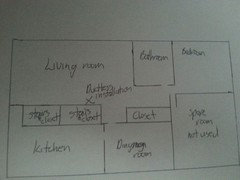
    map of placement of unit

  • 12 years ago

    Mitsubishi will use outdoor units paired with an indoor air handler that will accept ducts as well as what you are looking at. Hyper heat, I am not sure. Some conventional split systems may do as well. Probably not the ones you list. A high-wall mini split will heat an adjacent room just as well, or poorly as any other heat source will heat an adjacent room. I find that ceiling fans help the high wall units heat. Otherwise, in my house, I get cool floors and hot ceilings. I have a raised home with open crawl and no insulation down there.

  • 12 years ago

    I would locate the unit on the opposite wall from where you are showing it. That way the air is blowing toward the kitchen and will circulate thru adjoining spaces better.

  • 12 years ago

    Good suggestion by Jackfre. If there are no windows or other stuff there to interfere, you can make it blow straight at the opening to the other rooms. You'll find that as the blower speed tapers off as the set temp is approached, heat in the other rooms will probably not be as effective. Bump up the blower speed manually to help with that. I do that with mine to get better floor-ceiling heat distribution if there is no paddle fan on the ceiling.

    Toadman, let us know how it works out for you!

  • 12 years ago

    Thanks for the info. The room I'm installing is the only one that doesn't have a fan but I do have regular fans if need be. I'll post how it goes, especially when it gets really cold. If I like it I might buy a cheaper brand for the basement in the future.

  • 12 years ago

    I got it installed Saturday. I used it Sat evening as temps were into the upper forties. I set it at 67 and the room was 70 and stayed that way when I got up. The rest of the house was within a degree and the fan ran on low. Impressed so far since it used almost nothing in energy. Will have to wait until it gets colder to see how it performs.

  • 11 years ago

    Update. The unit is doin good so far except for it freezes quite about once an hour when it's below freezing. i don't see any ice build up though so idk. It's only uses about a kilo watt an hour in the upper 20s and low 30s. The living room stays between 69 and 71 ob average whole the rest of the house stays at 67. I did turn the fan to med speedwhen it got into the 30s . The auto fan didn't help much at that temp. I am impressed so far since using the radiant heat is so much more expensive. Ill turn the fan speed on high as the temps drop more.

  • 11 years ago

    You have good insulation so the heat should pass through interior walls much faster than out of the house. If you see what happens when you close the interior doors, you'll now how much conduction contributes to heat transfer vs. convection.

    I am glad to hear that it is working for you so far. It seems like your investment will prove worthwhile even if you have to run the resistance heaters in the coldest times. You should probably think of reverting to the resistance heat before the COP gets to 1:1 as COP only takes into account energy use. Your wear and tear on the expensive mini split counts for something compared to running the cheap resistance heaters.

    You can really notice the defrost when there is no integral back-up heat. I especially notice it when I am in a warm-up mode after sleep or after being out when I want heat quickly! I assume that it is an on-demand defrost rather than timed. If that is the case, you will have defrost more frequently in humid weather as opposed to cold weather.

  • 11 years ago

    Around what temperature would a one cop be estimated? Also what is demand defrost?

  • 11 years ago

    Demand defrost has sensors on the system to determine when defrost is necessary. That way fewer defrosts occur to pump heat out of the house at unnecessary times. They can also be programmed to limit defrost time and then repeat if defrost is not complete and a long defrost is not desirable.

    COP is often given in tabular form for only a couple of temperatures. You could try to find a curve by a web search or ask your dealer to find one for you.

  • 11 years ago

    It is a good idea to have the Mitsu performance curves. You can then make a more informed decision based upon your fuel costs. I have many friends in the N New England market who run their mini-splits down to 20 and then go to their oil or gas back up. You can chase the numbers and try to get the most efficient operation, but ,imho, it is your home and you want to be comfortable, first of all. If yu look at the Binn numbers for your area you are at less than 20* around 6-7% of the total season heating hours.

    It is good for you to really understand the system, but at some point you say, "to heck with it, I just want to be warm. Turn on the boiler."

  • 11 years ago

    Thanks

  • 11 years ago

    I got electric radiant ceiling heat. I used the infrared quartz heaters the last few years to avoid using ceiling heat. The installer said that the ductless be the cheapest to heat with. Ill prob end up using the quartz heaters when the ductless can't keep up. It's amazing how little energy they use compared to any resistance heating.

  • 11 years ago

    I searched and couldn't find the performance curves for the 18000 btu model. Found something on the smaller model though.

  • 11 years ago

    The lil unit still keeps amazing me. 15 degrees last night and wind chills below zero. It still cranked out the same heat and kept the room just as warm and still seem to use the 1.5 kw it advertised. Anybody on the fence that can't decide should pick one up.

  • 11 years ago

    I do got a question. Does turning the fan blower speed inside speed the outside fan or compressor up or does it got no effect. I thought it would bc cfms are increased but wasn't sure.

  • 11 years ago

    I have always assumed that there is no direct relationship because all aspects of the process are so tightly controlled. Fan speed indoors varies, as you know, with the difference btw the set point and the actual temp. Outdoors, it varies similarly. If there is little difference between air temp and HX temp, there is a big energy loss associated with running the fan fast or at all.

  • 11 years ago

    Update. The unit was excellent this year. My guessitmate was between $300 and $350 on heating from oct to may. It was still making 110 degree heat at -9 . I did notice the rest of the house was chilly when it was around zero. The defrosts every 45 to 55 min were noticable when it was that cold Anyways that got me thinking about adding another unit to help ease the work during the single/teens temperatures on the unit and having extra heat. The only problem I do notice is since my unit I have know cycles too much when its in the 50s so a smaller unit for heating with a smaller low end heat would help, I am not worried about ac end since I was able too use one 5000 btu and sometimes two 5000 btu units to cool the house before.


    So I've been looking and seen the MSX muti zone units are out and new single units are out. First basement has not heat and stays in the middle 40s in the winter and around 64 ish in the summer. There a lot of mositure and a dehumidfier doesn't really work well until mid summer. The rafters are insulated (r13) and some of the walls are too. Anyways I was thinking of possibly adding a air handler down there for heat either a .75 or 1 ton.


    The main floor (drawing above) I was debating on a unit in the dining room (.75 ton) to heat the dining room and the kitchen. The kitchen was 60 during the negative degree days with the radiant heat set at 60. When it was in the upper teens it would stay around 63. Then the spare bedroom I was thinking of putting a .75 ton unit to blow out to the hallway and push air to the bath room and bedroom. The spare bedroom was set to around 50 with the radiant and the door shut while the other bedroom I used a box fan to push the cold air down the hallway and the warm air would enter above.


    I'm debating on heating the basement and if I do `I was think a 20,000btu dualzone for one area on the main floor and one down in the basement or do a 24,000btu tri zone and heat all the areas listed. Or I could do one of the single zone units (FH9000btu) and just heat the basement area or on the main floor since they are the most cost efficient though.

  • 11 years ago

    For "heat" assistance I would direct you to a Rinnai Energysaver. I run my Fujitsu mshp's and wouldn't be without them, but in my 25 yr experience with the Rinnai's, nothing heats as well. When I come in from outside and am cold it is the Rinnai I stand in front of. Worth a look. Vent extensions allow basement installations.

  • 11 years ago

    Don't have natural gas though.

  • 11 years ago

    Any other opinions.

  • 11 years ago

    Propane on the Rinnai's. I just paid $1.32 for a gallon of lp.

  • 11 years ago

    I've been searching the past month and a half ahs found the fh09na for $1530 plus I get a $ 100 back in rebate from power company.


    My other was a 9rfllh floor model for $1740 plus I'd Still get a $100 back.


    Any votes for either one? The fh09na would have to be mounted foot or so of the floor on an interior wall and since I don't have an idea how to hide the piping. Any ideas how to do that without breaking the plaster on the wall?


    For the price I could possible as one other unit but it might be too much w with two .75 ton and a 1.5 ton for heating. The cop would probably jump on the bigger unit done it shouldn't have to run that hard in colder weather.

  • 11 years ago

    Found line sets for outside walls but anyone that has one would it look alright on an interior wall that is visible? Thanks