Software
Houzz Logo Print
johnnieb_dc

Heating an interior bathroom?

19 years ago

As part of a major home renovation, we will be completely gutting & re-doing a second floor full bath (about 5' x 11') that is on the interior of the house. It is currently vented but also has two skylights that go through the attic (i.e., the skylight wells are quite deep), but these will be removed as we are claiming the entire third floor/attic as a master bedroom suite. The second floor bath will then be used primarily as a guest bath.

Here's the question: the bathroom is heated by 2 small radiators (hot water) which are ugly and in the way; I would love to get rid of them, but the alternative we were looking into, radiant underfloor heat, adds too much to our budget (especially if we don't expect to use this bathroom very much). As this space will be surrounded by heated living area on all sides, and is relatively small, is it necessary to provide any heat at all? Is there any major downside to not heating this room?

Comments (10)

  • 19 years ago

    Given that you're removing a huge source of heat loss (the entire attic space and the sky lights, and that it's going to be a seldom used guest bathroom, I'd say you have a couple of options...

    1. Remove the heat entirely, cap off the hot water lines.

    2. Option 1, and put in either infrared lights or a ceiling fan with a heating unit in it.

    3. Put in a under-the-vanity hot water toe kick heater.

    4. Put in a strip of line voltage heating.

    Given that you're in DC metro (as am I), an interior bathroom may well not need any supplemental heat except when you have guests.

    Personally, I'd go with Option 2. Inexpensive, and more than adequate for occasional use by guests.

    A final option that might be a little more expensive, but which I've seen used, is to add a towel heater that's connected to the boiler water. That might be a little more complex to work out, though, as it may not provide heat when you want it most if the upstairs is already warm enough. You'd almost have to put it on its own dedicated circulator driven loop.

    Personally, I'd go with the infrared lamps. Instant gratification.

  • 19 years ago

    i would go with a combo heat/vent/light that way you only heat it when desired. they only cost a little more than a vent/light, and require only one more cable be pulled from the switch box.

  • 19 years ago

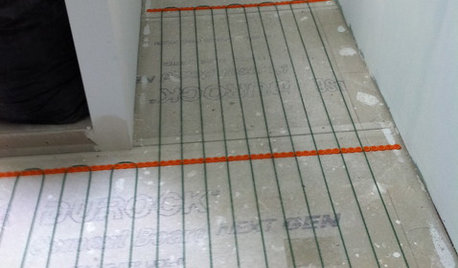
    what about an electric underfloor mat? that should be much cheaper than radiant hot water floor heat, and you can put it on a separate controller, so if it's a guest bath it's on only when needed.

  • 19 years ago

    I've seen 2 of those electric underfloor heaters in action. Quite honestly I wasn't inpressed with either. Neither were the people who put them in. I agree with the heater/fan combo. Depending on the particular mfg. you can get resistance heat or infrared. My personnal choice would be the infrared. You dry off under one of those on a chilly night and you don't wanna leave.

  • 19 years ago

    The electric underfloor mats really aren't, from what I can gather, for providing primary heat. They warm the floor so you're not freezing your feet on cold tile, but that's about it.

  • 19 years ago

    Exactly, and it takes a while for the heat transfer so its not something you want to be turning on and off. Besides, the big question,,,, what do you do with the tile floor when the grid gets a break in the wiring? hmmmmmm chip, chip,chip :-(

  • 19 years ago

    On the other hand, the whole reason taking the radiator out is viable is because it's an interior room, and won't need much heat.

    Also, why would the wires break when they're sitting in cement/mud? How often do normal copper wires break in the wall? It's almost always connections or when the wire is pierced by a nail or something.

  • 19 years ago

    why would the wires break when they're sitting in cement/mud? How often do normal copper wires break in the wall? It's almost always connections or when the wire is pierced by a nail or something.

    you ever heard of a house settling? when the wires are locked in place in the mud, they will break. in a wall they have a little room to move, though if the movement is enough it can still break them.

    heat mats themselves have thin strips, not regular wire. these break much easier than romex.

  • 19 years ago

    Well, our architect just checked with our GC and he recommends that we keep at least one radiator in the bathroom (it has two small radiators because it was originally two separate bathrooms in the original house).

    One alternative we considered was a heated towel rack--I believe some of them can actually double as radiators? Is this at all realistic, and how much does something like that cost?

  • 19 years ago

    "Also, why would the wires break when they're sitting in cement/mud? How often do normal copper wires break in the wall? It's almost always connections or when the wire is pierced by a nail or something."
    Thank you david, you're on the ball. Another reason could be something not done quite right during the installation that can cause some type of minor damage which could lead to a pre mature failure.