Software
Houzz Logo Print
jparkfire

Swimming laps- Design help

17 years ago

My wife wants to swim laps. Short of building an olympic pool we would like to get a few opinions regarding pool design. Our previous pool was free-form and when she swam there was way too many waves. We are wondering about geometric design and maybe a vanishing edge. Any ideas? Building a new pool soon and don't want the stationary jet type lap pool. Thanks

Comments (15)

  • 17 years ago

    The waves can be dampened with the use of lane floats. The good ones aren't cheap and use stainless cable. They also have a ratchet mechanism to loosen and tighten as needed. A spool is suggested for storage when not in use. Standard rope floats won't give you what you want.

    I do recommend deeper than normal ends of the pool to allow for flip turns. The deeper a pool is, the better as it helps to reduce waves by dispersing the energy of the water movement.

    Scott

  • 17 years ago

    Thanks, Scott. DO you recommend a geometric shaped pool vs a free form? The way I look at it what you suggest works well if the pool is more box shaped than shaped like an amoeba.

  • 17 years ago

    I think a non-diving capable rectangle is the way to go. With 5' ends and a 4' mid section you can do laps with flip turns, play volleyball, water polo and basketball. This makes each side fair and the pool is very versatile.

    Sizing with be dependent on how much money you are willing to spend, yard size and local zoning laws that control fence lines, easements, set backs and so on.

    Gunite is the most durable here. Liners would not like the added pressure of frequent push offs and the walls could develop bows over the long haul. Fiberglass is typically smaller though they can be had but if length is an issue and the builder wants a two piece solution, be careful! The push off zones are also subjected to added strain and can develop cracks in the gel coat finish over time.

    Scott

  • 17 years ago

    We have plenty of room and are thinking 35-40' length to keep all of the costs down.

  • 17 years ago

    A vanishing edge will greatly reduce the wave action in the pool.

  • 17 years ago

    We are doing a 50' long pool, rectangular, w/vanishing edge,but it has a bulb at one corner with a spa set into the bulb. The advantage of the rectangle is we can have the automatic pool cover. This is important to us, because otherwise, we would be required to have fencing, which ruins our view. Also, the pool cover will cut down on leaves from the oak trees.

  • 17 years ago

    Hi there,

    When we built our pool last year, I was amazed at how FEW people were building either rectangular OR lap pools. I was worried that I would not be making the right decision to do that, but we did it anyway and have been thrilled with the result.

    We did a 15' x 45' rectangle, and added some things like a tanning ledge with bubblers, columns with waterfalls and additional seating ledges to dress things up and add features. It is 6' deep on one end, and 3' 6" on the shallow end (builder would not do steps into anything deeper.)

    I'd agree with whomever said don't make it less than 40'. I am happy we went 45'. We decided against an infinity edge as it was going to add another $15,000 to the bottom line (builder charges $1,000 per foot for that feature.)

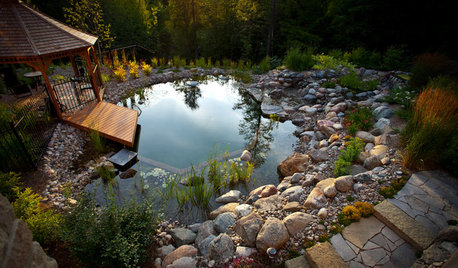
    Here are some photos of our pool.

    {{!gwi}}

    {{!gwi}}

    {{!gwi}}

    {{!gwi}}

  • 17 years ago

    what is a vanishing edge pool I am extemely interested since we are building a 7 foot by 75 foot lap pool and I am concerned about the roughness of the water being so narrow? I know ropes may help but will the vanishing edge help as well and how does it work, do you have pics?

  • 17 years ago

    Very nice pool in the woods. Simple but elegant. Thanks for the advice with experience.

  • 17 years ago

    A negative edged pool is one where at least one side is level with the water line. Water spills into a trough below it and is pumped back into the pool. When the water level rises a bit over the negative edge, it spills into the trough. The trough holds enough water to accommodate at least an inch or two of pool's surface volume.

    They are expensive to build and require a second pump to the the system to operate. The length of it's edge would dictate the effectiveness of the pool's ability to dampen waves.

    Lane floats, as seen in competition pools, usually offer better dampening for a narrow pool of the length described
    in sirsimoneaux's post unless she were to run the negative edge along the length, which would be extremely costly to build and might even require two pumps to run the edge properly and still might need the floats.

    Scott

  • 17 years ago

    My pool is 20' by 40', slightly oval in shape with the spa one one side.

    I swim laps everyday, and have never felt that rebound waves were a problem.

    If you're interested, consider adding turn tiles. At each end of the pool I tiled a turn "T" on the floor and also put target tiles on the walls.

    I was somewhat surprised that the plasterers said they had never done a pool with turn tiles before.

  • 17 years ago

    Competition pools have gutters and surge tanks to handle wave surge and bather load. A negative edge pool provides a percentage of this affect and is the most effective tool at quelling wave surge. Rolling out the lane floats might quell the ambiance.

  • 17 years ago

    For a residential applications, bang for the buck over runs the costs associated the ambiance delivered with gutters or a long negative edge. At least for most people. Might not be that important if I was an athlete with a 50 million dollar contract but I don't think the originator of this thread has that luxury.

    Scott

  • 11 years ago
    last modified: 11 years ago

    oakrunfarm - was hoping you could make your pool pics available again? I would love to show them to a pool company. I had previously saved the link but looks like the pics are down.

    kathi