Software
Houzz Logo Print
imrainey

Watermelon pincushion

17 years ago
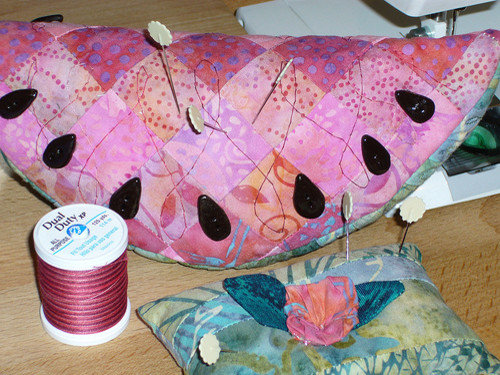
I saw one of these pincushions on the recent SoCal quilters' run and I was completely charmed by it. The store was out of the patterns from Miss Rosie's Quilt Company. I had to locate one onliine and order it. But it arrived and I made my own watermelon.

I had to make the little seed buttons out of Fimo clay.

Sitting next to it is a small emery pincushion I made with excess "rind" and one of Karlene's folded roses.

I love this puppy so much I'm going to enlarge the pattern slightly and make another with a zipper down one side so I can use it as a bag.

Comments (20)

  • 17 years ago

    How cute! And great work on the seeds, very clever.

    I have some watermelon fat quarters I bought inteding to make something for my granddaughter. This pattern would be perfect for them. How long is the slice?

    Dianne

  • 17 years ago

    Very cute, looks good enough to eat! Love your batiks, too.

  • 17 years ago

    Very cute! Donna

  • 17 years ago

    It's 8 1/2" from end to end across the top. The rind is cut from a piece that's 12" x 5" and the fruit comes from a an oval that's about 9" x 8".

  • 17 years ago

    Adorable! I love clever pin cushions. Now you've got me thinking about doing a whole set of fruit and veggie pillows, each pieced in the appropriate batik colors, of course!

  • 17 years ago

    Speaking of pincushions, a lot of the patterns for pincushions that I've read lately specify crushed walnut shells as a good filling. I was delighted when I found packages of it at the quilt show I just attended. Later, I found out that it's the stuff that's sold at pet stores for bird cage litter. I probably paid 5 or 6 times as much for it in cute little packages sold to quilters. =o

  • 17 years ago

    That is just too cute and you are so creative making your own seeds. Your folded rose is cute too. Can't wait to see your bag. Congrats on a great job.
    Jean

  • 17 years ago

    Oh wow, love them both.
    Glad you explained the seed buttons because that was my next question.
    Walnut shells, will have to look for those!
    Thank you,
    Kelly (lots2do)

  • 17 years ago

    Very clever and they look like fun projects. Like the idea of using Fimo for the buttons. I would never have thought of it. Nice job. TFS Jayne

  • 17 years ago

    I love 'em. We have a few plastic dishes with a watermelon theme, and I can't get enough of it. What great batiks you have! Makes me wish I had paid more attention to them when building my stash--which I now cannot do in such a carefree manner as formerly. Now I'm off to check on Fimo; never heard of it before and have no idea where to buy it.

  • 17 years ago

    Fimo is a brand name of polymer clay that is soft enough to shape but bakes in a home oven or toaster oven to a durable hard finish. It comes in many wonderful colors. That dark blend of brown and black hardly does it justice but it's what was required for the job.

    Sculpey is another brand name for the same thing.

    Michaels or JoAnns or any art supply store would have it. A 2oz block that will make about all the buttons you ever need is about $2.50.

    Here is a link that might be useful: little button-making video

  • 17 years ago

    Here's the bag:

    I enlarged the pattern 10% on the copier and inserted a zipper down one side (you may be able to see the pull on the left). I also added a wrist strap that snaps on or off.

    And here's inside. Wish the lining showed better. It's a watermelon print that happened to be in my stash. I bought it back in 2001 when we were living up in Vancouver so it's not just perfect, it's a memory. ;>

    Still have to sew the zipper tape to inside lining and glaze the seeds for the wet watermelon look. But I'll be able to take it to my appliqué class tomorrow.

  • 17 years ago

    That is just wonderful, Rainey! And I was about to ask you where you made holes for the seed "buttons" or whether they were just glued on, but now I can see the holes in the top picture of your latest post.

    That walnut shell info is going to be useful, too.

    I got some FIMO at JoAnns yesterday and because they didn't have bead-rollers or the equipment for baking beads, I got those at Michael's this afternoon. Was tempted by a book about polymer clay techniques, but decided to wait until I know more about what I want to make with it besides watermelon seeds and buttons! Well, earrings, for one thing! I have long made my own pierced-ear earrings, but had to make do with the beads I could find here and there.

  • 17 years ago

    Well, I got the FIMO, and now I can make my own "watermelons," but it was hard to control the temperature of the old second-hand toaster oven I got off San Diego Freecycle yesterday, and the little fish pendant I tried to make out of white FIMO came out a mottled peach and white translucent color.

    That's OK, but what concerns me more is that it is more like a 1/8" thick piece of stiff rubber or plastic than ceramic. Is it supposed to be like a ceramic in feeling when it has been baked properly, or does it always finish up as a substance that wouldn't break even if you banged it against a tile? Just want to know if I'm doing the right thing.

    The peculiar color may come from old toast smoke or something and be remediable by the oven's getting a thorough, VERY thorough, cleaning. I'm going to paint it with acrylic, anyway. But will it take the acrylic well if it is in this rubbery condition? Guess I'll have the answer to that tonight!

  • 17 years ago

    Oven cured polymer clay is, as you say, rather like hard rubber. I have never tried to paint is as I'm already crazy about the crisp vibrant colors it comes in.

    The business of heating it is really more flexible than the directions indicate. Larger denser things take more time (and a lower temp for a longer time is some insurance against burning it) and smaller thinner things take less.

    I bet your toaster oven is perfect -- especially if you can plug it in outside and keep the fumes out there. Just knead the clay well to bring the temp up to a consistent body temp. If you had uneven color (NEVER had that happen when I wasn't combining things for a marbled effect) I can only think that two colors or an opaque and a transparent clay were combined without being fully and thoroughly incorporated (my seeds were a combo of black and burnt umber) or there were bits at different temperatures that didn't both get fully cured.

    Keep experimenting with it. It's GREAT stuff. And I bet you could find a lot of resources for tips and project ideas online. Check for Fimo, Sculpey and Premo, all brand names of the same stuff.

    Have fun! ;>

  • 17 years ago

    Oh, thank you, Rainey! I checked the wrapper and found that what I used was "translucent". It looked like a pure, opaque white when I was kneading it, and I was only using the one color. Now that I am sure I can use this oven, I have cleaned it and perhaps the next time won't get peach-colored shadings in a translucent white.

    I appreciate the tip about not needing to be fanatical about keeping it at a certain temperature. The local JoAnn's had Fimo and Sculpey.

    Some of the marbling probably came from air bubbles. I don't have a pasta machine yet--but thanks to San Diego Freecycle, I hope to go pick one up soon from a lady who lives rather far from me and has a busy schedule, so it's been hard to get together. But I'm not complaining: Both the oven and the pasta machine are free!

  • 17 years ago

    I love creative pincushions. And I love watermelon patterns. Great job altering it to make a bag. I'm impressed!

    Darla

  • 9 years ago

    Where did you find the seed buttons you have on the pin cushion?

  • 9 years ago

    Smithouse4 - going back and reading this post it looks like they made their own seed buttons using FIMO. There is a link for a Youtube video listed above - just go back and read through the responses to find it. This is a really old post - good luck!

  • 9 years ago

    Following the lead of the quilter that originally made the watermelon pincushion--though I remember it as a small bag--I used Fimo clay. Since then, with books and the Internet and a group of clayers I found, I have really gotten into claying, and I would like to suggest that if you decide to make "watermelon seed buttons," you might find Premo polymer clay a bit easier to work with. I have tried Kato clay, which has since changed, so it might be less stiff to work with now, Sculpey III, Cernit (great for doll-making), and Premo, and now almost exclusively use Premo. The Michael's near us sells it, but if I need a lot, it is cheaper to buy it in 1-lb. bricks online.

    Polymer clay buttons are washable, even in a washing machine. After you have shaped and baked the buttons and drilled holes (or have put holes in them before baking), you can get a high shine on them by painting them with Varathane water-soluble gloss "crystal clear" varnish. But if you are only going to make a few buttons, it would be expensive to buy a whole can. A cheaper alternative, though you might have to renew it from time to time, would be Johnson's "Pledge with Future Shine acrylic floor finish." I sometimes just wipe it on with my fingers. The Home Depot near us sells it. I hear that with age, the Pledge tends to yellow a bit, but that wouldn't matter at all with watermelon seeds. What you should NOT USE on polymer clay is regular nail polish because it tends to turn cloudy and/or sticky over the long term. I once ruined a pair of earrings that way.