Software
Houzz Logo Print
reshal_gw

Waterlox

17 years ago

Does anyone here have any experience with Waterlox? I have wood tops on two 6' perimeter counters in my kitchen (one with a sink that is set up as a beverage center) and bought Waterlox as the sealer because it's recommended by most of the high end wood counter top manufacturing websites. But, I haven't talked with anyone who actually has the finish. Any insight? Do I need to be obsessively careful about liquids sitting on the counter? Thanks!

Comments (9)

  • 17 years ago

    I used Waterlox on all of our interior doors, baseboard, door casings and trim, cabinet doors and drawer fronts, and on our island counter! It is great stuff. We are not at all that careful with our island top. We have a prep sink in it, so it's often wet around the faucet, and of course, we prep on it, so don't worry about water and juices getting on the countertop. We don't let it sit for hours, of course, but we don't jump to immediately wipe up every spill either...Just wipe up when we're finished, as with any other counter.

  • 17 years ago

    We used waterlox on our white oak floors. it's terrific. But we used pure tung oil on our cherry counters.

  • 17 years ago

    I love waterlox so much that i used it in my shower (wood panels). (I sound like a commercial)..

    I use it for almost every woodworking project I do. Floors, cabinets, panels, outdoor teak furniture, etc. Great stuff. easy to use. brings out the grain in wood. easy to repair.

  • 17 years ago

    Waterlox is the best! Many here have used it and I was inspired by RHome's island to redo my own (the only DIY part of our kitchen reno!) People at Waterlox will walk you through whatever questions you have.

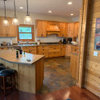
    Here's a pic of our finished island:

    Check out RHome's kitchen - she has great pix of her Waterlox

    Eliz

  • 17 years ago

    I have waterlox on my floors. I'm not a fan. (It was a miscommunication. Long story.)

    It depends on what you want. If you want it to feel like wood, and have a reparable finish, DON'T use waterlox. It looks and feels like polyurethane to me -- plasticky. (I think I have 2 coats.)

    There are also a few waterlox products, I believe, so which one you get may affect your level of happiness. Some people are extremely happy.

    It calls itself a tung oil finish because it contains tung oil. Which it does. Legit. It also contains resins. It's better than polyurethane though.

    But to "repair" the surface, you have to put down more layers of the stuff, I'm told, which is not MY idea of repairable. And I have been discouraged from waxing over it.

    And the vapors were worse than poly while it was being put down. (Now they have cleared it is fine.)

    I would use an oiled or waxed finish. You get enough wax down nothing gets through it. Just my opinion.

    You can check out the woodworking forum too. They know a lot about finishes.

    Good luck. Wood counters are beautiful!

  • 17 years ago

    I sure don't have the same view as Growlery. We have spot repaired where the dog scratched a portion of the trim on our stairway. If you put a poly finish on in one small spot to repair, you'd see the difference, we don't see that with the Waterlox. My dh is a long-time woodworker and woodshop instructor, and is so impressed with the Waterlox. I expect any finish to smell and as much of it as I applied, I never found it particularly or any more bothersome. I HATE the smell of fresh lacquer and didn't have that same problem with the Waterlox...But the odor tolerance is different for different people.

    I did 2 coats of the Original on all of our woodwork, then 2 coats of Satin on the doors and trim, but about 5-7 coats on the island top. For everything, I brushed on the first 3 coats, and hand rubbed the rest, doing very light sanding in between most, but before the hand-rubbed, I was more thorough.

    You can see the sheen on our cabinet doors here. Doesn't seem plasticky to me at all in appearance or feel. The island has a heavier finish so is a little shinier. I blame that on myself, because a past forum member (Mondragon) did his table with Waterlox, and also did several coats, and had a wonderful hand-rubbed-looking finish. (link below) I think I got in too big a hurry.

    In my photo you can see the difference between the Waterlox on the cabinets and the glossier lacquer finish on the trim on the display shelf. Thankfully, it's not as noticeable in person, because it looks awful in this picture to have them next to each other!

    Here is a link that might be useful: Mondragon's table

  • 17 years ago

    We are waiting for some dry weather to finish up our counter top sections with satin - they are sealed with the four coats of the Original Waterlox sealer, so we are using them. No problems with water - the water just sits there. We do not let it sit for any period of time, but have been quite happy.

    Also, I have finished some table tops with satin polyurethane in the past (for two tables that have had a lot of heavy daily use) and found the Waterlox easier to use - it goes on smoothly and I have had no "bubbles" - I had to fuss more with the polyurethane. If I had to do it again, I would probably use the Waterlox just for ease of use and finish.

    Here are some pics - we used Ikea Beech Butcher Block.

    Before Waterlox:

    After:

  • 17 years ago

    Another 'Waterloxer' here. Original finish formula on black ash floors, red oak window/door trim, stair rail and cabinets. It does get a shine the more coats you use but I LOVE how it brings the grain out of the wood and makes it look so rich. It's not like poly where the whole surface is shiny. With Waterlox the grain is accentuated and still quite apparent.

    So far as 'stuff' sitting on the surface, things seem to bead up and not soak in. Even with our senior cat who has a issue with 'spitting up' the floor cleans up with no lasting impression, even if it sits there for a while before we find it. We've also touched up a couple of areas with deeper scratches and it did blend them in.

    The odor is strong but it does go away, but then again I've gotten used to it. Like rhome says, all finishes stink. It's one less step, too unlike stain and poly.

    Jill

  • 17 years ago

    Just to show you how great this product is - I have tested about 10 different finishes on bubinga (an african rosewood). I have tried water based polys (horrible), oil based polys (ok), various other finishes and finally waterlox. It is easy to work with, smells a lot but ventilate it and it is gone in a few days.

    See for yourself. Here is a project i did

    Before waterlox

    After 4 coats of waterlox applied with a sponge. I wanted a high gloss finish. There is no stain (I am against staining wwood but that is another discussion)