Software
Houzz Logo Print
shezzy_in_sj

Rubberwood butcher block?

21 years ago

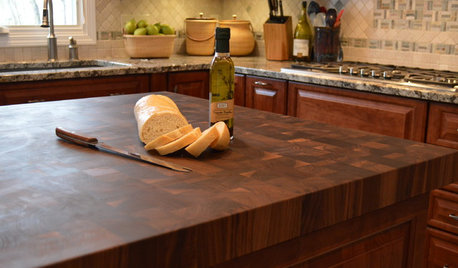
Anyone know of rubberwood butcher blocks? The retailer says it is a type of maple. The board is end grain. Looks very nice. Just want to know if it rings any bells.

Thanks.

Sherry.

Comments (15)

  • 21 years ago

    Thanks for the reply. So as far as purchasing a butcher block, would end-grain rubberwood be a good substitute for the end-grain maple if the maple price point was too out of reach, since the rubberwood is dense and not porous? Or is there not really any good substitute for the e.g.m.?

    For some reason, this retailer touts the fact that rubberwood is an eco-friendly wood since latex is used from its sap and thus the wood can be used. Using the whole tree is one thing, but not necessarily entirely eco-friendly if said manufacturers, (and some Asian ones perhaps not all that regulated) are not mindful of their practices. Any thoughts?

    Thanks.
    Sherry

  • 21 years ago

    Rubberwood (aka hevea) has a Janka rating of 995 or so (between Cherry and Teak), and hard maple is 1450, so I would expect the maple to hold up better. But if you plan on cutting directly on it, both hard maple and hevea will look terrible pretty darn quick. I understand that the beat-up, chopped-up, stained look is part of the charm of butcher block, but personally I'd use a cutting board that I could throw in the dishwasher every once in a while and then it wouldn't matter what species you use for the butcher block.

  • 21 years ago

    I think cheifneil's got a useful approach to thinking about this: the big question is what you expect out of your butcherblock, how you expect to use it and how much wear is okay. Answers probably vary widely. Do knife marks and scratches say "broken" or "broken in?" If the former, don't plan on cutting on any wood countertop. If the latter then either will work, though maple is probably somewhat better.

    The rationale that says "rubberwood is an eco-friendly wood since latex is used from its sap and thus the wood can be used" sounds suspicious to me; do the trees need to be cut to harvest the sap? I doubt there's an absoulute answer to the eco-friendliness issue. Cutting wood destroys trees, no doubt about it. How many trees is too many? Tough question.

  • 21 years ago

    These are all good questions I should answer.

    The idea is that my cabinet maker will make a "rolling chopping block island" out of a four drawer cabinet of the same cabinets he is doing for the rest of the kitchen. Butcher block screwed into the top for its counter, and locking casters to roll it where needed. (The idea is to maximize space for guests to help and pull out a knife and have their own station.) The rolling island will be stationed at the end of a run of cabinets when not in use, so it will look like it belongs with the stationary cabinets and is not an add on accessory, like a cart.

    I'm not too worried about the pristine look of the butcher block, but I do want to start out with a hard surface. Sounds like the stand-by end-grain maple is worth its price, and that one gets what one pays for with shortcuts.

    If allowable I've linked to the one I'm looking at. It's beautiful to me, but the sales pitch seems a bit over blown compared to some of the remarks about rubberwood here.

    Still, would an end-grain rubberwood be better than and edge-grain anything, if DH won't spring for the end-grain maple?

    Here is a link that might be useful: Rubberwood butcher block

  • 21 years ago

    "Still, would an end-grain rubberwood be better than and edge-grain anything, if DH won't spring for the end-grain maple?"

    Probably, though I'm saying that as a woodworker, not a butcher. My guess is that endgrain is good because it's more or less self-healing. Since the wood fibers are perpendicular to an end-grain surface, you don't cut through them as you chop food; you do less damage. I don't know enough about the cellular structure of rubberwood to guess whether it would absorb more or less moisture than maple, which I think might be relevant to the block's long-term lifespan since the expansion and contraction that go with moisture absorbtion might put stress on the glue joints that hold the thing together. Realistically, though, unless you're planning to use this thing very heavily, we're splitting hairs.

  • 21 years ago

    Thank you, Jon, and all, you've been very helpful.

    Sh.

  • 20 years ago

    I noticed that rubberwood flakes upon washing it...even more-so than other woods. Do you know why this happens? Is rubberwood dangerous to be around food because it flakes?

  • 20 years ago

    Regarding Rubberwood.
    > It is enviro-friendly because it is farm grown for its sap. At 30 years old it is no longer a good sap producer. Two choices then are its fate. 1) Be used forfirewood. 2) Be turned into furiniture. It makes very prety furiniture.
    > It is not Maple, but as I have read, it is in the Maple family because it is used for its sap.

    Links:
    http://www.oakplus.com/rubberwood.htm
    http://web.utk.edu/~mtaylo29/pages/rubberwood.htm
    http://www.andamans.com/RubWd.htm

    Now on to my question...

    Does Rubberwood yellow/darken with age like Maple does?
    Since both woods are near the same color when fresh, what happens if combined in the same piece over time?
    What is really at play here is that rubberwood is becomming very ecconimical, and I am in the market for some additional furniture, and the other pieces and the room accents are in natural Maple (which have aged). If I buy rubberwood, will it age like the Maple and ultimatelly match the Maple?

  • 20 years ago

    "it is in the Maple family because it is used for its sap."

    ...and cats are in the dog family because they are pets?

    Maple does yellow over time, especially with exposure to direct sun, but the yellowing of a given piece of furniture also depends on the finish used. In my casual observations, rubberwood has seemed to be more color-stable than maple. Any given piece of furniture, though, may or may not have a finish that's prone to yellow. Of course, the grain patterns will never change to match maple.

  • 9 years ago
    last modified: 9 years ago

    I'm looking at Rubberwood as an economical substitute for maple for a 30"x84" butcherblock counter. Has anyone had any success using Watco Butcher Block Oil as a finish? I'm not planning on using polyurethane, would just like to use oil.

  • 3 years ago

    I’d like to know if it is pressure treated with borate or boric acid. For a butcher block countertop I’d like wood that hasn’t been treated with preservatives and insecticides.

  • 3 years ago

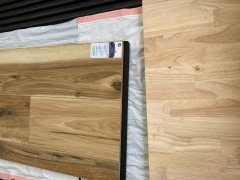
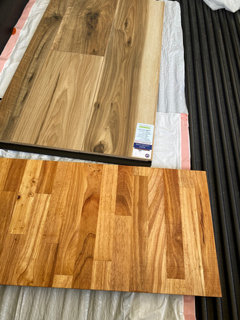
    I found rubber wood to be quite porous. Also, it has an orange undertone. I treated it with only a hemp drying oil (instead of a Tung drying oil , because Tung addd an amber hue). The result was an extremely orange piece of wood. The first picture is if my flooring on the left, the unfinished rubberwood countertop sample on the right. The second picture is of the flooring sample above, and the rubberwood finished with hemp drying oil, on the bottom. Needless to say, I will not be using the rubberwood. It!s important to choose a wood with the right undertones, or else it will clash with your other decor.

  • 3 years ago

    I found out that butcher block countertops have been pressure-treated with borate or boric acid. The lumber is always treated with such mildewcide and insecticide almost immediately after harvest because the wood borers and mildew typically will otherwise attack this wood immediately. And with rubberwood being highly porous, it becomes heavily saturated with this insecticide during treatment. To me, personally, this renders rubberwood unsafe for food contact.

  • 3 years ago

    I found rubber wood to be quite porous. Also, it has an orange undertone. I treated it with only a hemp drying oil (instead of a Tung drying oil , because Tung addd an amber hue). The result was an extremely orange piece of wood.