Software
Houzz Logo Print
dirtymartini_gw

please explain 'frameless' vs. other cabinets...

17 years ago

How many choices are there...and what is the difference? Which is pricier, and why? I know this may seem like a dumb question, but I am a kitchen remodel novice! Please tell me the pros and cons to each. I think it is a simple concept that I am making more difficult. I keep seeing these choices when I do my google searches, and I am just not sure why I would (or should)prefer one over the other....

Thanks!

Comments (15)

  • 17 years ago

    Frameless don't have a face frame, thereby increasing accessibility and (usually) space. Framed do have the face frame and that frame shows between the doors.

    Frameless are always full overlay meaning the doors butt up against each other. Framed, even when described as "full overlay" almost always do show at least some of the frame between the doors.

    Advantage to framed: the look
    Advantage to frameless: accessibility and space.

    However, the space issue can vary between manufacturers so measure space and know what you're buying.

    Price difference: There is none specifically tied to either style, price depends on the manufacturer. There are good and bad quality of both kinds, there are price ranges from low to high and in between in both kinds.

    Here is a link that might be useful: explanation with pictures

  • 17 years ago

    I will admit to a very strong bias here, as I absolutely do not care for European style cabinetry. I have always made faceframe cabinetry except for my current project which is an elaborate home theater that calls for frameless cabinetry. But there is a difference between frameless cabinets and European style cabinets.

    All cabinets are boxes. To make this simple, think of a simple box with four sides. Because it is cheaper, this box will be made of plywood or other manufactured materials, typically particleboard. Either way, though, the finished box will rack if nothing is done to reinforce it.

    Faceframe cabinets attach a frame to the front of the cabinets. There is also normally a back, but they are strong enough with the ¾" faceframe that they can get by without the back, if they are to be attached to a wall, which they normally are.

    Frameless cabinets have a back on them, but no front.

    So, at this point it would seem to be six of one and half a dozen of the other. However, the makers of frameless cabinets have found a number of ways to cut corners, beginning with the cabinet back, which can be as little as ¼". Doing so, though, weakens the cabinet.

    The other thing that is typically done with frameless cabinets is in the European style cabinetry. They run holes up the front and back of the cabinets in order to use the 32mm system. It's too complicated to explain here, but in a nutshell, it means that the cabinet manufacturer can use this system to quickly and easily attach doors or drawers by simply changing the hardware used.

    Also, with European style cabinetry, the material used is normally Melamine, which is really just particle board that has been coated with some sort of plastic. Faceframe cabinets can use this material too, and many manufacturers have opted for it.

    Personally, I use either solid wood or plywood in my cabinets, as both of these materials are considerably stronger than Melamine. And my frameless cabinets have a full ¾" back, and I do NOT run a line of holes up the cabinets.

    If you buy cabinets in any kind of a factory outlet, though, the difference between frameless cabinets and faceframe cabinets is not very much. What they are doing now in those cabinets is simply plopping a narrow faceframe on the front of European style cabinetry.

    I also think that if frameless cabinets are made well that they are every bit as strong as faceframe cabinets. But they have to be made well. Again, I am biased, but I would look for a small, independent cabinetmaker who prides himself on doing the best work he knows how to do.

    Here is a link that might be useful: Cabinet & Furniture Trends & Information

  • 17 years ago

    One thing not mentioned yet is the need for filler... With framed/full overlay and frameless cabinets more filler is sometimes needed to allow adjacent doors in corners or doors against walls to open fully and to account for knob depth. Framed/partial overlay cabinets often do not need filler b/c there's room on either side to allow adjacent doors to open. We have full overlay (a look I love, btw) but we have one in a partial overlay for just that reason...our corner sink base. By having a partial overlay on that cabinet we did not need the extra 1" or so of filler on the legs to allow the sink base door & adjacent drawer bases to open. We had limited space on the one leg so every inch counted! On other cabinets we did have to have filler b/w adjacent cabinets.

    As to seeing part of the frame on full overlay doors, I disagree. If they're well made there shouldn't be any frame showing anymore than a well-made frameless cabinet would show the walls...except a fraction of a fraction of an inch (yes, fraction twice!) to prevent adjacent doors/drawer from scraping each other...but frameless has this as well.

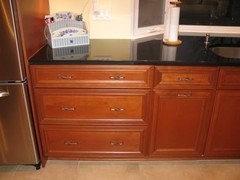
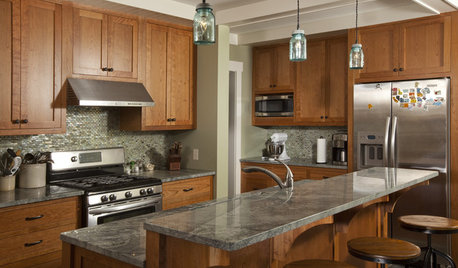
    Virtually no frames showing b/w doors or drawers:

    In this case, the cabinet's hinges are on the left against the refrigerator's end panels (so, in effect, a wall), so filler was needed b/w them to allow the cabinet door to open fully:

    Our corner sink base has a partial overlay to avoid filler. Notice that you can see the cabinet frame around the door and fake drawer front. (What appears to be a frame on the right side of the 4-drawer drawer base is actually the decorative door end panel on the end of the peninsula.)


    The Kitchen Forum FAQ also has a description of cabinets. (The FAQ is referenced in the "Read Me" thread.)

    Here is a link that might be useful: Read Me If You're New To GW Kitchens!

  • 17 years ago

    I live in Canada and in my region, framed cabinets are about 20% more expensive than frameless. So that may be a consideration for you.

  • 17 years ago

    As to seeing part of the frame on full overlay doors, I disagree.

    buehl, I stand corrected! I should have said, in my experience. I've never seen framed cabinets that had that much of an overlay. So! To correct myself I'll say that just as the actual space should be measured in a drawer, framed or frameless, before making a decision, the term "full overlay" should be confirmed as it can mean different things to different manufacturers.

    Which reminds me, when we were looking, one contractor to whom I specified FRAMELESS cabinets insisted that he knew of a local Amish cabinet builder who made frameless. At that point I'd done some pretty thorough research and was 99% sure I'd found all the frameless cabs available in my area. But ok, we drove out (about a 45 minute drive to this place) and met the contractor so he could show me. Turns out he made full overlay framed cabs. The contractor thought full overlay was the same as frameless. Lesson learned (for him!). Oh well!

  • 17 years ago

    buehl - what kind of cabinetry is in your picture - I love the color and door style. What brand is it?

  • 17 years ago

    Think of it this way: with frameless full overlay you see all door, with frameless partial overlay you see lots of door and a little bit of wood between, and with framed you see a lot of wood between the doors.

    My favorite style is a subset of framed called inset, which means there is no door sticking out at all and the whole cabinet face is smooth. This is really popular right now in the white period kitchen look, but it's very nice in stained wood, too:

    {{!gwi}}

  • 17 years ago

    If you're looking to save money, my advice is to put in the time to shop around. Get a lot of quotes. I did and it paid off. It takes a lot of time and effort but it's worth it to get what you want at a good price.

  • 17 years ago

    buehl, I just want to say a big thank you for explaining about the filler pieces and illustrating that with your pictures.

    I'm finding that every inch counts in my layout, and I also want full overlay/frameless cabinets. Your comments remind me that I have to be hyper-vigilant about those places where I might get conflicts between the opening doors/drawers.

  • 17 years ago

    Thank you! We love our cabinets as well!

    My cabinets are mostly from Omega's semi-custom line, Dynasty. The door is actually a Dynasty II door...one of the least expensive doors. The wood is cherry (an upgrade) w/mandarin orange stain and a coffee glaze (also an upgrade).

    We started with the Artesia door...the most expensive one and when our budget became an issue we switched door styles several times until we settled on this one. I should say it was NOT the door style that decided me...it was the drawer front! It has the exact same drawer front as the Artesia...and I really love it! Since most of my kitchen is drawers, the drawer front was the deciding factor.

    I was a little worried that the center panel is a 1/4" furniture veneer, but in the end it really hasn't mattered...the veneer has aged right along w/the solid wood and I think they look great! They are lighter (weight-wise) then solid wood, but once we put the soft-close dampers on all the doors you can no longer tell the difference.

    I still love the Artesia door, but our Anson door works fine in our kitchen. Once it was done, our KD looked at it and told us she thought it was a good switch...she said she thinks the Artesia may have been too "ornate" for our kitchen. (We're planning someday to create a hutch/china cabinet in the DR using the Artesia door...but not until after DS & DD are out of college...that's what we're saving for now!)


    BTW...We have at least 3 cabinets from the Omega Custom line...it was cheaper than modifying the semi-custom cabinets for these 3 cabinets (plus you get all the "extras" that come w/Custom). That's one of the advantages of Omega...you can mix & match cabinets since the majority of the door & drawer front styles are carried in both lines.

  • 17 years ago

    buehl - who has a LO up for help that had a peninsula on the outer wall (run with sink on it) - DR or office below kitchen (many trying to convince her to knock wall out) - last I read she was dropping her peninsula because too big I think - your peninsula size/style might work for her...

  • 17 years ago

    If it's who I think it is, the OP has stated she doesn't want the peninsula at all b/c it's a "junk collector"...that's why she's taking her existing one out.

    However, for others, you're right that it's worth noting that you can get kitchen seating in a narrow kitchen (ours is 10'6" wide) by utilizing a peninsula.

  • 17 years ago

    I will second what lowspark said about shopping around. Both frameless and framed cabinets are made in all quality levels. There are just as many, if not more, companies that make crappy framed cabinets. What makes a cabinet good is a combination of the materials used, appropriate joinery, good hardware for the joinery system selected and good workmanship and finishing.

    Unfortunately, its your responsibility to know the difference. I ran into a lot of people doing cabinet sales who didn't know the products they were selling, much less whether one line was constructed better than another.

    Below is a nice, fairly non-partisan write up of how to judge whether the cabinets is well made.

    Here is a link that might be useful: Keidels cabinet write up.

  • 17 years ago

    buehl - i'm sure you have it right. i think there's only been 2 (that I remember) lately who had peninsula in...then out. and 1 had the big laundry room/outside door right by it. so it's the other one - lol! glad that was the reason then - i only scanned some of the posts (behind in my reading here) so wasn't sure why it was 'out'.