Software
Houzz Logo Print
apbnash

HELP - White spots on tumbled marble backsplash

16 years ago

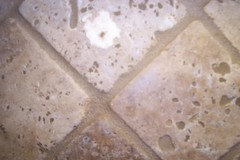
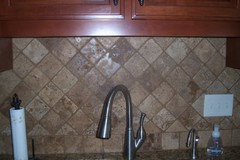
I just finished a total kitchen remodel and I've got some white spots on my tumbled marble backsplash. There is one in particular which is over the kitchen sink that I think is going to drive me nuts. The tile person says that he can't replace that tile without messing up the wall and I suppose the surrounding area. He also says that I won't even notice it after awhile. (The color of my tile is Noce (sp?). I like the color and grout and there are several other white spots (which you could not see until it was enhanced/sealed) but the one over the kitchen sink (up near where the lighting is) I think I will notice because it is circular and just very white. Please advise if there is any fix for this. I hate to have redone the entire room and have one little thing that is going to jump out at me everytime I walk in the room. Am I just being anal or would this drive you nuts too? And, most importantly, can one tile be replaced without messing up an entire wall?

Comments (28)

  • 16 years ago

    Can you take pics of these spots? Also, do you know what the spots are? Or are they just blemishes in the stone?

  • 16 years ago

    Ok, how do I post pics to this forum? I took some and would love to upload but not sure how. Any help please?

  • 16 years ago

    Go to photobucket.com and start a free account. With each pic you upload, you get what's called an "HTML line". click on it to highlight it, then rightclick to copy it. Then when posting, paste it into the body of your post, and when you preview it, you'll see your picture appear.

  • 16 years ago

  • 16 years ago

  • 16 years ago

    OK, so what does everyone think? My husband thinks I'm being ridiculous but to me this is very obvious and in a really obvious place. What should I do?

  • 16 years ago

    bump!

  • 16 years ago

    I don't think it is that bad, as it took me a while to find it on the non closeup. Luckily your tile has many variations of colors in it, so this just looks like the lightest one.
    Since it bothers you....it may be crazy but if you have any remnants, you may want to try staining a spot with coffee or strong tea to see if that works. I would not try that on the installed stuff, but you could play around with leftovers and see if something would help it blend a little. Keep checking after an hour, a few hours, next day, etc... so you will have an idea of what to try on the real spot.

  • 16 years ago

    I'm trying to not let it bug me but it just jumps right out at me everytime I walk in the kitchen.

    Speaking of variations, is it normal for the tiles to be so varied and also have some many pitted places in them? This is the first time that I have had natural stone in my home and so I'm not quite used to what is normal.

    Thoughts anyone, after looking at my pics above?

  • 16 years ago

    First thing to do is tell the DH you are NOT being ridiculous. Just because you have differing opinions doesn't make yours ridiculous. (It makes his ridiculous!)

    :-)

    It would probably bug me because when I pay good money for something, I want it to be as close to perfect as possible.

    How about gray and/or brown sharpies? There must be a way to hide it that isn't too complicated. Grout colorant?

  • 16 years ago

    I don't think I'm being ridiculous either but no one else seems to think it's as bothersome as I do.

    I would love a way to hide this but just need some good advice from people who do tile work on my options. I did ask the tile guy about grout but he did not seem to think that would work nor did he think it was a big deal. I just need some people to look at my pics and tell me what they would recommend. I'm open to any and all feedback!

  • 16 years ago

    i agree with earlier post - i would test options on spare tiles to dull/mute it down with some coffee or tea or something. if it bugs you i would try to find a solution but would try to avoid pulling out the stone.

  • 16 years ago

    I do have some spare tiles and so I might ask the tiler if that could work to try and mute it down somehow. I can get over a lot of imperfections in things but this I think is always going to bother me. It's just SOOOOO white. Not a little white, but a lot! I had no idea that these stones could have white spots.

    Again, if Bill V or another tiler is reading this post, could you look at the pics and tell me if this is just a normal variation and something you see all the time or what? And, as a tiler, do you normally wet your tiles with a sponge before or during installation to make sure that you avoid tiles like this one? And, is it normal for the tile to have so many large and deep pitted out areas? I just want to make sure that I don't have a defective batch of tiles b/c the installer said that a lot of the noce from various stores has been crumbling on him or unusually white (did not say that part til after it was done). I think I can live with the rest of most of the backsplash but something has got to give about that one tile being in such a prominent place.

  • 16 years ago

    Variation in natural stone not only is normal, it's desirable. It's what you pay the premium for---to be able to differentiate between something Mother Nature made as artwork and manmade imitations. Your stone does not have a "flaw" in it. :) It has a "beauty mark" from Mother Nature! It's real, and it's beautiful and your white spot only shows that off. Tumbled travertine like you chose for your backsplash is a very porous stone with many voids and pits in it. Those pits are usually filled at the factory for a more polished type of stone or while grouting for a more rustic tumbled type of stone like you have.

    If the tile hadn't been grouted, and you had a couple of tiles that just didn't work for you in the layout, even if they were within the bounds of "normal variation", then it's within the usual unwritten guidelines to ask that they be removed and replaced. After the tile is set, and because it's much more difficult to remove without the possibility of damage, any areas that are broken or damaged should be removed by the tile setter with him assuming the risk of damaging the adjacent tile. For tile that is not damaged and is just varied within the normal variation of the tile, if you want it replaced, you assume the risk of damaging the adjacent tiles and the payment of the additional labor to "correct" your problem. Now, if he had not varied the placement of the tiles so that you had a whole dark lot abutting a lighter lot, that would fall under not doing the layout properly to blend the differing colored lots. But, a single tile with perfectly normal color variation in an inconspicuous spot? Nope. Get out your sharpies.

    I personally don't even notice the spot in the overall scheme of things because it blends in with the other naturally varied stones in the backsplash. If it stood out so glaringly to me as it does to you, I'd experiment myself on the leftovers until I found a solution that worked for me. This isn't a "mistake" that you can ask a tile person to solve for you. If you don't like the natural variation, it's up to you to do the experimenting to "solve" the "problem" that you perceive. A tan sharpie should tint the white area down several notches just fine, but you should be the one experimenting on scrap. After all, the aesthetics of the fix being pleasing will be up to you, and you are the best judge of if the whitish spot is dark enough to please you.

  • 16 years ago

    Hi, I am in agreement with the above post.

    As for the hole in the stone, That is a function of the stone you chose. I have not used the Noce marble, but I have used tumbled marble. It varies on the amount of holing in it based on manufacturer and price. The less expensive tiles have more holes, the smoother tiles are more expensive.

  • 16 years ago

    I don't know that particular stone so I can't tell if it's natural but to me it looks like someone dropped a blob of whiteout on it. I have no idea if the sharpie would work but I suppose it's worth a shot. Another possibility might be to add a light rail to the bottom of your cabinet so it's not so visible. Worst case, if it really continues to bother you, bite the bullet and get a really good tiler to replace the tile. Hopefully, Bill Vincent will check back in and tell you how big a job it is to do it and the likelihood of not causing damage to the surrounding tiles.
    Good luck. In hindsight, you should have inspected the tiles before they were installed and removed this tile from the batch.

  • 16 years ago

    Thanks everyone for the replies. Still waiting on Bill V to weigh in too.

    Ok, I'm really fine with everything but the white blob, which is very accurately described in the post above. I think that my close up pic above is a more accurate representation of how bad it looks. It does not look as bad in the far off pic above because of the glare from the flash. In reality, it is quite noticeable and looks like a blob of paint or whiteout was dropped on it. I understand there is natural variation in stone and that is part of the beauty of it. But, this is an extreme variation that does not blend in with the other variations. I don't look at tile enough to know if the pitted places are excessive. I'm not sure how much the tile itself cost but the tile and labor was $1,735 for 65 sq. feet of backsplash, hung on the diagonal with a square tile border around the bottom and side by the desk. (I'm in Tn). I did not buy the tile (tile guy did)because he said that there was only one place he would trust the Noce tile since there have apparently been quality issues with a lot of Noce tumbled marble around here lately. He mentioned yesterday that he had returned an entire box because it was too white. Of course I find this out on the backside. If I had any idea that there could be "Albino" colored places then I would have had him wet every square inch of that tile while it was on the wall but before it was grouted. He did wet a small section just to show me the color that it would be after it was enhanced and sealed. It just did not happen to be that particular area.

    Would a Sharpie even work on a sealed tile? I thought that was part of the purpose of sealing - so that it could not be stained. What I wonder is if this tile can be removed and replaced. I understand that others around it may also inadvertently be damaged but this is certainly less drastic than redoing the entire wall. If I could hide this place then I would but it's in a very conspicuous place. It's right up against the light over the kitchen sink. It's true that a tall person would have to duck down to see it but I'm 5'7" and can see it just fine. It's right in front of my line of sight when I'm standing at the sink doing dishes. With 4 kids I'm always at the sink doing dishes.

    I'm not trying to "blame" my tile guy. I don't know what is normal to expect from tile people as far as thoroughly inspecting tiles before putting them on. They all looked white and chalky to me. I did not notice anything special about this particular tile and I don't guess he did either. I'm not saying that I won't pay him to redo the work. How much of the burden lies with the tile person versus the customer? I think it's a grey area in some places. I ultimately just want to know if this can be fixed without it being too noticeable.

  • 16 years ago

    While I understand that all kinds of pits are to be expected with many natural tiles (and are indeed a tip-off that the tiles are natural), I would be unhappy if I ended up with a bright white splotch right in my line of sight on an otherwise brownish, grayish backsplash. If this white mark really, truly is a reasonable, natural variation, then I would at least be disappointed that the tiling professional didn't avoid using it where he did. Just like when folks get their granite installed, and a less attractive (albeit 'natural') portion is placed front and center. Shouldn't the professional installers be able to point this stuff out to us?

    Maybe try Bill V on the bathroom forum?

  • 16 years ago

    Can't you just get a little beige paint and sponge it on the spot?

  • 16 years ago

    I do not like this white spot, either. I do not think you are being unreasonable to want to fix it. I think that we are just trying to help you think about other solutions.

    My first experience with stone was my 2003 kitchen remodel. tumbled marble. I remember looking at the finished backsplash and thinking why didn't my contractor set aside those dark ones that popped up every once in a while. After all, I had three boxes of tile left over. To me, it seemed a no-brainer. I also had no idea there was this much variation. But my contractor did. He knew what the tile looked like and how much variation was there. To him, the dark tiles were not something undesirable, or even something to ask me about. He had more experience, and I had not looked through the tiles to see what they were all like and pulled out the dark ones. Come to think of it, I helped him do tile on the second day. I put extra mastic on the back of the tiles that needed to be set forward a bit. On that day, I did pull out some tiles that were "too dark" for my taste. My expectations were different from Jim's.

    Now I am doing a second, different kitchen. I have an island that will be topped with 19" porcelain tiles that look like stone. I know from watching HGTV that some people lay tiles like this with no thought to the direction of the streaks of "grain" in the color. I hate that look. SO I am taking off a few hours on tiling day to give my input on the placement of the tiles and cuts. I would not know to do this if I had not seen other tile jobs I did not like, or see the dark tiles on my old backsplash.

    Since the sealer wears off in time, and since it is a liquid, I bet it has a solvent that will remove it. You may be able to do a "faux" finish on the white spot, then reseal it. It is possible that taking out that tile could hurt your wall and mean that the whole thing has to come down. Try something else first. After Bill Vincent jumps in and gives advice.

    There is a thread here somewhere about people hiring painters to faux finish outlet covers and other obstructions so that they cannot be recognized and ruin the flow of the backsplash. I would try that before taking out a tile and risking tearing the paper off the drywall underneath.

    Here is a link that might be useful: Painted outlets

  • 16 years ago

    Thanks everyone. I'm just waiting on Bill to read this and get his opinion.

  • 16 years ago

    That has nothing to do with the installer at all, other than his bad judgment in using that piece of tile. He needs to pull it and change it for another tile, and don't let him tell you that it can't be done. If that's true, he better be prepared to replace the entire thing including materials at his cost. He never should have used that piece, and there's no way he didn't see it.

    It has a "beauty mark" from Mother Nature!

    lwo-- sorry, but I disagree with you. That's not a beauty mark. That's an anomaly and should've been culled out.

    apbnash-- I'm sorry I didn't get right back to you. My wife and I took a day and did some work on her genealogy research.

  • 16 years ago

    Thanks Bill! So, this is not a huge deal to replace even after being grouted and sealed? He says it will pull off drywall but if it does, it does, right? I totally agree that it is an anomaly. There are other tiles with white streaks or spots but not ones where there is a quarter size white spot. Oh, another tile is half white and I think that one should have been thrown out too. So, do you sponge off your tiles before you put them in to make sure. These were so chalky out of the box that I'm not sure he would have seen this.

    So, Bill, other than the white blob, do you think the rest of the tiles look okay?

  • 16 years ago

    So, this is not a huge deal to replace even after being grouted and sealed?

    No, it's not. It's a bit of a pain in the butt, but nothing big. All he has to do is cut out the grout from around the tile, and then break the tile up. He doesn't need to POUND on it, because then he WILL destroy the wall board behind it. Tap on it with just enough force to break it into pieces, and then pick the pieces away with a painter's 5 in 1 tool. He might take the surface layer of paper, but so long as he doesn't show the raw gypsum core in the majority of the area, he should be fine. This is not a big deal. But even if it were, this is not on you. This is on him, and it's up to him to make it right, no matter WHAT it takes.

  • 16 years ago

    Thanks so much Bill! I will call him tomorrow and tell him to redo a couple of the tiles that just really stand out to me. I'm sure he's not going to like it but you've given me the encouragement I needed to know that I'm just not being silly.

  • 16 years ago

    Please let us know what happens!

    :-)

    francy

  • 16 years ago

    Will do! I'm calling him today to tell him I would like the tiles in 2 places replaced. There is another tile where just about half of it is almost totally white. It's on the desk where it could be hidden behind something but I don't want to have to worry with always keeping something in front of it. He is a nice guy and so while I'm sure he won't be happy I think he will understand.