Software
Houzz Logo Print
cavu_gw

Poor granite fabrication?

19 years ago
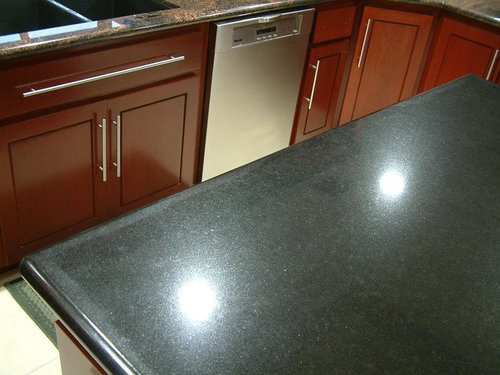
Here is a pic of the edge of the Black Pearl granite on my island. There is a strip about 1" wide that runs around nearly the entire perimeter. It looks like a poor job of doing the bull nose.

Can any experts comment? I'll be calling the granite guys tomorrow to discuss it.

Thanks,

Cavu

Comments (23)

  • 19 years ago

    Hi Cavu,

    It appears that the bullnose was done "at your site" on an already polished slab. The already existing fine polish (epoxy ?) layer got "removed" during the bullnose process...

    If that is the case, it can be remedied by using the "same" (epoxy ?) polish. This fix may work ok for the "black" granite, but may not work ok for the slab above the DW, since only the slab manufacturers can match the polishes for colored (non white/black) granites.

    /venkat

  • 19 years ago

    Thanks venkat,

    The bullnose wasn't done at the house, but it was done to the slab at the fabricator. He delivered it with the bullnose completed. The other granite was done by the same fabricator and doesn't seem to have this problem, but it may be easier to see on the black pearl.

    Cavu

  • 19 years ago

    Hi Cavu - it does indeed look like a poor polish job. It could have happened at the shop, though. Often times when the guy who does the polishing is inexperienced or careless, it could happen that the polishing pads slip over the aris of the edge and onto the surface of the stone. This mars the surface polish of the stone and this most likely is what happened to your island. It is possible to polish out the marks on the surface IF (and this is a big if) the stone guys have the correct skill set to do so. If they do not, the best option would be to contract a stone restoration professional to fix the fabricator's error.

    Does this phenomenon occur anywhere else in your kitchen?

  • 19 years ago

    The Aurora doesn't have the problem and they were delivered at the same time. There is a section of the Black Pearl, in the pic across from the sink, that doesn't have the problem.

    Can this be fixed in place?

    Cavu

  • 19 years ago

    Yes - it can be fixed in place if the stone guy knows how. Ask if they have done similar repairs before. They need special tools and a skill set unique to that kind of repair. It is not just a question of grabbing a set of polish pads and a grinder an polishing it out. The guy doing the repair has to have experience in fixing the face polish on slabs. It is notoriously difficult on black stones too.

    As for the other material not having the same issue - they might have used a different guy to polish those pieces. Give the granite guys the opportunity to fix their mistake.

  • 19 years ago

    Sorry to hear (and see) about your experience.

    Venkatbo's post may also be slightly confusing.....properly polished stone should not have any topical "polish" or coating applied to make it shine. The gloss is actually the stone itself. Most modern slabs do have an resin (could be epoxy-based) applied that helps to improve the overall surface finish and strengthen the stone, but it is NOT a topical coating that can be applied to create a polished-looking finish.

    Stonegirl is correct about black stones being "notoriously difficult" to achieve a perfect polish. Your other material may not show signs of this because it is.......a different material (i.e. easier to achieve a high-gloss polish).

    Have your fabricator take a look at the situation. If they can fix it, they should let you know. If they claim there is "nothing wrong", it is more likely they are incapable of correcting this, and it would be advisable to find (and pay for) a fabricator who can.

    Hopefully they can (and will) correct this issue.

  • 19 years ago

    cavu, the posters above had it close to right. With the surge in popularity of granite, many new shops were started by ex employees that knew one aspect of the trade. Work like this is more common than the decent work done by better fabricators.

    I agree that the shop that did this isn't likely to either know how to fix it, or they would have fixed it before it got out the door.

    I do question one thing, that regular border around the edge looks like masking tape residue. A lot of shops run masking tape before they start doing the edge, or at least polishing the edge. Have you tried solvent to see if this will clean off? Carefull though, check it on some scrap to make sure it doesn't damage the stone. I wouldn't use paint thinner, acetone or lacquer thinner would be better, or goof off.

    Let us know how this turns out.

  • 19 years ago

    I tried acetone and no joy. I'm still waiting for them to get someone out here to look at it.

    Thanks for the help so far.

  • 19 years ago

    I must agree with Al on this one. That does not look like polisher error, where he got up on the stone. It is to regular and perfectly straight.
    It almost looks like a 1 inch masking tape line.
    Look at the perfect corner.
    The bullnose polish is well done. I wonder if this is some sort of machine abrasion?

    Just guessing, What has the fabricator said?

  • 19 years ago

    Masking tape can be rubber based (latex) or acrylic based adhesive, also silicone, but unlikley.

    I have heard of rubber suction cups making marks on granite, have some pics of some, but they aren't anything like this. pH levels of masking tape can range, 4 ph for the latex, but it is neutalized by adding an alkali (6 to 9 pH level). Manufacturing defect might leave an overly acidic residue, or overly alkaline. Generally masking tape is considered not to be acid free.

    Remember all the warnings to use pH neutral cleaners on your granite? We might need to add pH neutral masking tape to the list... Black stone, likely to have some calcite or other calcium based mineral in it, slightly acidic masking tape, voila.... an etch...

    What about the posibility of doctored stone? The masking tape pulling out some enhancer or dye that the stone was treated with, or reacting with it.

    Another possibility, somewhat remote because of time frame, but possible. U V damage can cause lightening on some black quartz products, fading on dark colors, and darking on light colors. So they mask it off, maybe working outside and get distracted for a few days, come back to the top, finish polishing the edge, remove the tape and there it is. This is oposite what I would expect black to do, but this is a weird one. I have seen quartz tops fade, or someone moves a cansiter or toaster and there is a darker spot because it was protected from UV rays. Never seen black lighten because it was protected from UV rays....

    My money would be on acidic masking tape and an etch. Have you tried a flat single edge razor blade on it yet? Does it feel rougher than the polished area?

    No way it is a polishing problem. If you have vrjames and I agreeing on anything, that alone proves that it isn't polishing errors.

  • 19 years ago

    Lots of stones look lighter where the edge is polished. Maybe they could use some akemi darkener on the edges to make it match the rest.

    Here is a link that might be useful: darkener

  • 19 years ago

    I'm still waiting for the fabricator to come out and see it. I can't feel any difference in smoothness between this area and the rest of the stone.

    I just tried the single edge razor, and no difference. I'll let you know what happens after he comes out.

  • 19 years ago

    pompeii,
    it is the lines around the perimeter, not the edge if I understand this correctly.

    Cavu, did you do a lemon test on this stone before you purchased? If you still have a scrap, try it and see if it etches, if so, there is the culprite, calcite in the stone....

    If you used acetone with no result, that rules out doctored stone, in most cases.

  • 19 years ago

    I didn't do a test on the stone before purchasing. It's one of the things I just learned about, but I don't think that's the problem.

    The "foreman" from the fabricator came out today and said it looks like they goofed when buffing the bullnose edge and messed up the top. He said when they do the edge it gets very hot and actually creates little pieces that burn off and can turn the top white.

    He called the shop for about 5 minutes and came back in to say that they were sending someone out next Wednesday to polish it up and fix it. He then made it clear that he didn't think that would work and when it didn't that I should tell them I don't like it. At least he's honest.

    Stay tuned...

  • 19 years ago

    Cavu,
    that business about hot chunks flying off was pure BS. Even buffing with a felt wheel and powder wouldn't make a straight line like you have around the edges.

    Do the lemon test. I can almost guarantee that you have a granite with calcite content. If so, the lemon test will prove it. If this is the case, have it removed or be willing to keep all acidic food and drinks off the countertop, ketchup, all tomato products, lemons of course, lime juice, orange juice and many others. Soda pop, a lot of coffee, the list could be endless and you will need to worry about the ones you don't know about.

    Test it on one of the corners of the island in the picuture, it is going to be replaced anyway.

    No way they got up on top of the stone while polishing the edge. This is bad stone.

  • 19 years ago

    Cavu,
    Did you find out what the issue was caused by?

  • 19 years ago

    In my opinion, (first impression) somebody "got up
    on the face" of the stone.... like Stonegirl said..

    However - "al" brings up an interesting point that may be also
    a contributing factor....

    tape is used by many Fabricators in the polishing process,
    and you may have a residue that has stained the stone...
    the three best solvents that have worked (for me) to remove these kinds of residues from stones are: Acetone, Alcohol & Methyl
    Ethyl Keytone (MEK solution) - one of these may be the cure... but then, maybe not.

    IMHO - There's 2 other potential (yet most likely, remote) reasons that this has occured:

    1. the stone is resined, and a "C" arm type polishing machine
    was improperly set to it's last position (usually 89 to 89.5 degrees) and instead, it went up to 90 degrees, hitting some of the "face" when it shouldn't have, removing enough material to make a visual difference. repolishing should solve this IF this is the cause.

    OR

    2. the stone is topically "dyed" - same as above, but a bit more tricky to resolve - the more experience a Natural Stone Fabricator has at addressing this kind of scenario - the more likely the problem can be fixed.

    I hope that it's simply a tape residue, and a little solvent will "solve" your issue.

    let us all know how it turns out....

    Now that there's enough possible causes raised by all that have responded, it'll be interesting to see just who guessed the right one!

    good luck

    kevin

  • 19 years ago

    The OP has already tried acetone and a razor blade.

    This isn't tape residue, this is a masking tape etch, first that I have heard of.

  • 19 years ago

    I wouldn't jump the gun and claim this as an etch from masking tape. All of us are looking at picture to try to figure this out, so we are all guessing. It does look to me like this was caused in the polishing process on the edges. It is possible that if they ran this on a certain type of edge profile machine and did not have the settings properly adjusted, the machine could have caused this. I would surely have a restoration specialist look at it if the fabricator cannot correct this.

    There are too many factors that could play into this that we do not know here (fabrication methods, etc.).

    Let us know how this comes out. I am curious to know exactly what happened here.

  • 19 years ago

    Al - how can you diagnose something so positively if it is the first time you have ever heard of it?

    If you look at the dull marks, you can see that they do fluctuate somewhat and across from the dishwasher, totally disappears for about 24" - only to re-appear with a slight angle .

    I still stand by my original statement - it is a poor polish job - be it from an inexperienced or sloppy employee or, as Kevin suggested (and maybe a more plausible explanation because of the regularity of the marks) a badly calibrated C-arm polishing machine.

    Bottom line is - that top should never have made it past the QC person at the stone shop. I hope your stone guys do right by you.

  • 18 years ago

    How did this ever turn out?

  • 18 years ago

    Cavu,
    Please give us an update on what this problem turned out to be and what your fabricator did about it...

  • 18 years ago

    Sorry all for dropping this. I forgot to comeback with the results. They pulled out the slab and took it to the shop for a few hours to polish it. It certainly looks better, though not perfect. At this point I think I can live with it. In just the right light you can still see it a little, but it's ok.

    Thanks again for all your advice and help.

    Cavu