Software
Houzz Logo Print
crl_

Mixing styles

13 years ago

We are moving into a new house next week and while we won't be buying all new furniture at once, we will be making a few purchases (rug, maybe some side tables or a coffee table) soon and plan to replace the sofa and chairs down the line.

I find myself drawn to things that are not the same style. For example, I seem to be drawn to more traditional looking rugs, but when I started looking at coffee tables, I really liked several that are reclaimed wood tops with industrial piping or similarly modern looking legs.

Do you find that these things eventually can play well together if chosen well? Or does it end up a big mish mash and it would be better to choose items all of one style even if each is not individually your favorite?

If you find they can work well together, are there generally guidelines on how to achieve this? No more than two different styles? Make sure all the colors work well together?

I do tend to prefer rooms that look as if they evolved rather than we're purchased as a set so maybe that plays in my favor trying to mix and match styles?

Thanks for any thoughts on this!

Comments (25)

  • 13 years ago

    You sure can and I've attached a google search that shows you how.

    Here is a link that might be useful: mixture of styles

  • 13 years ago

    Thanks. Lots of lovely pictures, but not so much discussion of what makes the rooms successful.

  • 13 years ago

    If I were you, I'd go to the bookstore and peruse the decor section. I've bought a few books published in Europe where this look is successfully pulled off and books generally have details on how to accomplish the look.

    By "traditional looking rug" do you mean an oriental type? If so, I've always heard that these should be treated as a neutral. Sometimes they are very loud and can't really be neutral, but most often can. I'd think that you could do many things with that type of rug.

    I love the look of heavy industrial pieces juxtaposed with more delicate traditional items. I can't give you a rule on how to do this though. I just know when it looks right and when it doesn't. For example, if you look at thefoxespad recent post about her $10 chandie, she mixes a very traditional elegant chandelier with some very modern elements and it works (not sure if she has her new slipcovered sectional yet, but I think it will look fabulous with the chandelier).

    Can you post pics of a few items that you are thinking of putting together?

  • 13 years ago

    My house is a mixture of all kinds of styles. Mostly out of necessity. As you mentioned, most people do not furnish their entire home at once and people's preferences change over time. As I purchase new things, I have to consider items that I already own.
    My home is a mixture of rustic, industrial, transitional modern and a little bit of traditional. Some of it works and some of it doesn't -LOL It's a lot of experimemtation. And it changes with time. But I like the pieces I have.

    As far as the example you gave, I think a traditional rug that is more rustic or geometric will blend better with an industrial table than one that is more traditional and floral.

    For example a bukhara yes, a floral medallion rug, not so much.

    I have a Indian hand knoted wool rug with a salvaged wood/iron table. I will try to post pics later today.

  • 13 years ago

    Crl.. I am very much in the same boat-- love a variety of looks and want to make them all work together. I think many of us are that way and unless you want a very tight, everything matched kind of decor, I think you can do it fairly easily. I think it's important to keep the scale pretty close-- though you can sometimes I have one piece (like a coffee table) that is particularly large (or small), you do want your seating to be relatively on the same scale and definitely the same seating height.

    I think you should take another look at the images yaya shared-- or even better, check out the room photos at houzz.com. You'll see how others have brought together many different styles into a cohesive look. Try "eclectic" as a search term.

  • 13 years ago

    I believe it was Magnaverde that once said that the best way to pull it off is to use the best example of each styla that you can find.

  • 13 years ago

    I too love rooms that look and feel like they have evolved over time.i live in a 1920 colonial but love modern as well. I have definitely tried to mix styles throughout my house - not sure it would be considered "successful" but it works for me.:) I usually try to apply some constraints to hold the room together.

    When we redid our kitchen - everything wood was traditional and appropriate for the age of the house (windows, trim, cabinetry etc) but everything metal (hardware, sink,and faucets) leaned modern. It helps the traditional items seems fresher and younger. And I feel like someone could move in and change those more modern pieces to traditional and get a historic kitchen pretty easily.

    In my other rooms - I use a really tight color palette to help all the pieces work together and seem more cohesive. It also helps me decide what should (and should not) be in the room.

    Those are my two approaches for trying to help disparate items blend together - Other GWers with lots more skill than me will be able to do it more effortlessly but I need a plan to keep it all together.

  • 13 years ago

    If instead of trying to match style or period, you aim for balance and harmony, I think you'll be on your way.

    It is much easier to mix styles when you make sure that things are the right size to work harmoniously, and that you stay away from things that are extreme examples of a motif or style. It's also simpler to control how much pattern you allow in, since not all patterns play nicely together. Aim for fewer, larger things, rather than a packed-in, busy collection of things.

    For instance, a traditional Oriental rug is often dark to mid toned, and thought the colors are similar in saturation, it still brings a lot of pattern to the mix. The simplicity of modern furniture, upholstered in good but plain fabrics (silk burlap, or smooth leather, or very good linen, or an ottoman weave, to name a few examples) can stand up to it without competing with it.

    Likewise, a simple glass or pale stone-topped coffee table on a metal or enameled base, or even a driftwood base, can fit in. (A heavy, dark, industrial style table less well, unless the room is very large - those pieces are more at home in the factory with its high ceilings and open floors than in most of our more modestly sized rooms, I think.)

    Ornate antique mirrors look great with modern furniture. Interesting modern lamps when used with classic shade shapes also mix well, particularly if all the shades are the same color, so that the light they emit is consistent.

    It's also helpful to maintain an edited color scheme, so that no matter what the material or shape of something is, it is in tune with the whole.

  • 13 years ago

    Thank you for all the thoughtful responses. I figured out long ago that I learn more by explanation than by example so I really appreciate the discussion.

    Someone asked for examples. This is an example of a coffee table I like: http://www.etsy.com/listing/117212598/wood-coffee-table-with-steel-pipe-legs?ref=sr_gallery_17&ga_search_query=Coffee+table&ga_view_type=gallery&ga_ship_to=US&ga_search_type=all&ga_facet=Coffee+table

    And this is a rug I like: http://m.homedecorators.com/mt/www.homedecorators.com/P/Menton_Area_Rug/910/?un_jtt_redirect

    I have only started looking so these are just examples, not necessarily particular items I am seriously considering.

    This post was edited by crl_ on Sun, Dec 16, 12 at 16:15

  • 13 years ago

    How about a room that you like. It depends how it all comes together. The rug you show is soft and delicate in both color and pattern. The table plays hard, strong and heavy. You would need to juxtapose that overall in the room for it to work. I would not try to place that table on that rug unless the rug were large because the table is so strong and heavy. People often skimp on rug size. You need to balance things in some way. You would also want to include some other strong furniture pieces to balance the table. In the photo, the bookcase repeats the heavy wood of the table. It also has an industrial feel like the table. They managed to do this in a room with a formal palladian window. You would also want to repeat some black because it's a strong heavy color.

    One thing when trying to mix things up, is to relate or repeat color or similar lines and shapes that they can connect on. People will often do this naturally because they are drawn to those things without thinking.

  • 13 years ago

    Thank you for the explanation of how you might make thee two elements work together. You asked for a picture of a room. I love this eclectic dining room. I can see that the color palate is very limited. And that pieces are of similar sizes. What else makes the room work?

    Here is a link that might be useful: [Eclectic living room[(https://www.houzz.com/photos/sfgirlbybay-shabby-chic-style-dining-room-san-francisco-phvw-vp~26568)

  • 13 years ago

    crl - The lines in that room are either simple curves or straight. There is nothing frilly or baroque or complicated. It's a two-color scheme: wood and white.

    As for blending the rug and that coffee table ... You could easily do it with a rug with stronger colors to stand up to the table, or if you got a reclaimed wood look table with different legs, perhaps wood legs, or painted legs, to look a bit less "hard-core industrial".

  • 13 years ago

    Thank you for the continued discussion. On that rug and that coffee table, as I said they are just for discussion. Part of the reason I am drawn to that rug is that is will be going in a room with dark wood floors and (for the moment) dark brown leather furniture. So I thought a paler rug would help keep the room from feeling too heavy and dark.

    I could easily see going with less chunky legs on a table. Let me see if I can find a possibility.

    Editing to add a different coffee table link. I am not sure I am thrilled with the different kind of wood for the legs on this one, but offering it as an example of something with more delicate looking legs.

    Here is a link that might be useful: Coffee table

    This post was edited by crl_ on Sun, Dec 16, 12 at 18:37

  • 13 years ago

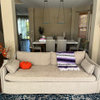
    I imagine something like this :

  • 13 years ago

    To my, completely untrained, eye, those items all read transitional? Lovely rug, btw.

  • 13 years ago

    Bronwynsmom - excellent piece of advice about aimomg to achieve harmony.

    I like a mix of styles too. I think that I've been able to manage it well but only so w/in the last 2 yrs. or so of decorating our home and I've been at it for almost 13yrs.

    I used to rush to buy things and in my rush I made so many wrong purchases. When I sort of stopped and then let things 'find me' or 'call' to me is when I started making good choices to achieve a mixed bag. It's so often hard to wait though but it's gotten alot easier since I've seen it paying off. My downfall was always 'filler' stuff.

  • 13 years ago

    I can see the point about rushing purchases. It's a bit of a quandary at the moment as some purchases seem some what urgent. The rug, for example, will go in the only play, gatherining, tv, space we have in the new-to-us house, which has all hardwood floors. With two children, it seems important to get some thing soft down in the short term.

    The coffee table can easily wait. But in looking, I started wondering about overall direction the room is going and how to purchase a rug that harmonizes with that.

    I found this "eclectic" living room on Houzz that I like. The rug is much warmer looking because of the color scheme. And the coffee table has a lighter base, although it is still modern in feel.

    One thing that occurred to me in thinking about repeating elements as suggested above, we actually already have a reclaimed wood dining room table that we love and will use. The living room and dining room are open to each other. That table is shaker in style, which I have always thought lends itself nicely to a variety of settings because of the simple lines. Maybe I can find a similar coffee table and it will go better with a more traditional rug and repeat the style of the dining room table. Also we have both loved our dining room table for years now, so it seems unlikely that we will tire of the style.

    Here is a link that might be useful: [Houzz electic living room[(https://www.houzz.com/photos/modern-farmhouse-spring-parade-of-homes-house-farmhouse-living-room-boise-phvw-vp~928078)

  • 13 years ago

    Shaker furniture is a great example of how a radically simple but traditional style can feel so modern.

    One thing you might consider is using a pair of square or round things, maybe in in wood or rattan, or a pair of simple storage ottomans, in place of a coffee table. It's a very flexible arrangement, particularly with children, and you can put up your feet or sit if the top is cushioned, and use trays when you need a surface to put things on.

    If you like them, a couple of rain drums can make a wonderful partnership with traditional and rustic things. They also are very satisfying to whack with a wooden spoon, particularly if you're under four feet tall....

  • 13 years ago

    When I was mixing furniture with modern clean lines, I found that other pieces of furniture in a different style needed to have similar lines to mix well. But color can also be a unifier. Its hard to define as a blanket statement of what works and what doesn't. I find you can have a lot more flexibility with accessories then with furniture pieces. As someone else said, look at rooms on houzz to train your eye as to why it works or doesn't work to your eye. And as foxespad said, take your time. I try to remember a line from another poster here, Magnaverde, who said - "decorate in hast, repent at leisure".

  • 13 years ago

    I love the room you found in Houzz, why not use that for your inspiration and try to duplicate the look. I think it's the rug that makes that room complete. I have dark floors and rugs similar to that and they work wonderfully.

  • 13 years ago

    Thank you all for your helpful thoughts n this topic.

    The problem with the Houzz rug is that we already have a beautiful and special-to-us painting that will go over the mantel. The painting is blue, yellow and brown with a few bits of green. I intend to use that as our color scheme and it is not at all compatible with the red rug. Also, although I like the overall feel of the room, I am actually not a huge fan of gray for decorating. So I don't think I would be happy living with gray furniture.

    So I guess the challenge is to identify what it is about that room that works and can be translated to a different color scheme.

  • 13 years ago

    Again, what I see is simple lines: squares and cubes and circles and cylinders. No ogee edges, curlicues or frilly stuff. Materials are mixed, but mostly natural and/or soft-looking.

    Paying attention to lines and scale seems to be the trick.

    ====================

    My furniture style is "eclectic", but when I bought a real treasure of a piece - a Mission buffet from a close associate of Stickley - it looked absolutely horrible in that setting.

    It was uncompromisingly rigid and squared, and everything else I had was softly curved or tapered, even my pieces of that era were closer to Art Deco or Nouveau.

    So I sold it to a neighbor who had a genuine Craftsman house and it looked splendid amongst its stylistic soulmates.

  • 13 years ago

    lazygardens, I think your experience is not uncommon - it's my experience that strict mission, art deco, and art nouveau furniture are the hardest to work into an eclectic scheme.

  • 13 years ago

    Thank you all so much!

  • 13 years ago

    I mix styles all the time as I use what I like. I think 2 key elements help keep it all together:

    o Scale. I don't care what the styles are, mixed or not, but if the pieces are out of scale for the room or the space it will always look off.

    o Color. I remember this lesson from Hearst Castle where Julia Morgan was charged with building rooms to accommodate specific pieces of art and antiques which came from many different eras. The unifying factor was color and it made all the pieces work together nicely.

    I guess the close cousin to color is pattern...make sure the patterns play together nicely as well.