Software
Houzz Logo Print
kitchenkrazed09

Need Help Fast - Range Hood Same Size As Rangetop?

15 years ago

Hello fellow Gardenwebbers,

I need an answer to this question rather quickly, as I am about to place the cabinet order. However, if you do read this post late and have some information to share, I would still be interested in reading it.

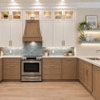
I plan to install a 36" Wolf gas rangetop with 6 burners. I would like to order a 36" Modernaire hood with a 15" wide cabinet abutting it on either side, instead of the recommended 42" hood. If I order the 42" hood, the cabinets on either side have to be reduced to 12" wide. The cabinets will be white inset with glass doors and I am afraid they will look too narrow. I would rather have the wider 15" cabinets and I also like the look of a hood that matches the size of the stove or rangetop.

Would it be terrible to decrease the size of the hood? I do some frying, but not an unusual amount. I haven't done indoor grilling before, but would like to try it sometime. If I make sure the CFMs are sufficient, would it be alright to order the 36" hood? Does anyone have their hood the same size as their cooking area that can comment? Do I need to worry that the cabinets flanking the hood will get ruined? Thank you so much!

Comments (19)

  • 15 years ago

    Many of us have the hood the same size and the range. Since you'll have cabinets flanking the hood you shouldn't have a problem.

  • 15 years ago

    Thanks for the quick responses. Beekeeperswife - I always love to look at photos of your kitchen! Your hood does not look too big for your range. I think I'm more worried that the narrow 12" cabinets will look too narrow, especially next to a wider hood and because they will have inset doors.

    Does anyone have photos of narrow or even 12" wide cabinets so I could get an idea of how they might look?

    Weissman - Do you think I should worry at all about the cabinets that flank the hood getting ruined by grease?

    Thanks!

  • 15 years ago

    I've had my range and hood for 8 years and haven't had a problem with grease on the side cabinets. Can't say for sure what your experience would be. Check the Finished Kitchens Blog for pictures of range hoods and flanking cabinets.

    Certainly in an island setting you'd want an oversized hood.

  • 15 years ago

    Get a deep hood - either 24" or 27" deep. That will greatly improve your capture area. Mine is only 19" deep and I do get grease on the front of the hood.

  • 15 years ago

    The bigger problem with a painted or thermofoil cabinets with a high BTU range will be heat damage to the cabinet sides adjacent to the hood. Having the hood area be larger than the rangetop will keep the cabinet sides 3" further away from that potential heat damage. It wouldn't even be under consideration to have a 36" over a 36" in my book. Cabinets are way too expensive to take that chance.

  • 15 years ago

    I agree with hollysprings...I've researched this same issue & will be having a range hood 3" bigger on each side.

  • 15 years ago

    Functionally: I agree w/BeeKeepersWife, HollySprings, Melaska, and Weissman's comment about the deeper hood.

    The two types of cooking that really need the wider & deeper hoods are frying and grilling...and you do or plan to do both.

    I really think you should get the wider & deeper hood. I understand about the cabinets flanking the hood. But another thing to consider is that you will have glass cabinets there as well and any grease that escapes the hood will land on your glass fronts as well as the cabinets themselves.

    Have you ever watched steam, etc. wafting up & spreading as it goes? That will show you how the air currents affect smoke, steam, grease, etc. I don't fry nor do I have a grill, but I still went w/a hood 6" wider and 24" deep...and am glad I did. I see steam reaching the edges (sides & front) of the hood all the time!

    Aesthetically: Personally, I actually think a hood that's the same width of a range, especially 36" and wider, looks too small. I think the extra width & depth balance the extra mass of a larger range. Again, that's my personal opinion, YMMV.

  • 15 years ago

    I don't plan on doing a lot of frying - but it's those unplanned "OH NO!" that I really need the hood for.

    I also wanted my hood a bit higher up, so getting a larger one made scense. I have a 36" hood over a 30" cooktop, and I'm so glad I went that route. Seemed back when I had a 30" hood over a 30" cooktop, I got way too much grease on the bottoms of my cabinets.

  • 15 years ago

    Just at thought, but if you get a really powerful hood (say 1200cfms), you might be able to get away with a narrower hood. I probably still wouldn't go narrower if it were me, but I thought I'd mention it as an option (a less desirable option, but one nonetheless).

  • 15 years ago

    If you can get a bigger one, I think it's wise. We ended up with the same size as our range, roughly, but that's only because we couldn't find a 42" hood in our price range. Since our range is actually 34.5" and is lower BTU than modern ranges, we're risking it---but would have preferred going wider and/or deeper (or both!) had it been in the budget. I'm expecting we'll end up with some grease on the hood, but since we're coming from the land of no ventilation whatsoever, hopefully it will work out. If/when we replace the range, we'll probably bump up the hood to a larger size too---so no cabinets there.

  • 15 years ago

    I have never had a real range hood, so please excuse me if my questions are silly. If I understand correctly, you suggest the hood to extend 3" beyond the width of the range in order to capture all grease and moisture as it escapes from the things cooking off of the range (as they tend to drift outward rather than in a perfect vertical line). Does this mean every single time you cook, you run the range hood? How do you make certain your range hood noise level is tolerable for use every time you cook if your price range tends to be in the mid-range appliances rather than high end professional-style appliances? Thanks.

  • 15 years ago

    Thank you all so much for the great information and insight. I decided to stick with the larger hood size. It will be 24" deep and 18" high. You all make a lot of sense!

    Buehl - Good point about the glass doors getting grease on them too.

    Macybaby - How high did you install your hood? I'm planning to install mine higher too. Does it work out for you?

    Pricklypearcactus - I've never had a range hood either, so I'm not sure i'll be of the most help, but I'll share what I've found when researching. It's generally suggested to extend the hood to a width 3" on each side of the cooking area, so the range hood would actually be 6" wider than the cooking surface. This is to capture all grease, moisture, steam and odors and prevent them from attaching to and potentially ruining surrounding surfaces such as cabinets, curtains and furniture. I don't know if other people run the range hood more often, but I planned to use it mostly when frying, grilling, or cooking anything that creates a lot of steam or smoke. From what I understand, some of the higher end hoods can be very noisy too.

  • 15 years ago

    Yes, I run my hood just about every time I cook. If the house is dry & I'm boiling water (for pasta or soup), I'll sometimes leave it off to add a bit of moisture into the house, but for the most part, I use it every time I cook.

    My hood isn't all that loud, so it's not an issue. Yes, it does make some noise, but I can carry on a conversation with someone else in the kitchen or watch TV while the hood is on.

    Both noise level & effectiveness depend on the length of duct run, # of turns in the duct run, the size of the ducting, and the speed you run it at. Location of the fan can also help with noise level (external fans are sometimes quieter than internal fans). Effectiveness is also dependent on proper hood sizing (at least 6" wider/24" deep) and duct sizing (see hood specs) and a strong enough fan.

    Tip: If you get a more powerful hood and run it on low, you will get both effectiveness and less noise.

    Here is a link that might be useful: Applieances Forum - Overview of vent hoods

  • 15 years ago

    I am lost by your last tip, Buehl. Can you explain why, if you buy, for instance, a 900 CFM hood and run it at 600, why it'd be more effective or quieter than getting a hood that tops out at 600?

    In case it helps, here is an article that Fine Homebuilding linked in their latest email newsletter, about hoods and CFMS, including info/discussion about hood size and make-up air, in the thread I started about it.

    Here is a link that might be useful: Hood thread and article link

  • 15 years ago

    I can answer the question as to why you need to get MORE cfm's than you think you need. The reason you run the unit lower than the high has to do with the physics of the air in the duct. When you run the unit on the highest setting you create turbulence inside of the duct. This in turn leads to the HOGS returning to your kitchen " back at ya" as it were , rather than venting them out. This is a fact. This is why I have 1400 cfm in a 54" hood liner. I use it on medium and low. Mine is quiet even on high but I don't need the high setting. I have NEVER had to clean one spot of grease off of my wooden hood or the surrounding cabs/shelves. There is never any residue ever at all. I do have direct splatters on the wall behind the cooking pot at times when DH woks but other than that the HOGS are all removed completely.

    I read the article sited and had a problem with a lot of what he said. I don't have any unsealed fireplaces in my home and my waterheater is outside on the wall of the house . Since our house is an 1890 the problem of drafts and makeup air doesn't exist for me , which I am glad of . As far as I know there is no code here, or wasn't at the time of my install. I am glad of that too. We need the cfm's that I have since I see the result on the baffles every single Sunday when I clean them...they are all gresy greasy gressy. I also can't tell what is cooking in the kitchen at all even sometimes when I am standing in the kitchen. It sucks LOL.

    The other thing that bothered me about the article and the backdrafting etc was that the implication is that you run the hood for great lengths of time. In all of my experience that is not the case. Wok cooking requires minutes as does deep frying. I never have it on for more than possibly 30 min. and usually way less than that.

    So that is of course my experience of 4 1/2 yrs with this set up of a Tradewind LIner. I would like to hear from others. c

  • 15 years ago

    I'm bumping this thread for any other comments as I'm also wanting to use the same size range/hood (48 over a 48) mostly because I'm afraid the planned 54" hood will be HUGE in our space.

    I know about the recommendations/conventional wisdom of this amazing group, but surely the majority of average homeowners still match their hood size to their range, no?

    We are not getting a grill or deep frying and want to get a 1200 CFM blower inside a 48" hood over our 48" Bluestar. (We're also an old house and don't have code issues to worry about.)

    Both our KD and the appliance guy said in our situation it was really our call, probably better to err for the 54" if we can afford/fit it, but that a 48" would be ok provided we do the 1200 CFM.

    I've researched this heavily and feel like I know the right answer (get the 54), but I'm just not at peace with it and can't pull the trigger on this monstrosity, LOL.

  • 15 years ago

    Littlesmokie, one other thing to consider is the configuration of your burners and how you will use them. How are the Btu's distributed across the cooktop? Are you likely to do your highest heat cooking near the center, or at a front corner?

  • 15 years ago

    mnerg, you make a really good point. Originally (using the configure your own Bluestar tool at the website) we planned a double griddle off to the far right, which would center one of the two 22k burners under the hood. Great! we thought.

    Unfortunately, it was $1k more and double the lead time to make this change! We've been feeling kind of stuck ever since, resigning ourselves to the double griddle in the middle (which incidentally is also how every other manufacturer configures theirs, maybe there is a reason to leave it that way...?)

    Seeing your post just gave me the idea that maybe we could reconsider ordering the preferred range configuration AND get the smaller hood. Paying to get the configuration we want seems to make it more feasible to go down to a 48" hood because then we could do our most "HOGS" producing cooking centered under the hood. And if the smaller hood is even a few hundred less, it would help balance out the financial hit that the special order configuration represents.

    Thanks for the good food for thought :)